
Predicting Long-Term Stability of
Liposomal Suspensions using Zeta Potential
Leveraging electrokinetic charge data to preemptively identify aggregation risks and optimize lipid-based formulation shelf-life.
Introduction to Zeta Potential in Liposomal Formulation
In the landscape of lipid-based drug delivery, long-term stability remains one of the most critical challenges facing formulation scientists. Liposomes, being thermodynamically unstable systems, have a natural tendency to aggregate, fuse, or leak their encapsulated payloads over time. While steric stabilization (often achieved via PEGylation) is a common strategy, electrostatic stabilization plays an equally vital role. This is where Zeta Potential (ZP) becomes an indispensable metric.
Zeta potential is not merely a physical property; it is a predictive indicator of the repulsive forces present between particles in a suspension. By measuring the potential difference at the hydrodynamic shear plane, researchers can forecast the likelihood of particle flocculation or coagulation. A high zeta potential magnitude (whether positive or negative) generally correlates with increased stability, while values approaching zero often signal imminent aggregation.
For researchers developing novel carriers, integrating our Formulation Stability Evaluation services early in the development pipeline ensures that charge data is used effectively to optimize shelf-life and performance.
The Physics of Stability: DLVO Theory
To understand why zeta potential predicts stability, one must look to the Derjaguin-Landau-Verwey-Overbeek (DLVO) theory. This theory posits that the stability of a colloidal system is determined by the balance of two opposing forces:
-
Van der Waals Attraction: A universal force that pulls particles together, promoting aggregation.
-
Electrostatic Repulsion: A force generated by the electrical double layer surrounding charged particles, pushing them apart.
When the zeta potential is high (typically > ±30 mV), the electrostatic repulsion barrier is sufficient to overcome Van der Waals attraction, preventing particles from coming into close contact.
Key Stability Thresholds
*Note: These values serve as a general rule-of-thumb under low-to-moderate ionic strength and primarily electrostatic stabilization. Steric stabilization (e.g., PEGylation) can decouple ZP from colloidal stability, maintaining dispersion even at lower ZP magnitudes.
High Stability
Indicates strong repulsion and excellent suspension stability.
Incipient Instability
Suggests moderate stability but risk of eventual aggregation.
Rapid Aggregation
Usually results in rapid flocculation unless steric stabilizers are present.
Predicting Zeta Potential from Structure:
The Nano-QSPR Model
Traditionally, zeta potential is determined experimentally. However, recent advancements in computational biology have introduced nano-Quantitative Structure-Property Relationship (nano-QSPR) models. These allow researchers to predict zeta potential based solely on molecular composition, accelerating formulation screening.
DOPE
A neutral helper lipid often used to facilitate endosomal escape.
DC-Chol
A cationic lipid derivative used for nucleic acid complexation.
DOTAP
A highly efficient cationic lipid for gene delivery.
EPC
A natural zwitterionic lipid forming the backbone of many formulations.
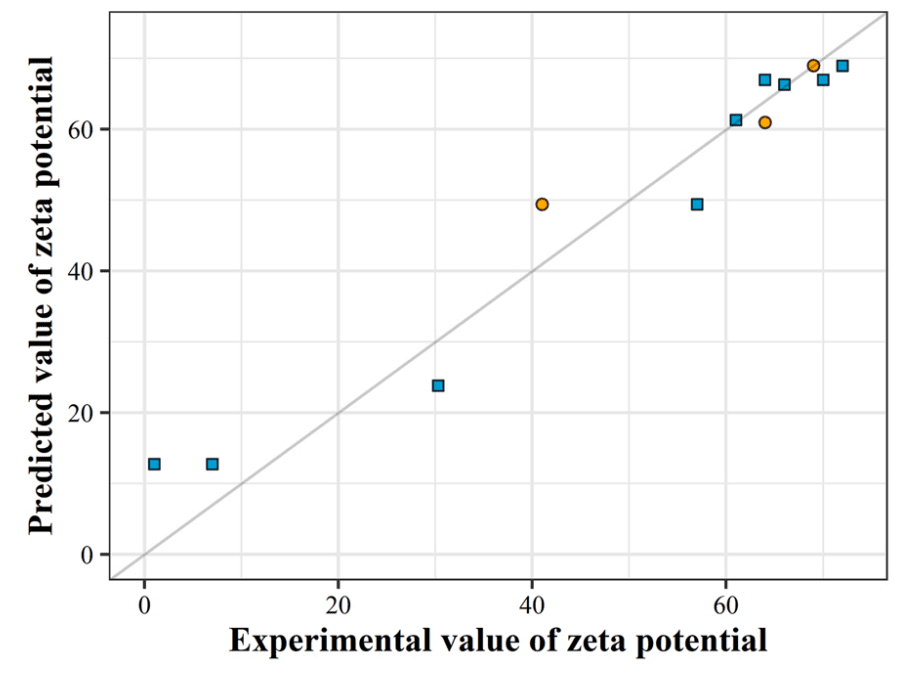
Fig.1 Scatter plot of experimentally determined versus predicted zeta potential values for training and validation compounds of the nano-QSPR model1,2
Validating the Prediction
By utilizing multiple linear regression (MLR) and specific molecular descriptors—such as the number of nitrogen atoms, topological polar surface area, and lipophilicity—the nano-QSPR model can predict ZP values with high correlation to experimental results.
This predictive capability allows formulation scientists to "design in" stability before a single lipid film is hydrated.
Model Scope & Limitations
Confirm your model predictions with physical data.
Explore Liposome Surface Charge Analysis ServicesFactors Influencing Zeta Potential and Stability
pH Effects (Context-Dependent)
Zeta potential is an operational readout reflecting the electrokinetic potential at the shear plane. Its pH-dependence is strongly formulation-specific. Ionizable lipids may exhibit pronounced ZP shifts near their apparent pKa, while permanently charged cationic lipids (e.g., quaternary ammonium headgroups like DOTAP) tend to maintain consistent potential. Zwitterionic and PEGylated systems require careful evaluation of ZP alongside size/PDI evolution.
Ionic Strength
High ionic strength compresses the electrical double layer (Debye length), effectively shielding the surface charge. This reduction in the effective range of repulsive forces can induce aggregation even in highly charged liposomes. Buffer optimization is crucial for maintaining the DLVO barrier in relevant physiological conditions.
Surface Modifications
Incorporating PEGylated lipids shifts the shear plane outwards, often reducing the measured zeta potential magnitude while providing steric stability. Our Long Circulating Liposome Development Service specializes in balancing these factors to ensure optimal circulation times without compromising formulation integrity.
Typical Applications & Use Cases
Understanding how surface charge influences different delivery platforms helps in selecting the right formulation strategy.
Nucleic Acid Lipid Nanoparticles (LNP-like Systems)
Critical for assessing the encapsulation efficiency of anionic nucleic acids and supporting charge-density–guided screening for uptake/endosomal release hypotheses, to be verified experimentally.
Protein & Peptide Delivery
Ensures electrostatic compatibility between the cargo and the lipid bilayer to prevent aggregation or premature release during storage.
Vaccine Adjuvants
Tuning surface charge to modulate antigen association, colloidal stability, and uptake profiles in in vitro immune-cell assays.
Targeted Ligand Modification
Monitoring ZP shifts during conjugation protocols to confirm successful ligand attachment and assess the impact on colloidal stability.
Methodology & Deliverables
Accurate prediction of long-term stability requires a rigorous analytical workflow. Creative Biolabs employs Electrophoretic Light Scattering (ELS) combined with the Henry equation to determine zeta potential with high precision. We standardize measurement conditions (temperature, dilution factor, conductivity range) to ensure reproducible data.
Beyond simple measurement, we conduct accelerated stability testing where liposomes are subjected to thermal stress or centrifugation. For biological relevance, we can track stability in complex fluids using Fluorescent Liposomes to monitor integrity ex vivo.
Key Deliverables
- Zeta Potential Reports: Data across defined pH & ionic strength matrices.
- DLS Analysis: Correlated size and PDI growth charts.
- Stress Testing Trends: Stability profiles under accelerated conditions.
- Risk Assessment: Pass/Fail criteria and optimization recommendations.
Why Choose Creative Biolabs?
We move beyond basic data generation to provide actionable formulation insights.
High-Salt Capable ELS
Robust workflows for measuring charge in physiologically relevant buffers.
Model-Informed Screening
Integration of QSPR insights to guide lipid selection before synthesis.
QC-Aligned Packages
Comprehensive analytics combining ZP with DLS, TEM, and EE suitable for pre-CMC data packages.
Frequently Asked Questions
Generally, a zeta potential magnitude greater than +/- 30 mV is considered ideal for electrostatic stabilization, as the repulsive forces prevent particle aggregation. However, sterically stabilized liposomes (e.g., PEGylated) may be stable with lower absolute zeta potential values due to physical barriers.
Ionizable functional groups and buffer conditions (pH/ionic strength) can shift the electrokinetic potential at the shear plane. Changing pH can protonate or deprotonate these groups, altering the surface charge density and consequently the zeta potential, which impacts stability.
Zeta potential is most predictive for electrostatically stabilized systems. For sterically stabilized liposomes (using polymers like PEG), zeta potential is less critical for preventing aggregation but remains important for understanding biological interactions and cellular uptake.
Typically, we require approximately 100-200 µL of sample at a concentration of 0.1-1 mg/mL lipid. However, specific requirements may vary based on the formulation type and buffer system. Please contact our technical team for a tailored consultation.
Yes, we offer specialized protocols to measure zeta potential in biological matrices. This is crucial for understanding the formation of the protein corona and predicting in vivo fate, though it often requires careful data interpretation due to high conductivity and background scattering.
Our stability studies are conducted with rigorous quality control standards, generating data suitable to support early-stage CMC documentation and technical reports for preclinical development; formats can be aligned to client documentation needs.
Reference
- Jarzynska, Kamila, et al. "Predicting zeta potential of liposomes from their structure: A nano-QSPR model for DOPE, DC-Chol, DOTAP, and EPC formulations." Computational and Structural Biotechnology Journal 25 (2024): 3-8. https://doi.org/10.1016/j.csbj.2024.01.012
- Under Open Access license CC BY 4.0, without modification.
Online Inquiry
This site is protected by reCAPTCHA and the Google Privacy Policy and Terms of Service apply.