The phase transition behavior of the lipid bilayer dictates membrane fluidity, permeability, and long-term storage viability, serving as the fundamental blueprint for formulation success. Whether developing thermosensitive liposomes for oncology or robust vaccines, precise characterization is non-negotiable. Creative Biolabs leverages decades of expertise in lipid thermodynamics to provide rigorous, data-driven phase behavior analysis, empowering researchers to optimize formulations with confidence and precision.
At the core of liposome functionality is the phase transition temperature (Tm or Tc). This parameter marks the reversible transition of the lipid bilayer from a rigid, ordered gel phase (Lβ) to a disordered, fluid liquid-crystalline phase (Lα). In the gel state, hydrocarbon chains are fully extended and closely packed, minimizing permeability. Above the Tm, the chains become mobile, increasing membrane fluidity and often facilitating drug release.
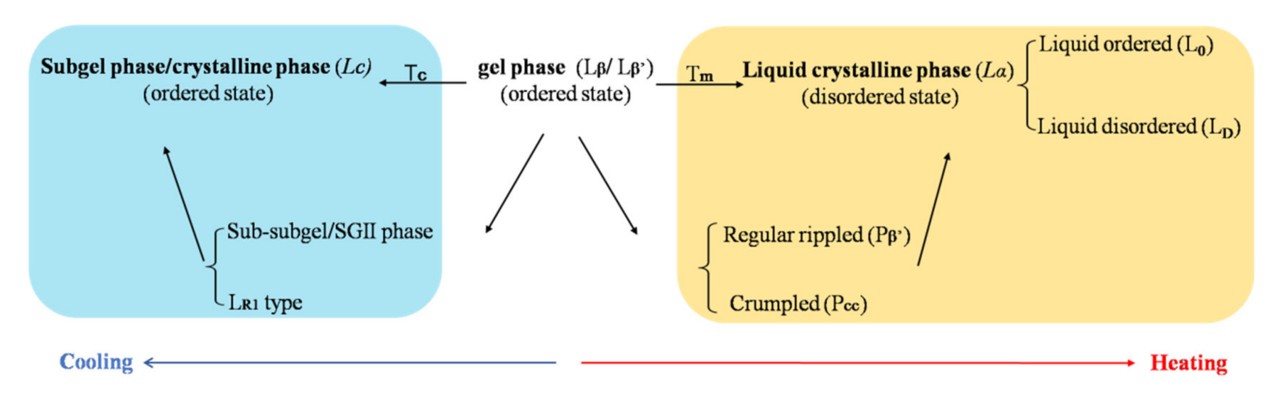 Fig. 1 The phase transition of liposomal bilayer dispersed in aqueous solution.1
Phase behavior directly correlates with in vivo performance. Liposomes must maintain structural integrity at physiological temperature (37°C) to prevent premature leakage (the "burst effect") while remaining fluid enough to fuse with target cells or release cargo when triggered. furthermore, phase separation in mixed lipid systems can lead to domain formation (rafts), which influences protein binding and immune recognition.
To fully understand the thermodynamic properties of a liposomal formulation, a multi-modal analytical approach is often required. Different techniques provide complementary information regarding the macro-level thermal events and micro-level molecular arrangements.
| Technique | Operating Principle | Key Parameters Measured |
|---|---|---|
| Differential Scanning Calorimetry (DSC) | Measures the difference in heat flow between the sample and a reference as a function of temperature. | Main transition temperature Tm, Enthalpy (ΔH) |
| Fluorescence Anisotropy | Monitors the rotational mobility of membrane-embedded fluorophores during heating. | Membrane microviscosity, fluidity, order parameter. |
| X-Ray Diffraction (XRD) | Analyzes the scattering pattern of X-rays to determine structural lattice arrangements. | Bilayer thickness, lamellar repeat distance, phase type (lamellar vs. hexagonal). |
| FTIR Spectroscopy | Detects vibrational frequency changes in lipid functional groups (e.g., CH2 stretching). | Acyl chain conformational order (trans/gauche ratio), headgroup packing. |
The Tm is intrinsic to the lipid molecule but modifiable through formulation. Factors such as acyl chain length, degree of saturation, and headgroup charge dramatically influence the transition temperature. For instance, longer saturated chains (like DSPC) result in higher transition temperatures compared to shorter or unsaturated chains (like DOPC). Understanding these physicochemical rules is essential for engineering "smart" carriers that respond to specific environmental triggers.
The table below outlines common phospholipids used in formulation and their characteristic phase transition temperatures, serving as a guide for selecting the optimal matrix for your application:
| Lipid Name | Tm | Lipid Type |
|---|---|---|
| MPPC 14:0-16:0 PC | 35°C | PC |
| MSPC 14:0-18:0 PC | 40°C | PC |
| PMPC 16:0-14:0 PC | 27°C | PC |
| PSPC 16:0-18:0 PC | 49°C | PC |
| DMPS 14:0 PS | 35°C | PS |
| DSPS 18:0 PS | 68°C | PS |
| DLPE 12:0 PE | 29°C | PE |
| DPPE 16:0 PE | 63°C | PE |
| DSPE 18:0 PE | 74°C | PE |
| DMPE 14:0 PE | 50°C | PE |
| DOPG 18:1 (Δ9-Cis) PG | -18°C | PG |
| DSPG 18:0 PG | 55°C | PG |
| DPPG 16:0 PG | 41°C | PG |
| DMPG 14:0 PG | 23°C | PG |
| DLPG 12:0 PG | -3°C | PG |
| DPPS 16:0 PS | 54°C | PS |
| POPS 16:0-18:1 PS | 14°C | PS |
| POPG 16:0-18:1 PG | -2°C | PG |
| DOPS 18:1 PS | -11°C | PS |
| DLPC 12:0 PC | -2°C | PC |
| DMPC 14:0 PC | 24°C | PC |
| DPPC 16:0 PC | 41°C | PC |
| DSPC 18:0 PC | 55°C | PC |
| POPE 16:0-18:1 PE | 25°C | PE |
| DOPE 18:1 (Δ9-Cis) PE | -16°C | PE |
Creative Biolabs offers a professional, end-to-end service designed to elucidate the thermodynamic profile of your liposomal formulations. We utilize a multi-modal approach to ensure no structural detail is overlooked.
Our phase behavior analysis services are integral to advancing research across multiple disciplines:
Creative Biolabs is dedicated to accelerating your lipid-based drug delivery research. Our advanced Liposome Phase Behavior Analysis service provides the thermodynamic insights necessary to build stable, effective, and innovative formulations. Contact our team today for more information, to request a quote, or to discuss your specific experimental needs with our scientists.
Reference
 For Research Use Only. Not For Clinical Use
Services
Online Inquiry

Creative Biolabs is a world-leading liposome provider with extensive experience in liposome preparation, custom formulation development, and characterization.

© 2026 Creative Biolabs. All rights reserved.