
Homemade vs. Commercial Kits: Why Standardization Matters in Liposome Research
Efficiency: Moving from manual prep to standardized kits. Explore how transitioning to commercial solutions enhances reproducibility, reduces variability in in vivo studies, and accelerates the timeline from formulation to clinical translation.
The Reproducibility Crisis in Nanomedicine
For decades, the "art" of liposome preparation has been a rite of passage for graduate students and formulation scientists. The traditional thin-film hydration method, often followed by manual extrusion or probe sonication, is foundational knowledge in drug delivery. However, as the field of lipid-based drug delivery matures—driven largely by the global success of COVID-19 mRNA vaccines and novel oncological therapies—the reliance on "artisan" or homemade liposomes is becoming a significant bottleneck in translational research.
The core issue lies in standardization. Manual preparation is inherently prone to operator-dependent variability. Subtle differences in hydration temperature, sonication energy, extrusion pressure, or even the rate of solvent evaporation can lead to drastic batch-to-batch variations. These variations manifest in critical quality attributes such as particle size distribution (Polydispersity Index, PDI), encapsulation efficiency (EE), and zeta potential.
In in vivo studies, this physicochemical variability translates directly to inconsistent pharmacokinetics (PK) and biodistribution profiles. A formulation that targets the liver in one batch might accumulate in the spleen in the next due to a slight shift in mean particle diameter, rendering promising data unpublishable or unscalable.
To address this, the industry is shifting toward standardized commercial kits. These are not merely conveniences; they are tools for scientific rigor, designed to eliminate the multivariate chaos of manual preparation and ensure that data generated in the discovery phase is robust enough for clinical translation.
Key Challenges with Manual Prep
-
✕High PDI Variability: Manual extrusion often results in PDI > 0.2. Heterogeneous populations behave unpredictably in vivo, triggering faster immune clearance.
-
✕Low Encapsulation Efficiency: Passive loading methods (e.g., thin film) typically yield EE < 30% for hydrophilic drugs, wasting expensive API.
-
✕Time Intensive: A single high-quality batch can take 24-48 hours from film formation to purification and characterization.
-
✕Scalability Issues: Processes developed in a round-bottom flask often fail completely when scaling up for animal studies.
Manual Preparation vs. Commercial Kits: A Comparative Analysis
Understanding the trade-offs between traditional laboratory methods and modern standardized kits is crucial for experimental design and resource allocation.
| Parameter | Homemade / Manual Prep | Standardized Commercial Kits |
|---|---|---|
| Particle Size Control | Operator-dependent; requires multiple extrusion passes; difficult to reproduce exactly between researchers. | Highly reproducible; pre-calibrated lipids or microfluidic cartridges ensure consistent size (e.g., 80-100 nm). |
| Polydispersity Index (PDI) | Often > 0.2 (heterogeneous), leading to faster clearance in vivo. | Typically < 0.1 (monodisperse), ideal for clinical translation simulation. |
| Time to Formulation | Hours to Days (Film drying, hydration, freeze-thaw cycles, extrusion). | Minutes to Hours (Ready-to-use mixes or rapid mixing protocols). |
| Material Waste | High (Losses during extrusion and transfer; dead volume in equipment). | Minimal (Optimized volumes and efficient loading buffers). |
| Regulatory Readiness | Low; requires extensive validation of raw materials and cleaning validation. | High; often use GMP-grade or traceable raw materials with Certificates of Analysis (CoA). |
| Cost per Successful Batch | Variable (Hidden costs of labor, equipment depreciation, and failed batches). | Fixed and Predictable. |
Technical Deep Dive: Why Standardization Matters
The Physics of Lipid Self-Assembly
Liposome formation is thermodynamically driven but kinetically controlled. In manual preparation, the rate of solvent removal during thin-film formation dictates the lipid stacking order (lamellarity). If the film is uneven, the resulting multilamellar vesicles (MLVs) will require aggressive downstream processing (sonication/extrusion) to become unilamellar.
Standardized kits often utilize rapid-mixing technologies or lyophilized pre-formed vesicles that bypass the kinetic traps of thin-film hydration. This ensures that the self-assembly process is thermodynamically favorable toward small unilamellar vesicles (SUVs) from the start, significantly reducing the energy input required to achieve a stable formulation.
Impact on In Vivo Biodistribution
The physiological fate of a liposome is strictly dictated by its physicochemical properties. A manual batch with a PDI of 0.25 might contain a significant population of particles >200nm. When injected intravenously, these larger particles are rapidly opsonized and cleared by the Reticuloendothelial System (RES), specifically macrophages in the liver and spleen, before they can reach their target.
Conversely, commercial kits designed for LNP or liposome synthesis are optimized to produce particles in the 80-100 nm range with PDI < 0.1. This size range ideally utilizes the Enhanced Permeability and Retention (EPR) effect in oncology models and ensures efficient hepatocyte uptake in ApoE-mediated delivery. Using standardized kits eliminates "particle size" as a confounding variable in your in vivo data.
Buffer Chemistry and Lipid Oxidation
Lipids are highly prone to hydrolysis and oxidation. Manual preparation often involves exposing lipids to organic solvents and atmospheric oxygen for extended periods, leading to the formation of lysolipids and peroxides which destabilize the membrane and are toxic in vivo.
- Inert Atmosphere Packaging: Commercial kits often package lipids under argon or nitrogen, preventing oxidation of unsaturated lipids (e.g., DOPE, DOTAP).
- Optimized Buffers: Kits include buffers at the precise ionic strength and pH to maximize drug loading (e.g., trans-membrane pH gradient buffers using ammonium sulfate for Doxorubicin loading).
- Excipient Ratios: The ratio of Cholesterol to PC/PE is critical for membrane rigidity. Kits enable precise molar ratios that are difficult to weigh out accurately for small-scale manual batches.
Looking for Advanced Genetic Delivery?
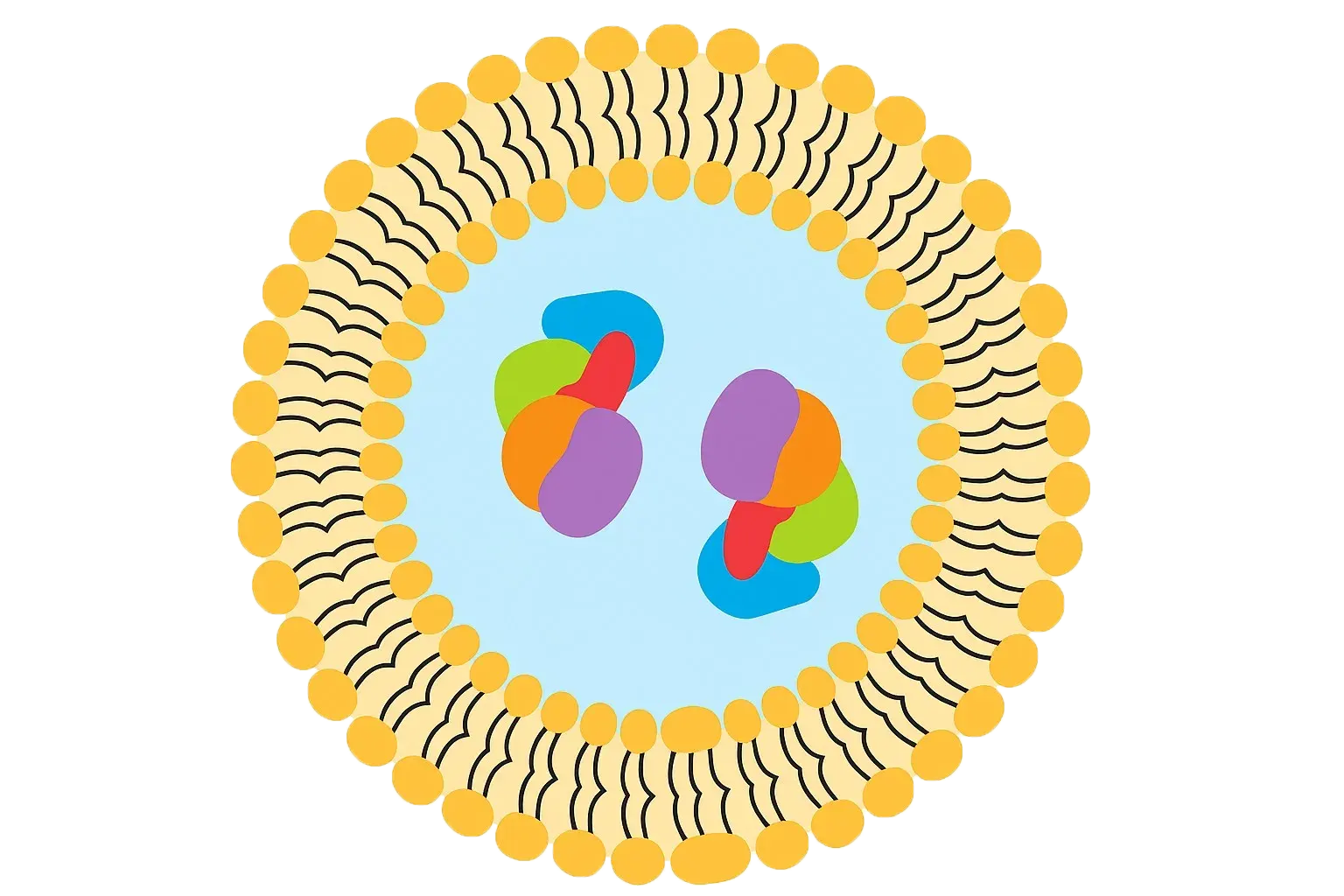
For mRNA, siRNA, or DNA delivery, the formulation requirements are even more stringent. Lipid Nanoparticles (LNPs) require precise microfluidic mixing or specific ethanol-dilution protocols provided by specialized kits to achieve high encapsulation.
The Economics of Efficiency
Moving from "Cheap Materials" to "Cost-Effective Science"
It is a common misconception that buying raw lipid powders is cheaper than purchasing a kit. While the raw material cost per milligram is lower, the Total Cost of Ownership (TCO) for manual preparation is often significantly higher when labor, equipment time, and failure rates are factored in.
The Cost of Failure
If 1 in 4 manual batches fails QC (size/EE) and must be discarded, the cost of the lost drug payload (often expensive APIs or mRNA) far exceeds the savings on lipids. Kits minimize this risk.
The Cost of Time
A kit allows a researcher to produce a formulation in 2 hours. Manual prep takes 2 days. This frees up ~14 hours of researcher time per batch for data analysis and experimental planning.
Equipment Capital
Manual prep requires rotary evaporators, extruders, high-pressure nitrogen lines, and sonicators. Kits often require only standard pipettes and a vortex mixer, reducing lab infrastructure costs.
Application Scenarios: When to Switch to Kits
Three common scenarios where switching from manual preparation to standardized kits yields immediate scientific and economic benefits.
High-Throughput Drug Screening
When screening a library of 50 small molecules for encapsulation, manual extrusion is physically impossible and inconsistent.
Solution: Commercial kits often offer multi-well plate formats or rapid-mixing protocols compatible with high-throughput workflows.
Complex Nucleic Acid Delivery
Encapsulating large mRNA or plasmid DNA requires precise charge interaction (N/P ratio) that manual hydration cannot achieve uniformly.
Solution: LNP Preparation Kits provide the exact ionizable lipids and buffers for >90% encapsulation.
Pre-Clinical In Vivo Validation
Regulatory bodies and journals demand high reproducibility. Data generated with homemade liposomes is often scrutinized for batch variability.
Solution: Using a kit ensures that "Batch A" used for toxicity studies is physicochemically identical to "Batch B" used for efficacy studies.
Ready to Standardize Your Research?
Stop struggling with variability. Accelerate your discovery with Creative Biolabs' proven, standardized solutions.
Frequently Asked Questions
Commercial kits utilize standardized buffer systems and lipid mixes that are designed to be scale-independent. Unlike manual sonication (which is volume-limited) or extrusion (which faces pressure limits at scale), kit protocols often use scalable mixing techniques (like ethanol injection or T-mixing) that maintain the same critical process parameters (CPPs) whether you are making 1 mL or 100 mL. This ensures that the particle size and PDI remain consistent during scale-up.
Yes, many "Advanced" or "Custom" kits allow for modularity. While standard kits come with pre-mixed lipids for maximum reproducibility (e.g., HSPC:Chol:DSPE-PEG), flexible kits provide the buffer systems and mixing hardware while allowing researchers to introduce their own specific lipid ratios or add targeting ligands (e.g., antibodies or peptides) during the formulation process.
Absolutely. There are specific kits designed for hydrophobic drug loading. These usually involve a protocol where the drug is co-dissolved with the lipids in the organic phase before vesicle formation. This ensures the drug is integrated into the lipid bilayer. Standardized kits help maximize the drug-to-lipid ratio, preventing the drug precipitation often seen in manual "thin-film" methods where rehydration is incomplete.
Manual extrusion typically yields a Polydispersity Index (PDI) between 0.15 and 0.25, which is considered "moderately polydisperse." High-quality commercial kits, especially those utilizing microfluidic or rapid-mixing principles, routinely achieve PDI values < 0.1 (often 0.05 - 0.08). This narrow distribution is critical for in vivo applications, as it ensures uniform biodistribution and prevents the preferential clearance of larger particles by the spleen.
Most liposome preparation kits are designed to work with standard laboratory equipment like pipettes, syringes, and vortex mixers. Some advanced LNP kits may require a specific syringe pump to control flow rates for mixing, but they eliminate the need for expensive and maintenance-heavy equipment like rotary evaporators, high-pressure extruders, or probe sonicators.
Online Inquiry
This site is protected by reCAPTCHA and the Google Privacy Policy and Terms of Service apply.