In the rapidly evolving landscape of lipid-based drug delivery systems, precision is paramount. Phosphatidylserine (PS)-based anionic liposomes have emerged as a sophisticated tool for hijacking natural biological pathways, specifically the recognition of apoptotic cells by the immune system. Creative Biolabs leverages decades of biophysical expertise to engineer high-fidelity PS-based liposomes, transforming complex immunological concepts into stable, reproducible, and highly effective delivery vehicles for your research.
Phosphatidylserine (PS) is an anionic phospholipid normally sequestered on the inner leaflet of the plasma membrane in healthy cells. During apoptosis (programmed cell death), PS translocates to the outer leaflet. PS-based liposomes are engineered vesicles that mimic this specific surface topography. By incorporating 1,2-dioleoyl-sn-glycero-3-phospho-L-serine (DOPS) into a neutral lipid matrix (typically DOPC), these liposomes present a negative surface charge that is biologically significant, acting as a specific ligand for receptors on phagocytes.
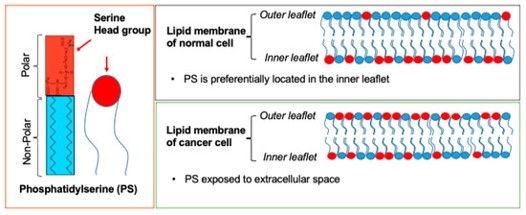 Fig. 1 Schematic representation of phosphatidylserine (PS) and its distribution on normal and cancer cell.1
The efficacy of this interaction depends heavily on the Zeta Potential—the measure of the liposome's electrokinetic potential.
Researchers are increasingly turning to anionic systems to mitigate the adverse effects of cationic lipids, such as hemolysis and complement activation. By utilizing divalent cations (e.g., Ca²⁺, Mg²⁺) to bridge the negative lipid headgroups with negatively charged nucleic acids, PG-liposomes achieve high encapsulation efficiency without the cytotoxicity associated with permanent positive charges.
We develop liposomes with varying ratios of DOPS to DOPC to achieve the exact negative Zeta potential required for your study.
Our scientists are experts in loading diverse cargoes into the aqueous core or the lipid bilayer:
Every batch undergoes rigorous quality control to ensure reproducibility:
| Step | Description | Starting Materials | Deliverables | Estimated Time |
|---|---|---|---|---|
| 1 | Consultation & Design | Project Requirements | Selection of lipid ratios (e.g., DOPS:DOPC 30:70) and payload strategy. | < 1 Week |
| 2 | Formulation | High-purity Lipids (DOPS, DOPC), API/Payload | Thin-film hydration or microfluidic mixing followed by extrusion to achieve uniform unilamellar vesicles. | 2-4 Weeks |
| 3 | Purification & Loading | Crude Suspension | Removal of unencapsulated drug via dialysis or column chromatography; Active or passive loading of payload. | |
| 4 | QC & Characterization | Purified Sample | Rigorous testing for Size (DLS), Zeta Potential, PDI, and Encapsulation Efficiency (EE%). | |
| 6 | Delivery | / | Product and COA | < 1 Week |
Our specialized formulations are driving innovation across diverse biomedical fields:
We combine deep biophysical knowledge with industrial scalability to solve the common challenges associated with anionic liposomes.
Creative Biolabs is dedicated to advancing the frontiers of immunotherapy and drug delivery through superior lipid technology. Our PS-Based Anionic Liposomes Development Service offers the precision, stability, and biological fidelity required to move your research from concept to clinical reality. Contact our team for more information and to discuss your project
| Product Name | Description | Inquiry |
|---|---|---|
| DOPS | High-purity 1,2-dioleoyl-sn-glycero-3-phospho-L-serine for anionic formulations. | Inquiry |
| DOPC | 1,2-dioleoyl-sn-glycero-3-phosphocholine, the standard neutral matrix lipid. | Inquiry |
| DOPS:Chol Liposomes | Pre-formed anionic liposomes stabilized with cholesterol for enhanced membrane rigidity. | Inquiry |
| DOPS:Chol Liposomes | Specialized DOPS liposome variant for comparative research and control studies. | Inquiry |
Reference
 For Research Use Only. Not For Clinical Use
Services
Online Inquiry

Creative Biolabs is a world-leading liposome provider with extensive experience in liposome preparation, custom formulation development, and characterization.

© 2026 Creative Biolabs. All rights reserved.