Long Circulating pH-Responsive Liposome Development Service
Background Our Services Workflow Applications Why Choose Us Related Services & Products FAQs
At Creative Biolabs, we resolve this paradox. Our Long Circulating pH-Responsive Liposome Development service combines the stealth properties of PEGylation with smart, environmentally sensitive lipid chemistry. We engineer nanocarriers that evade Reticuloendothelial System (RES) uptake during circulation but undergo rapid destabilization or membrane fusion when triggered by the acidic microenvironment of tumors or intracellular endosomes.
What are pH-Responsive Liposomes?
pH-responsive liposomes are "smart" nanocarriers designed to undergo a physicochemical change when exposed to specific acidic conditions. Unlike conventional liposomes, which are static, these dynamic vesicles are composed of pH-sensitive lipids (such as CHEMS or proprietary ionizable lipids) and helper lipids (like DOPE). This unique composition allows them to distinguish between the neutral pH of the bloodstream (pH 7.4) and acidic environments found in pathology or cellular compartments.
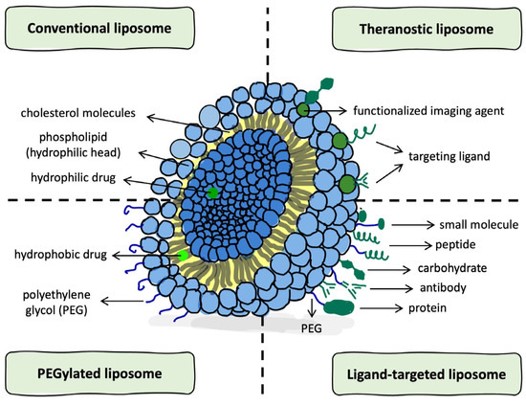 Fig. 1 Schematic representation of liposome types and structural components.1
The "Stealth" and "Trigger" Mechanism of Long Circulating pH-Responsive Liposome
-
Circulation (Stealth): A Polyethylene Glycol (PEG) coating provides a hydration shell, preventing protein adsorption (opsonization) and macrophage uptake, thereby extending circulation half-life.
-
Activation (Trigger): Upon reaching the target site—such as the Tumor Microenvironment (TME, pH ~6.5–6.8) or late endosomes (pH ~5.0–5.5)—the acidic protons trigger the protonation of the lipid headgroups.
Key Components of the System
-
Fusogenic Lipids: Lipids like DOPE (Dioleoylphosphatidylethanolamine) that favor a hexagonal phase transition, facilitating membrane destabilization.
-
Titratable Lipids: Components with pKa values tuned to protonate specifically at the desired pH range.
-
Stabilizing Agents: PEG-lipids that ensure steric stability during transport but do not inhibit the fusion event upon triggering.
Comprehensive Formulation Development Services
Creative Biolabs provides a fully integrated service platform for the design, fabrication, and characterization of long circulating pH-responsive liposomes. We move beyond generic solutions by offering deep customization capabilities tailored to your specific therapeutic goals:
-
Custom PEGylation Strategies: We provide an extensive selection of PEGylated lipids with customizable molecular weights (ranging from PEG 350 to PEG 5000) and diverse lipid anchors (C14–C18). This allows for precise fine-tuning of the hydration shell to optimize circulation retention times versus cellular uptake efficiency.
-
Precision pKa Tuning: By modulating the molar ratio of titratable lipids (such as CHEMS or ionizable cationic lipids) to helper lipids, we engineer the bilayer's ionization point to align perfectly with your target biological microenvironment.
-
Cargo-Agnostic Loading Optimization: Whether your API is a hydrophobic small molecule, a hydrophilic protein, or a nucleic acid, we develop bespoke encapsulation protocols (including remote pH-gradient loading) to maximize loading efficiency and stability.
Workflow
Applications in Modern Research
Our long circulating pH-responsive liposomes are versatile tools applicable across high-impact research areas:
-
Oncology Drug Delivery: Specifically targeting the acidic extracellular fluid of hypoxic solid tumors (Warburg effect) to increase local drug concentration while minimizing systemic toxicity.
-
Gene Therapy (mRNA/siRNA): Facilitating efficient endosomal escape to protect nucleic acids from lysosomal nucleases and ensure cytosolic delivery.
-
Immunotherapy: Delivering antigens or adjuvants to the acidic phagosomes of antigen-presenting cells (APCs) to boost immune response.
-
Intracellular Infection Treatment: Targeting bacteria or parasites that reside within acidic intracellular compartments of host cells.
Why Choose Creative Biolabs?
-
Tailored pKa Tuning: We can fine-tune the ionization point of the liposomes to trigger release at specific pH thresholds (e.g., pH 6.5 for TME vs. pH 5.0 for lysosomes).
-
High Encapsulation Efficiency: Our proprietary remote loading techniques ensure high drug-to-lipid ratios, minimizing API waste.
-
End-to-End Support: From initial concept and lipid synthesis to final scale-up and animal study readiness.
-
Dual-Functionalization: We can combine pH-responsiveness with active targeting ligands (antibodies, peptides) for synergistic targeting effects.
-
Transparent Data: You receive full access to raw data, formulation protocols, and detailed CoAs.
Creative Biolabs is your premier partner for navigating the complexities of Long Circulating pH-Responsive Liposome Development. By combining advanced lipid chemistry with precision engineering, we deliver formulations that solve the dual challenge of stability and release. Whether you are targeting the tumor microenvironment or seeking cytosolic delivery for gene therapies, our expert team is ready to accelerate your path to discovery.
Related Services & Products
Related Services
Related Products
|
Product Name
|
Description
|
Inquiry
|
|
DOPE
|
A key "helper" lipid that promotes fusogenic hexagonal phase transition in acidic conditions.
|
Inquiry
|
|
CHEMS
|
An acidic cholesterol derivative that acts as a pH-titratable switch in the bilayer.
|
Inquiry
|
|
DSPE-PEG2000
|
The gold standard for imparting "stealth" properties and extending circulation time.
|
Inquiry
|
FAQs
What is the primary advantage of pH-responsive liposomes over standard PEGylated liposomes?
Standard PEGylated liposomes are very stable but can be slow to release their drug payload. pH-responsive liposomes retain this stability in circulation but actively release the drug and fuse with membranes upon entering acidic disease sites or endosomes, significantly improving bioavailability.
Can you tune the pH at which the liposomes release the drug?
Yes. By adjusting the ratio of pH-sensitive lipids (like CHEMS or ionizable cationic lipids) to helper lipids, we can modulate the pKa of the formulation to trigger release at early endosomal pH (6.0–6.5) or late lysosomal pH (4.5–5.0).
What types of drugs can be encapsulated?
We can encapsulate a wide range of payloads, including hydrophilic small molecules (via the aqueous core), hydrophobic drugs (within the lipid bilayer), and nucleic acids (siRNA, mRNA, DNA).
Do you offer animal-free (synthetic) lipids?
Yes, Creative Biolabs prioritizes the use of high-purity synthetic lipids to ensure batch-to-batch consistency and regulatory compliance, avoiding the variability found in animal-derived lipids.
What is the typical size range of these liposomes?
Standard formulations are extruded to a size range of 80–120 nm, which is optimal for exploiting the EPR effect in tumor tissues while avoiding rapid renal clearance.
Reference
-
Fraczek, Wiktoria, et al. "Liposomes and Extracellular Vesicles as Distinct Paths Toward Precision Glioma Treatment." International Journal of Molecular Sciences 26.14 (2025): 6775. https://doi.org/10.3390/ijms26146775. Distributed under Open Access license CC BY 4.0, without modification.

For Research Use Only. Not For Clinical Use