Antibody-Inducing Polyvalent Cancer Vaccine Development
Creative Biolabs offers an integrated, end-to-end preclinical platform for the design and evaluation of Antibody-Inducing Polyvalent Cancer Vaccines. Unlike single-antigen approaches, polyvalent vaccines simultaneously target multiple tumor-associated carbohydrate antigens (TACAs) and glycoprotein epitopes—including gangliosides (GM2, GD2, GD3), neutral glycolipids (Globo H, Lewis Y), mucin-associated glycans (TF, Tn, sTn, MUC1), and cell-surface proteins (EpCAM/KSA, PSMA, CA125). By eliciting coordinated polyclonal antibody responses against this antigenic spectrum, our strategy addresses the twin challenges of tumor antigen heterogeneity and immune escape that render monovalent vaccines insufficient. From antigen profiling and carbohydrate synthesis through carrier-conjugate design, formulation, and rigorous immunogenicity evaluation, our multidisciplinary team delivers fully customizable preclinical vaccine candidates built to generate durable, high-titer humoral immunity.
Comprehensive Antibody-Inducing Cancer Vaccine Solutions
Why Polyvalent Vaccines? Confronting Antigenic Heterogeneity
The Biological Basis for Multi-Antigen Targeting
Tumor cells within a single mass exhibit substantial antigenic diversity—a phenomenon that drives immune escape when vaccines target only one epitope. Polyvalent cancer vaccines overcome this by presenting multiple distinct antigens simultaneously, ensuring that even if subpopulations downregulate a given target, other antigen-specific antibody responses remain effective. Equally important is the heterogeneity of patient immune repertoires: individuals vary in their capacity to mount antibody responses against any single antigen. A polyvalent formulation that includes gangliosides (e.g., GM2, GD2), mucin glycans (e.g., Tn, sTn, TF), and protein antigens (e.g., MUC1, EpCAM) maximizes the probability that each patient generates a therapeutically relevant antibody response.
Beyond direct neutralization, vaccine-induced antibodies engage complement-dependent cytotoxicity (CDC) and antibody-dependent cellular cytotoxicity (ADCC), recruiting innate immune effectors to the tumor site. The overall antibody titer against the tumor cell surface correlates strongly with these effector functions—making breadth of antigen coverage a direct determinant of preclinical potency.
- Core Preclinical Challenges We Address:
- Overcoming tumor antigen loss variants through multi-epitope coverage.
- Achieving high-titer IgG responses against poorly immunogenic carbohydrate antigens.
- Selecting optimal carrier proteins and adjuvants to break B-cell tolerance.
- Quantifying antibody-mediated effector functions in vitro and in vivo.
Monovalent vs. Polyvalent Cancer Vaccine Strategies
| Key Comparison | Monovalent Vaccines (Single Antigen) | Polyvalent Vaccines (Multi-Antigen) |
|---|---|---|
| Antigen Coverage | One epitope; vulnerable to antigen-loss variants. | Simultaneous targeting of multiple TACAs and glycoproteins. |
| Immune Escape Risk | High; single-antigen loss confers resistance. | Redundancy across antigens minimizes escape probability. |
| Patient Response Rate | Variable; dependent on individual immune repertoire. | Higher probability of response across diverse HLA backgrounds. |
| Antibody Effector Functions | Limited to single-epitope opsonization. | Polyclonal antibody engagement amplifies CDC and ADCC. |
End-to-End Polyvalent Vaccine Development Service Packages
Our preclinical services are structured into flexible, modular packages designed around the unique requirements of multi-antigen vaccine development. Every module can be customized—from the specific antigen panel and carrier chemistry to adjuvant selection and assay endpoints—to align with your target indication and study objectives.
Target Antigen Profiling & Selection
Strategic identification of the optimal polyvalent antigen panel for your indication.
- Indication-Specific Profiling: Analysis of antigen expression patterns across tumor types (breast, ovarian, prostate, lung, melanoma).
- Glycomic Screening: Characterization of tumor-associated carbohydrate antigen profiles from biopsy specimens.
- Immunohistochemistry Validation: Confirmation of antigen surface expression at ≥50% prevalence in target indication.
- Antigen Prioritization: Data-driven ranking based on expression level, specificity, and immunogenicity potential.
Antigen Synthesis & Carbohydrate Chemistry
High-purity synthesis of carbohydrate and glycopeptide antigens for conjugate vaccine construction.
- Ganglioside Synthesis: Chemical and chemoenzymatic production of GM2, GD2, GD3, and fucosyl-GM1 antigens.
- Glycopeptide Assembly: Solid-phase synthesis of MUC1 tandem-repeat peptides bearing Tn, sTn, and TF glycans.
- Globo H / Lewis Y Production: Multi-step synthesis of neutral glycolipid antigens with stereochemical control.
- Quality Analytics: NMR and high-resolution mass spectrometry confirmation of antigen structure and purity.
Carrier-Conjugate Design & Optimization
Engineering optimal carrier-antigen conjugates that convert T-independent carbohydrate responses into robust T-dependent antibody production.
- Carrier Screening: Evaluation of protein carriers (KLH, CRM197, TT, OMV platforms) for maximal immunogenicity.
- Conjugation Chemistry: Site-selective linker strategies preserving antigen structural integrity.
- Hapten Density Optimization: Titration of carbohydrate-to-carrier ratios for balanced B-cell receptor cross-linking.
- Multivalent Assembly: Co-conjugation of multiple distinct antigens onto single or complementary carriers.
Adjuvant Screening & Formulation
Systematic adjuvant evaluation to maximize antibody titer, isotype switching, and duration of response.
- Adjuvant Library Screening: Head-to-head comparison of saponin-based, TLR-agonist, and emulsion adjuvants.
- Self-Adjuvanting Designs: Incorporation of built-in immune stimulators (e.g., α-GalCer, MPLA conjugates).
- Formulation Stability: Accelerated stability testing under varied storage conditions.
- Dose-Ranging Studies: Determination of optimal antigen and adjuvant dosing schedules in preclinical models.
Immunogenicity & Antibody Response Evaluation
Comprehensive humoral and functional characterization of vaccine-induced antibody responses.
- Antigen-Specific ELISA: Quantitative IgG titer determination against each individual antigen in the polyvalent panel.
- Isotype Profiling: IgG subclass analysis (IgG1, IgG2a, IgG2b, IgG3) to assess Th1/Th2 balance.
- CDC & ADCC Assays: Functional evaluation of complement activation and NK-cell-mediated tumor cell lysis.
- Flow Cytometry Binding: Confirmation of antibody recognition of native antigens on tumor cell surfaces.
In Vivo Efficacy & Preclinical Data Package
Rigorous in vivo proof-of-concept studies and comprehensive documentation for translational research.
- Tumor Challenge Models: Prophylactic and therapeutic efficacy evaluation in syngeneic mouse tumor models.
- Metastasis Monitoring: Assessment of vaccine impact on spontaneous and experimental metastasis.
- Immune Correlate Analysis: Correlation of antibody titers with tumor growth inhibition and survival endpoints.
- IND-Enabling Documentation: Complete preclinical study reports supporting regulatory submissions.
Polyvalent Cancer Vaccine Development Workflow
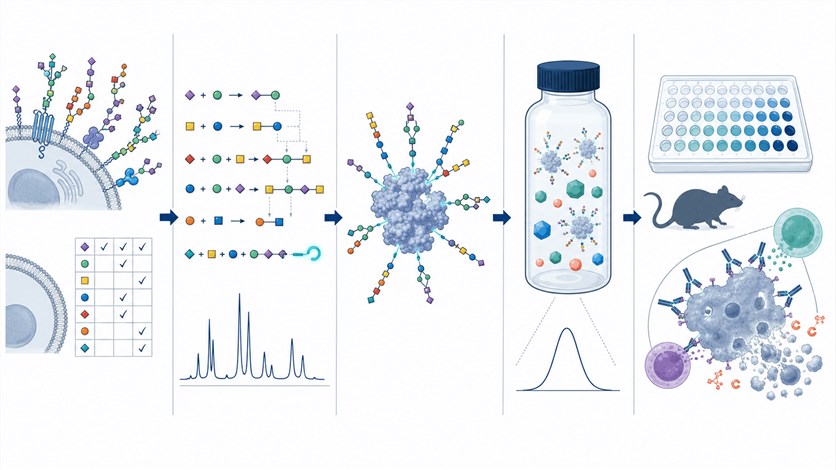
Phase 1 — Target Antigen Discovery & Profiling
We perform comprehensive antigen expression profiling for your target cancer indication using immunohistochemistry and glycomic analysis. Candidate antigens—spanning gangliosides, neutral glycolipids, mucin glycans, and cell-surface glycoproteins—are ranked by expression prevalence, tumor specificity, and documented immunogenicity to assemble an evidence-based polyvalent panel.
Enabling Technology Platforms for Polyvalent Vaccine Development
Why Choose Creative Biolabs?
Our team brings specialized knowledge in complex glycan synthesis and glycoconjugate design—a rare combination essential for developing polyvalent vaccines targeting TACAs.
We do not offer one-size-fits-all solutions. Each polyvalent vaccine is designed around the specific antigen expression profile of your target cancer indication.
From structural confirmation of synthetic antigens to functional CDC/ADCC assays, every quality attribute is measured within a single, traceable workflow.
We deliver complete preclinical data packages—including immunogenicity reports and in vivo efficacy data—that directly support your IND-enabling documentation.
Research Insight: Tumor-Associated Carbohydrate Antigens as Polyvalent Vaccine Targets
Key Findings from Recent Preclinical Research
Advances in glycoconjugate vaccine engineering have revitalized interest in tumor-associated carbohydrate antigens (TACAs) as targets for antibody-inducing cancer vaccines. Polyvalent strategies that combine multiple TACAs with optimized carrier platforms are showing unprecedented immunogenicity in preclinical models.
-
Ganglioside Immunotherapy Renaissance: GD2 and GD3 remain among the most well-validated TACA targets, with GD2-directed monoclonal antibodies already demonstrating clinical benefit. Polyvalent vaccine formulations incorporating multiple gangliosides (GM2, GD2, GD3) show enhanced antibody breadth compared to single-ganglioside approaches, potentially overcoming the antigen escape that limited earlier monovalent GM2-KLH vaccine trials.
-
GMMA Platform for MUC1 Glycoconjugates: Recent work demonstrated that bacterial outer membrane vesicles (GMMA) decorated with synthetic Tn and STn mimetics elicit high-titer, tumor-binding IgG responses in mice—achieving 90% reduction in tumor bioluminescence signal in triple-negative breast cancer models. The inherent adjuvant properties of GMMA eliminate the need for external immune stimulators.
-
Next-Generation Conjugate Designs: Contemporary conjugate vaccines incorporating conformationally locked TACA mimetics, optimized hapten densities, and low-interference carriers are overcoming the historical limitations of carrier-induced epitope suppression (CIES) and weak immunogenicity that led to the failure of earlier TACA vaccine candidates.
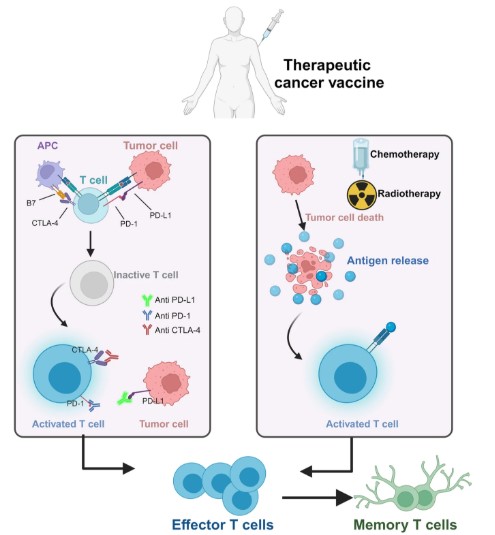
Fig.1 Schematic illustrating mechanisms of combination treatments post cancer vaccination in patients.1,3