
Polyepitope Vaccine Construction with Optimized Spacer Design
Creative Biolabs offers specialized preclinical services in polyepitope vaccine design and development, an approach that links consecutive cytotoxic T lymphocyte (CTL) epitopes into a single polypeptide construct to achieve broad HLA coverage and multi-pathogen targeting. Unlike full-length antigen vaccines, polyepitope constructs eliminate risks associated with the oncogenicity or toxicity of native proteins while maintaining the ability to prime specific CD8+ and CD4+ T cell responses across diverse HLA haplotypes. Our team provides end-to-end support, from epitope selection and construct optimization to delivery vehicle engineering and in vitro/in vivo immunogenicity validation, enabling researchers to advance polyepitope vaccine candidates toward preclinical proof-of-concept with confidence.
How Polyepitope Constructs Broaden T-Cell Immunity
One Construct, Many Epitopes
A polyepitope vaccine is an engineered polypeptide in which multiple defined CTL epitopes are linked end-to-end, often without the need for native flanking sequences. This design enables a single immunogen to present epitopes restricted by multiple HLA class I and class II molecules, overcoming the HLA diversity barrier that limits single-epitope vaccines. Because the construct contains only the minimal immunogenic sequences, it avoids potential toxicity or autoimmune reactions associated with full-length tumor antigens.
Full-length tumor-associated antigens can carry oncogenic risk or exhibit poor immunogenicity due to self-tolerance. Polyepitope constructs bypass these limitations by including only well-characterized, immunodominant epitopes, allowing precise control over the breadth and specificity of the T cell response.
- Core Preclinical Challenges We Address:
- Eliminating junctional neo-epitopes in multi-epitope strings through optimized epitope ordering.
- Achieving broad HLA population coverage exceeding 90% with curated epitope panels.
- Enhancing proteasomal processing via ubiquitin fusion and spacer design optimization.
- Validating epitope-specific T cell responses in vitro and in vivo after construct delivery.
Polyepitope Vaccines vs. Full-Length Antigen and Single-Epitope Approaches
| Key Comparison | Full-Length Antigen / Single-Epitope Vaccines | Polyepitope Vaccines |
|---|---|---|
| HLA Population Coverage | Limited to a few HLA alleles (single epitope) or unpredictable (full antigen). | Deliberate multi-HLA epitope selection for >90% coverage. |
| Oncogenic / Toxicity Risk | Full-length oncoproteins may retain transforming activity. | Minimal epitopes only; no oncogenic or toxic domains. |
| Immune Escape Prevention | Single epitope: vulnerable to antigen loss or mutation. | Simultaneous multi-epitope targeting reduces escape risk. |
| Construct Design Flexibility | Fixed by native protein sequence; limited engineerability. | Fully modular: epitopes, linkers, adjuvants, and tags are tunable. |
End-to-End Polyepitope Vaccine Development Services
Our preclinical polyepitope vaccine services are organized into modular, customizable packages. Whether you need a single epitope validated or a full polyepitope construct delivered and tested in vivo, each module can be adapted to your specific pathogen target, HLA requirements, and delivery platform.
Epitope Discovery & HLA Coverage Planning
Systematic identification of immunodominant CTL epitopes with broad population coverage.
- Epitope Mining: Database-driven screening of IEDB and literature for validated CTL epitopes.
- HLA Coverage Analysis: Computational modeling of allele frequencies for target populations (global or regional).
- Conservation Assessment: Sequence conservation analysis across viral strains or tumor subtypes.
- Immunogenicity Ranking: Prioritization based on binding affinity, antigenicity, and published T cell response data.
Polyepitope Construct Design & Optimization
Engineering the polyepitope string for maximal antigen processing and minimal junctional artifacts.
- Epitope Ordering: Junctional neo-epitope minimization using dedicated optimization algorithms.
- Spacer Engineering: AAY or native flanking sequence insertion for efficient proteasomal liberation.
- Ubiquitin Fusion: N-terminal ubiquitin tagging (G76V mutant) to accelerate proteasomal degradation.
- In Silico Validation: Molecular docking of epitope-HLA interactions to confirm predicted binding.
Gene Synthesis & Delivery Vehicle Assembly
Construct production and packaging into the optimal delivery platform for your research question.
- Gene Synthesis: Codon-optimized polyepitope gene synthesis for the chosen expression system.
- Viral Vectors: Recombinant vaccinia virus, modified vaccinia Ankara (MVA), or adenoviral vector construction.
- DNA Plasmids: Preclinical-grade plasmid preparation for DNA vaccination studies.
- Protein Formulation: Polyepitope protein expression and formulation with ISCOM adjuvants.
Adjuvant & Formulation Strategy
Enhancing vaccine potency through rational adjuvant pairing and delivery optimization.
- Adjuvant Selection: TLR agonists, CpG, or ISCOM formulation tailored to the delivery vehicle.
- Lymph Node Targeting: Amphiphile-adjuvant conjugation for efficient lymph node delivery.
- Combination Design: Co-formulation with immune checkpoint inhibitors for synergy studies.
- Stability Testing: Formulation integrity and functional assay under storage conditions.
Comprehensive Immunogenicity Evaluation
Rigorous multi-level assessment of polyepitope vaccine-induced T cell responses.
- In Vitro Assays: PBMC stimulation, IFN-γ ELISpot, and intracellular cytokine staining.
- Epitope Mapping: Individual epitope-specific T cell response profiling across the polyepitope string.
- In Vivo POC: HLA-transgenic mouse immunization and tumor challenge models.
- Immune Profiling: TCR repertoire sequencing and polyfunctionality analysis.
QC & Preclinical Data Package
Comprehensive quality characterization and data reporting for translational research.
- Construct Verification: Sequence confirmation and expression validation by Western blot and mass spectrometry.
- Potency Assurance: Functional T cell activation assays as release criteria for cell and gene products.
- Safety Screening: Biodistribution and toxicity evaluation in relevant animal models.
- Regulatory Documentation: Pre-IND data package compilation and CMC documentation support.
Optimized Polyepitope Vaccine Development Workflow
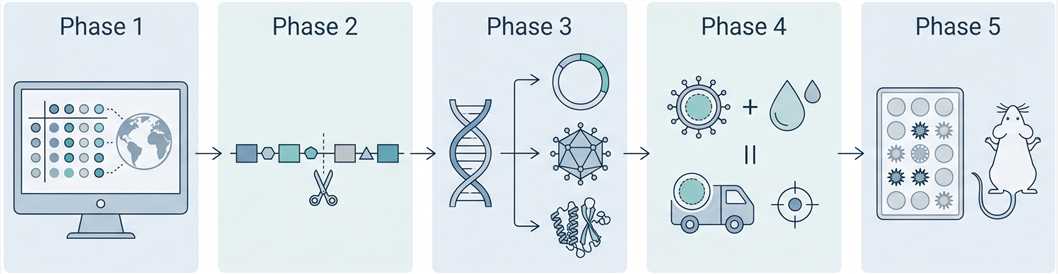
Phase 1 — Epitope Identification & HLA Coverage Mapping
We begin with comprehensive database mining (IEDB, published literature) and computational epitope prediction to identify candidate CTL epitopes from your target antigen(s). HLA binding affinity prediction and allele frequency analysis ensure that the selected epitope panel achieves maximal population coverage, typically exceeding 90% for global populations.
Enabling Technologies for Polyepitope Vaccine Engineering
Why Choose Creative Biolabs?
Our scientists have years of experience in multi-epitope construct engineering, from epitope selection to junctional optimization and delivery vehicle matching.
We perform comprehensive HLA population coverage modeling to ensure your polyepitope construct targets the widest possible patient population across global or regional demographics.
From viral vectors to DNA plasmids and ISCOM-formulated proteins, we offer multiple delivery platforms to match your specific research question and preclinical model requirements.
Our integrated workflow covers everything from epitope discovery to in vivo proof-of-concept, providing a seamless path from design to validated immunogenicity data.
Research Insight: Recombinant MVA Polyepitope Vaccine Design and Preclinical Evaluation
Key Preclinical Findings from our Recombinant MVA Polyepitope Study
Developing universal influenza vaccines capable of inducing broadly protective cellular immune responses is a vital global objective. Recent preclinical research successfully engineered and evaluated an artificial poly-epitope immunogen utilizing the Modified Vaccinia virus Ankara (MVA) platform, delivering promising cross-reactive T cell responses in vitro and in vivo.
-
Highly Conserved Epitope Selection & 99.5% HLA Population Coverage: The study selected twenty highly conserved influenza A virus (IAV) CD8+ T cell epitopes from internal proteins (NP, M1, PB1, PB2, PA) with over 50% conservation across human, swine, and avian strains. This panels' HLA restriction targets an estimated 99.5% of the global human population, assuring high versatility.
-
Ubiquitin Fusion & Optimized AAY Spacers Enhance Antigen Processing: To optimize proteasomal targeting, the construct was fused with N-terminal mutant ubiquitin (G76V), while individual epitopes were separated using AAY spacer sequences. Verification confirmed that human CTL lines successfully recognize and liberate individual epitopes regardless of their location (positions 4, 5, 10, or 14) in the poly-epitope string.
-
Robust In Vitro Human Reactivation & In Vivo Immunogenicity: Recombinant MVA-delivered poly-epitope vaccine (rMVA-PE) successfully reactivated and expanded memory CD8+ T cell responses in healthy HLA-typed human PBMCs, matching or exceeding responses induced by natural viral infection. Intramuscular immunization of humanized HLA-A2.1-/HLA-DR1-transgenic mice prompted highly robust antigen-specific CD8+ T cell responses in vivo.
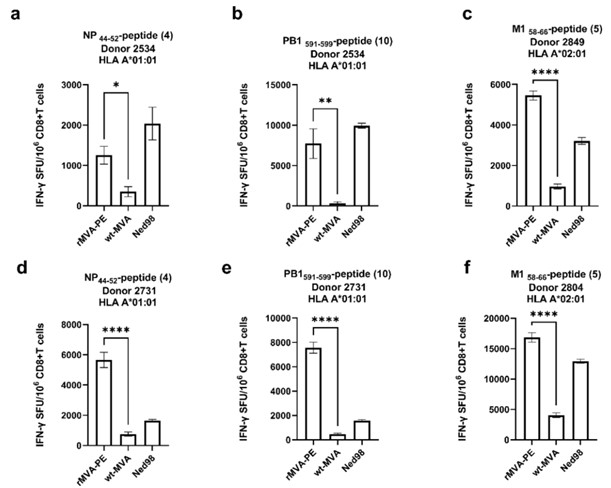
Fig.1 In vitro immunogenicity analysis of rMVA-PE.1, 2