
Adenovirus-Based Cancer Vaccine Design: Preclinical Ad Vector Engineering
Creative Biolabs delivers a comprehensive, end-to-end preclinical platform for the rational design and engineering of adenovirus-based cancer vaccines. Adenoviral vectors combine a high-capacity ~36 kb double-stranded DNA genome, the ability to accommodate up to ~7.5 kb of foreign antigen-encoding sequence, and efficient transduction of both dividing and quiescent cells — all while maintaining an extrachromosomal state that eliminates insertional mutagenesis risk. Our platform spans two complementary modalities: replication-deficient Ad vectors engineered to express tumor-associated antigens (TAAs) or immunomodulatory molecules, and conditionally replicating oncolytic adenoviruses that couple direct tumor lysis with in situ vaccination. From serotype selection and capsid engineering to heterologous prime-boost regimen design, we provide the vector expertise and immunological depth to advance your cancer vaccine candidate from concept through rigorous preclinical validation.
Adenovirus Biology as a Foundation for Cancer Vaccine Engineering
Engineering the Adenoviral Genome for Antigen Delivery
Adenoviruses are non-enveloped, icosahedral viruses whose ~36 kbp dsDNA genome has been extensively characterized over decades. Deletion of the E1 and E3 regions renders the vector replication-deficient while creating space for up to ~7.5 kb of transgene insertion — sufficient for single or multiple tumor antigens plus regulatory elements. The vector remains extrachromosomal in infected cells, eliminating the risk of host genome integration. Recombinant proteins are expressed at high levels, and high-titer production supports reproducible batch manufacturing for preclinical studies. For cancer vaccines, adenoviral delivery of TAAs allows professional antigen-presenting cells (APCs), including dendritic cells (DCs), to acquire and cross-present tumor epitopes through both MHC class I and class II pathways, generating coordinated CD8+ cytotoxic and CD4+ helper T cell responses that are essential for durable antitumor immunity.
Replication-deficient Ad vectors serve as pure antigen-delivery platforms, while oncolytic adenoviruses add the dimension of tumor-selective replication and lysis — releasing tumor antigens in situ and converting the tumor itself into an endogenous vaccine.
- Core Preclinical Challenges We Address:
- Overcoming pre-existing anti-vector immunity via rare serotype platforms and capsid modification.
- Engineering tumor-selective replication via E1A/E1B modification and tumor-specific promoters.
- Designing heterologous prime-boost regimens to maximize CD8+ T cell magnitude and memory.
- Achieving DC-targeted transduction via fiber knob modification and tropism retargeting in vitro and in vivo.
Adenovirus-Based Vectors vs. Other Viral Platforms for Cancer Vaccines
| Key Comparison | Other Viral Vectors (Lentivirus, AAV, Poxvirus) | Adenovirus-Based Cancer Vaccines |
|---|---|---|
| Genomic Insertion Capacity | Limited to ~4–5 kb (AAV); ~8 kb (lentivirus) with integration risk. | ~7.5 kb, extrachromosomal — no integration risk. |
| Genomic Safety | Lentivirus integrates; AAV has low-risk integration potential. | Strictly extrachromosomal; zero insertional mutagenesis. |
| Serotype Diversity | Limited clinically validated serotypes available. | 50+ human and non-human serotypes for immune evasion. |
| High-Titer Production | Moderate yields; AAV production is complex and costly. | Robust, scalable production with established protocols. |
End-to-End Adenovirus Cancer Vaccine Engineering Service Packages
Our preclinical services are structured into modular packages covering the full adenoviral vaccine development pipeline. Every module can be independently scoped or combined — from single-antigen replication-deficient vectors to armed oncolytic adenoviruses — to match your target indication, antigen selection, and immunological endpoints.
Target Antigen & Platform Design
Rational selection of antigen payload, vector modality, and serotype backbone for your tumor indication.
- Antigen Evaluation: Bioinformatic selection of TAAs, neoantigens, or immunomodulatory transgenes.
- Modality Decision: Replication-deficient vs. oncolytic vector strategy assessment.
- Serotype Screening: Selection from human adenovirus species B/C/D and non-human Ad platforms.
- Regimen Planning: Prime-only, homologous boost, or heterologous prime-boost protocol design.
Recombinant Ad Genome Construction
Precision genetic engineering of the adenoviral backbone, including E1/E3 deletion and transgene cassette insertion.
- E1/E3 Deletion: Replication-deficient backbone construction with optimized deletion boundaries.
- Cassette Design: Promoter optimization (CMV, tumor-specific), codon optimization, and polyA engineering.
- Oncolytic Engineering: E1A-Δ24 modification, tumor-specific promoter (hTERT, survivin, Cox2) insertion.
- Armed Vector: Co-expression cassettes for GM-CSF, IL-12, or CD40L immunomodulatory payloads.
Capsid Engineering & Tropism Retargeting
Structural modification of the adenoviral capsid to evade pre-existing immunity and redirect infection toward DCs.
- Fiber Knob Swap: Replacement of fiber knob domain with alternative serotype knob for receptor retargeting.
- Hexon Modification: Hypervariable region (HVR) substitution to escape neutralizing antibody recognition.
- RGD Peptide Insertion: Integrin-binding motif incorporation for enhanced DC transduction.
- Pseudotyping: Capsid protein exchange between serotypes for combined immune-evasion and tropism benefits.
Vector Rescue, Amplification & QC
High-titer adenovirus production with comprehensive quality characterization for preclinical use.
- Vector Rescue: Transfection of packaging cell lines (HEK293, PER.C6) for replication-deficient vectors.
- Amplification: Serial passage and large-scale production under optimized culture conditions.
- Purification: Cesium chloride gradient or ion-exchange chromatography for high-purity yields.
- QC Panel: Infectious titer (TCID50), physical titer (OD260), sterility, and transgene expression validation.
Comprehensive Immunogenicity Evaluation
Multi-level assessment of vaccine-induced T cell and antibody responses in preclinical models.
- Antibody Response: ELISA-based quantification of antigen-specific IgG and neutralizing antibody titers.
- T Cell Assays: IFN-γ ELISpot, intracellular cytokine staining (ICS), and tetramer analysis.
- DC Activation: Flow cytometry assessment of DC maturation markers (CD80, CD83, CD86, HLA-DR).
- Cross-Presentation: MHC-I-restricted peptide presentation quantified via specific T cell hybridoma assays.
In Vivo Efficacy & Data Package
Preclinical proof-of-concept studies in syngeneic and xenograft tumor models with complete reporting.
- Tumor Challenge Models: Prophylactic and therapeutic efficacy in subcutaneous and orthotopic models.
- Metastasis Studies: Experimental and spontaneous metastasis models with survival endpoint analysis.
- Combination Arms: Ad vaccine + immune checkpoint inhibitor (anti-PD-1/PD-L1) synergy evaluation.
- Final Report: Comprehensive data package with statistical analysis, histopathology, and immune correlates.
Preclinical Adenovirus Cancer Vaccine Design Workflow
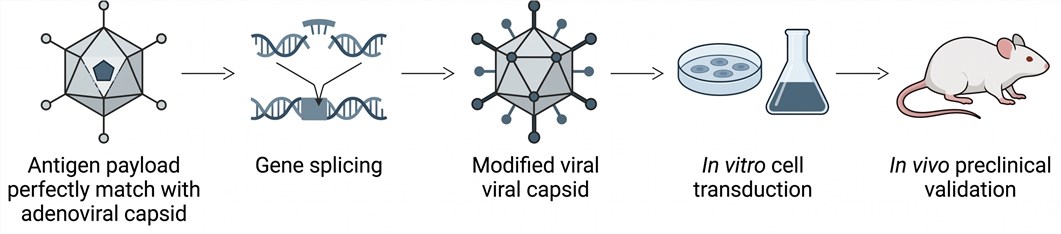
Phase 1 — Target Antigen & Serotype Platform Selection
We work with you to define the optimal antigen payload (TAA, neoantigen pool, or immunomodulator) and match it to the most suitable adenoviral serotype. Low-seroprevalence human Ad types (e.g., Ad26, Ad35) and non-human Ads (e.g., chimpanzee ChAd) are prioritized when pre-existing immunity is a concern. For oncolytic applications, we select serotypes with natural or engineerable tumor tropism.
Enabling Technologies for Adenoviral Cancer Vaccine Engineering
Why Choose Creative Biolabs?
Our team brings decades of collective experience in adenovirus molecular biology, capsid structure-function relationships, and vector engineering across diverse serotypes.
We support both replication-deficient Ad vectors for antigen delivery and conditionally replicating oncolytic Ads — and can advise on which modality best matches your therapeutic hypothesis.
From rare serotype selection to capsid engineering, we systematically address anti-vector immunity — one of the most persistent barriers to adenoviral vaccine efficacy.
Every construct, titer, and immunogenicity data point is documented and delivered in a structured report, enabling seamless transition to your next development stage.
Research Insight: Adenoviral Vectors in the Evolving Cancer Vaccine Landscape
Key Findings from Preclinical & Translational Research
The adenoviral vector platform has matured into one of the most versatile tools in cancer immunotherapy. Recent advances in capsid engineering, oncolytic arming, and serotype diversification have expanded the design space for tumor-specific vaccine candidates.
-
Serotype Diversification Strategy: Comprehensive reviews by Trivedi et al. and Dobner et al. document that expanding beyond Ad5 to low-seroprevalence human and non-human primate serotypes can reduce the impact of pre-existing neutralizing antibodies, which affect 40–90% of the population for common serotypes.
-
Oncolytic Adenovirus Engineering: Researchers summarized that armed oncolytic adenoviruses expressing GM-CSF, IL-12, or CD40L can convert immunologically "cold" tumors into "hot" ones, with tumor-specific promoter-driven replication (e.g., hTERT, survivin) reducing off-target toxicity.
-
Neoantigen Delivery via Oncolytic Ad: Shen et al. demonstrated that an oncolytic adenovirus encoding tumor neoantigens plus Flt3L (NeoViron) sensitized low-mutation-burden tumors to anti-PD-1 therapy and prevented metastasis by inducing CD69+ CD8+ tissue-resident memory T cells.
-
Viral Vectored Vaccine Design Principles: Wang et al.provided a systematic framework for viral vector vaccine development, highlighting adenoviral platforms as leading candidates due to their high transgene capacity, robust immunogenicity, and validated manufacturing scalability.
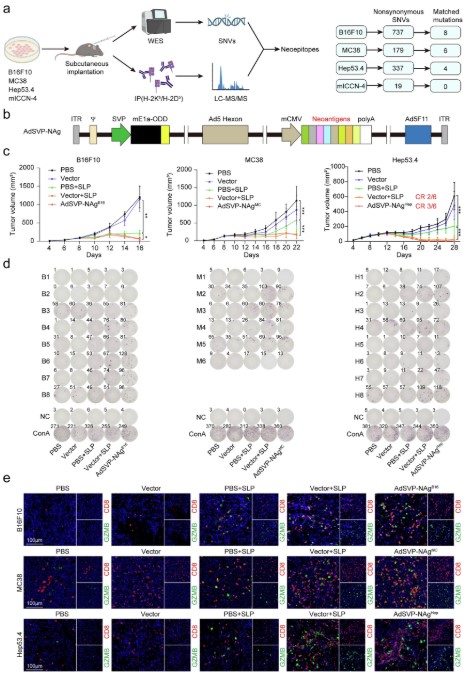
Fig.1 Neoantigen identification and delivery using oncolytic adenoviral vectors.3,5