
Preclinical Listeria-Based Cancer Vaccine Design & Construction
Creative Biolabs is a leader in preclinical cancer vaccine development, offering a specialized, end-to-end platform for the design and construction of attenuated Listeria monocytogenes-based immunotherapeutics. L. monocytogenes is a Gram-positive facultative intracellular bacterium with a unique ability to escape the phagolysosome and enter the host cell cytosol—an attribute that makes it one of the most potent live bacterial vectors for delivering tumor-associated antigens (TAAs) directly into the MHC class I antigen presentation pathway. By engineering attenuated strains that secrete TAA-LLO (listeriolysin O) fusion proteins under the control of the master virulence regulator PrfA, our team constructs vaccine candidates that elicit robust, antigen-specific CD8+ cytotoxic T lymphocyte (CTL) responses while reshaping the immunosuppressive tumor microenvironment. From backbone selection and virulence gene deletion to comprehensive in vitro and in vivo potency validation, we provide a fully integrated service designed to bridge the gap between bacterial vector engineering and translational cancer immunotherapy.
Why Listeria monocytogenes Is a Powerful Vaccine Vector for Cancer
Cytosolic Antigen Delivery with Built-in Adjuvant Activity
L. monocytogenes (Lm) selectively infects professional antigen-presenting cells (APCs)—macrophages, neutrophils, and dendritic cells. Following phagocytosis, the bacterium deploys its pore-forming virulence factor LLO to rupture the phagolysosomal membrane, releasing itself and its secreted protein cargo into the cytosol. This phagosome-to-cytosol transition is the defining feature that distinguishes Lm from other bacterial vectors: antigens delivered via Lm are processed through the ubiquitin-proteasome pathway and presented on MHC class I molecules, directly priming CD8+ CTLs. Meanwhile, pathogen-associated molecular patterns (PAMPs) from the bacterium provide potent innate adjuvant signaling, inducing IL-12, IL-6, and TNFα secretion and driving DC maturation without the need for exogenous adjuvants.
While Lm is renowned for MHC class I-restricted CTL priming, the secreted antigen pool can also be taken up by bystander APCs and cross-presented on MHC class II molecules, enabling coordinated CD4+ helper T cell activation. This dual pathway engagement is essential for durable antitumor memory.
- Core Preclinical Challenges We Solve:
- Designing safe, immunogenic attenuated strains (ΔactA, ΔactA/ΔinlB, LADS, KBMA).
- Overcoming immunodominant Lm epitopes that compete with TAA-specific responses.
- Optimizing TAA-LLO fusion cassettes for stable secretion and proteasomal processing.
- Quantifying Lm-mediated TME remodeling (Treg, MDSC, and effector cell profiling).
Lm vs. Other Bacterial & Viral Vectors: A Preclinical Perspective
| Key Comparison | Other Bacterial / Viral Vectors | Listeria monocytogenes Vector |
|---|---|---|
| Antigen Access to MHC-I Pathway | Mostly restricted to phagosomal processing; cross-presentation required. | Direct LLO-mediated phagosome escape; efficient cytosolic delivery. |
| Innate Immune Activation | Often requires co-administered adjuvants or TLR agonist supplementation. | Built-in PAMP-driven adjuvant activity (IL-12, TNFα, NO). |
| Pre-existing Vector Immunity | Neutralizing antibodies common for adenovirus, HSV-1, measles virus. | Low seroprevalence; minimal pre-existing neutralizing immunity. |
| Genomic Integration Risk | Viral vectors (LV, AAV) carry insertional mutagenesis risk. | No genomic integration; antibiotic-clearable if needed. |
End-to-End Listeria Vaccine Design & Preclinical Characterization
Our preclinical services are organized into six modular packages that cover the complete Lm vaccine development pipeline. Every module can be customized—from the choice of attenuation strategy to the specific TAA-LLO fusion architecture—to align with your target indication and antigen selection.
Attenuated Strain Engineering & Selection
Selection and construction of the optimal attenuated Lm backbone for your project.
- Virulence Gene Deletion: ΔactA, ΔactA/ΔinlB, or custom multi-gene deletions.
- Advanced Platforms: LADS (Live Attenuated Double Substitution), KBMA (killed but metabolically active), and Lm-RIID.
- Safety Verification: In vitro intracellular growth kinetics and plaque size reduction assays.
- Genetic Stability: Serial passage analysis confirming attenuation phenotype retention.
TAA-LLO Fusion Cassette Design & Cloning
Custom molecular engineering of the antigen expression and secretion module.
- Fusion Architecture: Design of truncated LLO (non-hemolytic) fused to single or multi-epitope TAA sequences.
- PrfA-Regulated Expression: Placement under the endogenous PrfA-dependent hly promoter for intracytosolic induction.
- Signal Sequence Optimization: SecA2-dependent secretion tag engineering for efficient protein export.
- Multi-Cassette Configurations: Dual or triple TAA-LLO operons for polyvalent vaccine constructs.
Recombinant Lm Production & Quality Control
Scalable culture of recombinant Lm strains with rigorous identity and purity testing.
- BHI Broth Culture: Brain-heart infusion-based growth under selective antibiotic pressure.
- Colony PCR Screening: Confirmation of gene deletion loci and TAA cassette integration.
- Western Blot Verification: Detection of secreted TAA-LLO fusion protein in culture supernatant.
- Viability & CFU Determination: Colony-forming unit quantification for precise dosing.
In Vitro Infection & Antigen Presentation Assays
Functional validation of Lm infection, phagosome escape, and antigen processing in APCs.
- BMDC Infection Kinetics: Gentamicin protection assay measuring intracellular CFU at 1, 4, and 8 h post-infection.
- Phagosome Escape Assay: LLO-dependent cytosolic access monitored by fluorogenic reporter systems.
- MHC-I Presentation: SIINFEKL-H-2Kb surface staining in Lm-OVA-infected DCs by flow cytometry.
- DC Maturation Panel: Upregulation of CD80, CD83, CD86, and MHC-II on infected BMDCs.
Immunogenicity & T Cell Response Profiling
Comprehensive assessment of vaccine-elicited T cell immunity and TME remodeling.
- ELISpot & ICS: IFN-γ ELISpot and intracellular cytokine staining for TAA-specific CD8+ T cell quantification.
- In Vivo CTL Assay: Peptide-pulsed target cell clearance measurement following prime-boost vaccination.
- Tetramer Staining: MHC class I tetramer-based enumeration of antigen-specific CD8+ T cells.
- TME Profiling: Multiparametric flow analysis of Treg (FoxP3+), MDSC (Gr-1+CD11b+), and NK (NK1.1+) populations.
In Vivo Tumor Efficacy & Biodistribution
Preclinical tumor model testing with comprehensive pharmacodynamic and safety endpoints.
- Syngeneic Tumor Models: CT26 (colorectal), B16-F10 (melanoma), TC-1 (HPV+), and 4T1 (breast) models.
- Tumor Growth Monitoring: Caliper measurement of tumor volume with Kaplan-Meier survival analysis.
- Biodistribution: CFU-based organ colonization profiling (liver, spleen, tumor) at serial time points.
- Combination Therapy: Co-administration with immune checkpoint inhibitors for synergy evaluation.
Preclinical Listeria Vaccine Development Workflow
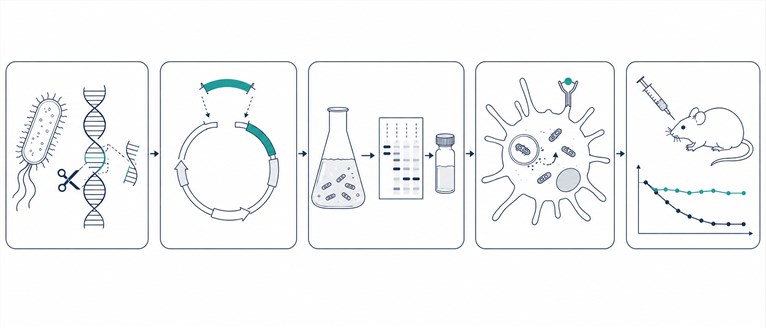
Phase 1 — Attenuation Strategy & Backbone Selection
We consult on the optimal attenuated Lm backbone based on your target indication and antigen characteristics. Options range from single-gene deletions (ΔactA) to double-deletion strains (ΔactA/ΔinlB) and advanced platforms such as LADS and KBMA. Each candidate is evaluated for intracellular growth attenuation, genetic stability, and retained immunogenicity before final selection.
Enabling Technologies for Listeria-Based Cancer Vaccines
Why Choose Creative Biolabs for Lm Vaccine Development?
Our team has extensive hands-on experience with Lm virulence regulation, attenuation strategies, and intracellular life-cycle manipulation for preclinical vaccine design.
From classic ΔactA deletions to cutting-edge LADS and KBMA platforms, we offer the full spectrum of attenuation and antigen delivery strategies under one roof.
Our immunogenicity assessments go beyond ELISpot—we profile TME remodeling, memory T cell formation, and combination therapy synergy in relevant syngeneic tumor models.
Every service module is independently selectable and fully customizable. You receive clear timelines, raw data access, and a dedicated project scientist for direct communication.
Research Insight: Optimizing Lm-Based Vaccine Design for Cancer
Key Preclinical Findings Guiding Current Vector Design
Attenuated Listeria monocytogenes has emerged as one of the most versatile live bacterial vectors for cancer immunotherapy, with over 30 clinical-stage programs and an extensive preclinical literature detailing its mechanisms and optimization strategies.
-
Comprehensive Review of Lm Vector Biology: The phagosome-to-cytosol transition mediated by LLO, combined with ActA-dependent intercellular spread, positions Lm uniquely among bacterial vectors for MHC class I-restricted antigen delivery. Virulence-attenuated strains retain potent adjuvant activity while eliminating pathogenicity, as reviewed by Ding et al.1
-
Immunodominance as a Design Constraint: Flickinger et al. demonstrated that immunodominant Lm epitopes (LLO, p60, Mpl) can outcompete TAA-derived epitopes for MHC binding due to superior peptide-MHC complex stability. Epitope engineering through anchor residue substitution rescued TAA-specific CTL priming in a colorectal cancer model.2
-
Pyroptosis & Necroptosis Shape Durable Immunity: Olagunju et al. showed that caspase-1/11 and GSDMD deficiency—while impairing acute bacterial control—paradoxically enhanced long-lasting effector CD8+ T cell generation from Lm-OVA vaccination, revealing that host cell death pathway modulation can be leveraged to fine-tune vaccine durability.3
-
Memory T Cells as the Ultimate Vaccine Goal: A 2025 review by Olagunju et al. consolidates evidence that recombinant Lm vaccines excel at inducing functional memory T cell pools capable of long-term tumor surveillance, and highlights how vector design parameters—attenuation level, antigen secretion rate, and dosing schedule—collectively determine memory formation efficiency.4
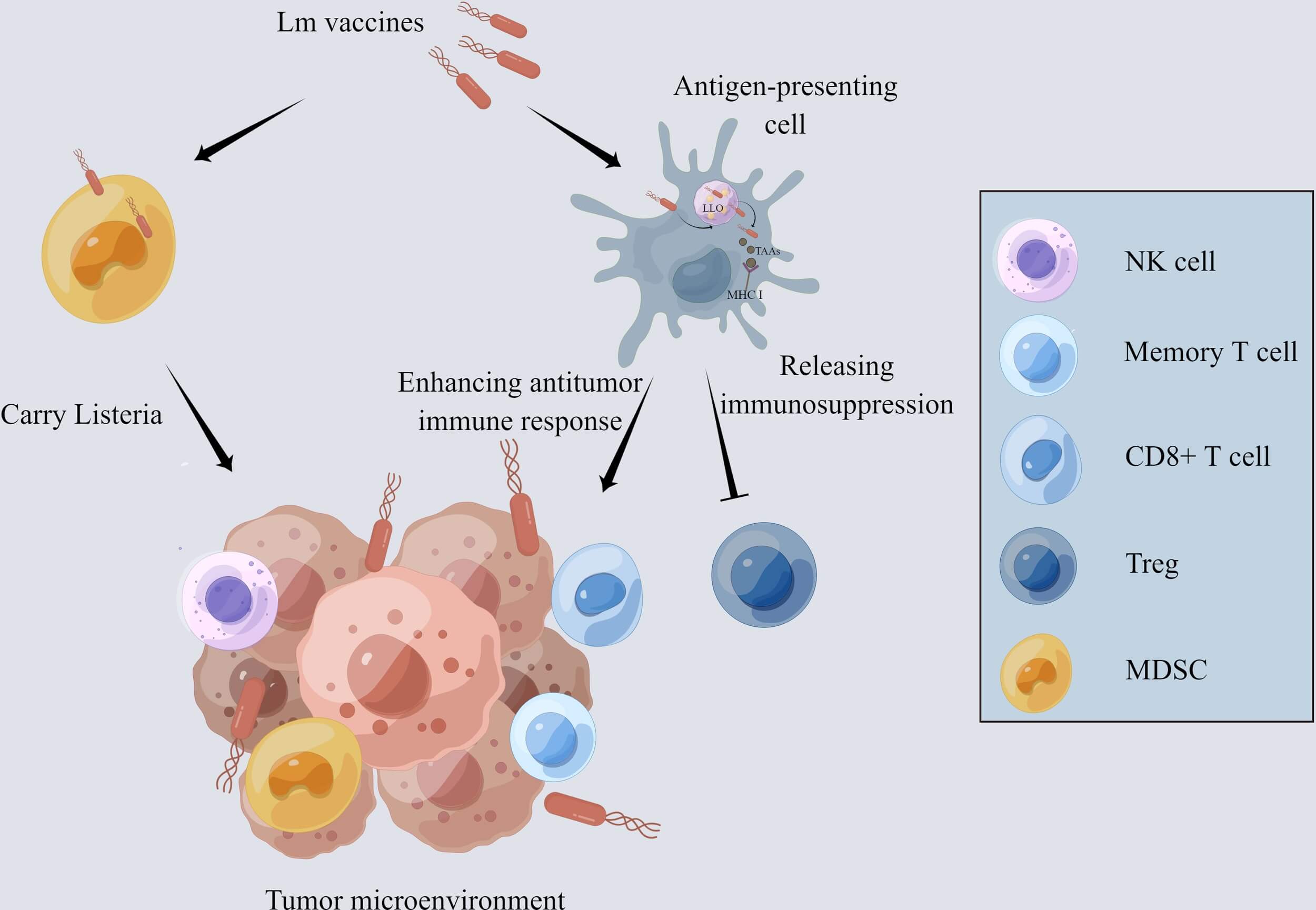
Fig.1 Mechanism by which Lm-based vaccines modulate the tumor microenvironment.1,5