
Preclinical Arenavirus Vector Design for Cancer Vaccine Development
Creative Biolabs offers a comprehensive, end-to-end preclinical platform for the rational design and development of arenavirus-based cancer vaccine vectors. Leveraging the unique biology of lymphocytic choriomeningitis virus (LCMV) and Pichinde virus (PICV)—two phylogenetically distant, non-cytopathic arenaviruses with inherent tropism for professional antigen-presenting cells—our platform empowers researchers to engineer replication-competent, tri-segmented vectors that deliver tumor-associated antigens directly to dendritic cells and macrophages. Unlike conventional oncolytic viruses that require defective interferon signaling pathways in tumors, arenavirus vectors replicate robustly even in IFN-competent malignancies, offering a fundamentally differentiated mechanism of antitumor immunity. From reverse genetics-based vector engineering through in vitro APC tropism characterization to in vivo efficacy evaluation in syngeneic tumor models, our integrated service modules are designed to accelerate the translation of arenavirus-based immunotherapies from concept to validated preclinical candidate.
The Arenavirus Vector Advantage for Cancer Immunotherapy
Non-Cytopathic Replication in Professional APCs
Arenaviruses are enveloped, bi-segmented negative-strand RNA viruses encoding four structural proteins: the RNA-dependent RNA polymerase (L), the ring-finger Z matrix protein, the nucleoprotein (NP), and the glycoprotein precursor (GPC). Their defining feature as vaccine vectors is their ability to infect and replicate within dendritic cells and macrophages without causing cytopathic cell death. This non-lytic infection preserves APC viability, thereby sustaining antigen presentation and extending the window of T cell priming. With a replication cycle confined to the cytoplasm—entailing zero genomic integration risk—and a remarkably low seroprevalence of 2–5% for LCMV in the general population, arenavirus vectors offer a uniquely attractive safety and immunogenicity profile. The availability of the phylogenetically distant PICV (endemic only to Colombia, South America) further enables a heterologous prime-boost alternating regimen that effectively circumvents anti-vector neutralizing antibody responses.1,2
Unlike adenoviral or poxviral vectors, arenaviruses are naturally non-lytic and replicate with full efficiency in IFN-I-competent cells, expanding the treatable tumor spectrum to include malignancies with intact innate immune signaling pathways.
- Core Preclinical Challenges We Address:
- Engineering tri-segmented arenavirus genomes for stable transgene expression.
- Overcoming pre-existing anti-vector immunity via heterologous PICV/LCMV alternation.
- Balancing vector attenuation with retention of APC-targeting immunogenicity.
- Characterizing APC activation and CD8+ T cell priming in vitro and in vivo.
Why Arenavirus Vectors Outperform Conventional Viral Vectors?
| Key Comparison | Conventional Viral Vectors (Adeno/Pox/Alpha) | Arenavirus Vectors (LCMV/PICV) |
|---|---|---|
| Cytopathicity & APC Viability | Cytopathic; compromises APC survival and antigen presentation window. | Non-cytopathic; preserves APC viability for sustained antigen presentation. |
| IFN-I Sensitivity in Tumors | Requires defective IFN signaling for replication; excludes many tumor types. | Replicates robustly in IFN-I-competent tumors; broad applicability. |
| Pre-Existing Anti-Vector Immunity | High seroprevalence (Adeno 40–90%); limits primary and repeat dosing. | Very low seroprevalence (LCMV 2–5%; PICV ~0%); repeat dosing enabled. |
| Genomic Integration Risk | Variable; lentiviral vectors carry definitive integration risk. | Strictly cytoplasmic replication; zero genomic integration. |
| Transgene Capacity | Moderate; limited by capsid packaging constraints. | Tri-segmented genome accommodates multiple antigens; flexible cassette design. |
End-to-End Arenavirus Vector Engineering Service Modules
Our preclinical service packages are structured as flexible, modular offerings. Recognizing that each tumor indication and antigen target presents distinct engineering requirements, all modules are fully customizable—from arenavirus backbone selection to specific attenuation strategies and heterologous prime-boost scheduling—to align with your therapeutic goals.
Vector Backbone & Modality Selection
Strategic selection of the optimal arenavirus chassis and replication modality for your tumor target.
- Species Selection: LCMV (Old World) vs. PICV (New World) based on target indication and dosing strategy.
- Modality Decision: Replication-competent artARENA vs. replication-attenuated r3LCMV configurations.
- Heterologous Regimen: Design of artPICV prime → artLCMV boost alternating schedules to bypass anti-vector immunity.
- Tumor Indication Fit: Assessment of tumor IFN-I pathway status and predicted APC accessibility.
Reverse Genetics & Antigen Cassette Construction
Full tri-segmented genome engineering with custom tumor antigen expression cassettes.
- Tri-Segmented Rescue: Cloning of the second S segment encoding your tumor antigen(s) of interest.
- Multi-Antigen Cassette: Design of polycistronic or fusion antigen constructs for multivalent targeting.
- Promoter Optimization: Tuning of arenavirus 5′ and 3′ UTR elements for balanced transgene expression.
- Attenuation Engineering: Introduction of specific mutations to modulate replication kinetics without abolishing APC tropism.
Vector Amplification, Titration & QC
Scalable production and rigorous quality control of recombinant arenavirus vector stocks.
- Cell Substrate: Amplification in BHK-21 or Vero cells with optimized infection parameters.
- Titration: Focus-forming assay (FFA) or TCID50 determination with replicate validation.
- Purity Assessment: Verification of vector stock homogeneity by RT-PCR and sequencing of transgene insert.
- Stability Testing: Freeze-thaw and storage condition optimization for preclinical batch consistency.
In Vitro Characterization & APC Tropism
Comprehensive in vitro validation of arenavirus vector functionality and cellular tropism.
- APC Infection Panel: Flow cytometric quantification of vector infection in cDC1, cDC2, pDC, and macrophage subsets.
- Antigen Expression: Intracellular staining and western blot confirmation of transgene expression kinetics.
- Cytopathicity Assay: Confirmation of non-lytic phenotype via LDH release and annexin V staining.
- DC Maturation Readout: Upregulation of CD80, CD86, CD40, and MHC-I/MHC-II on infected APCs.
Immunogenicity & T Cell Response Profiling
Comprehensive assessment of arenavirus vector-induced antigen-specific immune responses.
- MHC Tetramer Staining: Quantification of antigen-specific CD8+ T cell frequencies by flow cytometry.
- ELISpot (IFN-γ): Functional enumeration of cytokine-secreting antigen-specific T cells.
- Intracellular Cytokine Staining: Polyfunctional profiling (IFN-γ, TNF-α, IL-2, granzyme B).
- Neutralizing Antibody: Assessment of anti-LCMV and anti-PICV antibody titers post-administration.
In Vivo Efficacy & TME Remodeling
Rigorous in vivo evaluation of antitumor efficacy and tumor microenvironment modulation.
- Syngeneic Models: Tumor growth inhibition in B16-F10, CT26, and TC-1 subcutaneous models.
- Heterologous Dosing: PICV/LCMV alternating schedule optimization for maximal CTL frequencies.
- TIL Analysis: Multiparametric flow cytometry of tumor-infiltrating CD8+, CD4+, Treg, and NK cell subsets.
- Combination Studies: Synergy assessment with immune checkpoint inhibitors (anti-PD-1/PD-L1, anti-NKG2A).
Optimized Preclinical Arenavirus Vaccine Development Workflow

Phase 1 — Vector Backbone Selection & Antigen Cassette Design
Based on your tumor indication and antigen target, we select the optimal arenavirus species (LCMV or PICV) and define the tri-segmented genome architecture. The tumor antigen sequence is codon-optimized and cloned into the second S segment under appropriate arenavirus regulatory elements. Attenuation mutations are designed in silico to fine-tune replication kinetics for the desired safety–immunogenicity balance.
Enabling Technologies for Arenavirus Vector Engineering
Why Choose Creative Biolabs?
Our scientists bring extensive experience in arenavirus biology, including LCMV and PICV reverse genetics, tri-segmented genome engineering, and attenuation strategy design.
Access to both LCMV and PICV backbones enables heterologous alternating regimens that maximize T cell responses while overcoming anti-vector immunity barriers.
From APC tropism and DC maturation through in vivo efficacy and TME remodeling, we deliver fully integrated data packages supporting your next translational milestone.
Whether you need only vector engineering, or a full efficacy package with combination checkpoint inhibitor studies, our modules adapt to your project scope.
Research Insight: Arenavirus Vectors Reprogram the Tumor Immune Microenvironment
Key Findings from Preclinical Arenavirus Vector Studies
Arenavirus-based vectors represent a paradigm shift in cancer immunotherapy, targeting tumors through mechanisms fundamentally distinct from oncolytic virotherapy. Recent preclinical research has illuminated their unique mode of action.
-
IFN-I-Independent Replication: Unlike oncolytic viruses that selectively replicate in IFN-defective tumors, LCMV replicates efficiently in IFN-I-competent cells. The attenuated r3LCMV vector has been shown to enhance tumor control in B16 melanoma, and CT26 models partly via host type I interferon signaling, expanding applicability to a broader range of tumor types.4
-
Massive Antigen-Specific T Cell Expansion: In preclinical models, a single intravenous dose of artLCMV encoding HPV16 E7E6 induced E7-specific CD8+ T cell frequencies reaching 2–3% of peripheral CD8+ T cells. Heterologous artPICV prime followed by artLCMV boost further amplified this response to over 40% in clinical evaluation.1,2
-
Cold-to-Hot Tumor Conversion: Arenavirus vector administration reprograms the tumor microenvironment by recruiting CD8+ T cells and inflammatory monocytes, upregulating MHC-I on tumor cells, and inducing the alarmin IL-33. This converts immunologically "cold" tumors into "hot" tumors susceptible to checkpoint inhibitor combination therapy.1
-
Intercellular Spread Mechanism: Recent structural and cell biology studies have revealed that LCMV exploits intercellular connections for cell-to-cell spread, providing a mechanistic basis for its efficient dissemination within lymphoid tissues and tumors. Understanding this process informs vector engineering strategies for optimized biodistribution.3
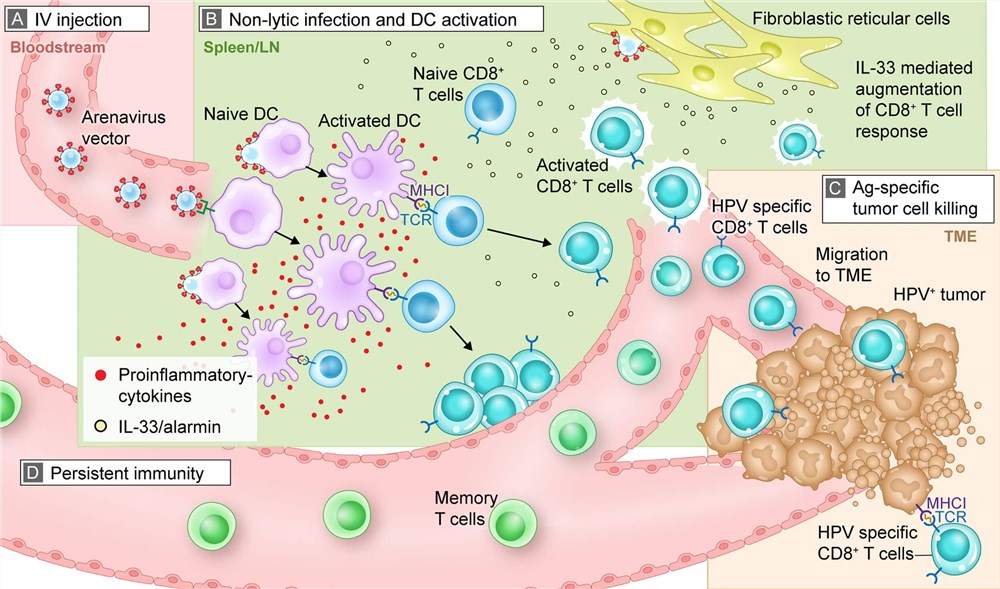
Fig.1 Proposed in vivo mechanisms by which arenavirus vectors induce antigen-specific antitumor immune responses.2,5