
Chimeric DNA Vaccine Design to Break Immune Tolerance to Tumor Self-Antigens
Creative Biolabs provides a specialized preclinical Chimeric DNA Vaccine Design Service that addresses one of the most persistent challenges in cancer vaccinology: the immune system's intrinsic tolerance to self-derived tumor antigens. By engineering hybrid plasmids that encode chimeric proteins—incorporating both xenogeneic (non-self) and homologous (self) tumor antigen domains—our platform triggers a coordinated cross-reactive immune response that neither purely autologous nor purely xenogeneic vaccines can achieve alone. The strategy leverages subtle sequence and conformational differences between the two domains to expose subdominant epitopes, recruit both CD4+ and CD8+ T cells through dual MHC-I/MHC-II presentation, and drive B cell differentiation into plasma cells that produce antibodies targeting the homologous self-antigen. Our end-to-end design pipeline covers antigen selection, sequence alignment, Treg epitope replacement, structural validation, and preclinical immunogenicity testing, providing researchers with a ready-to-evaluate chimeric DNA vaccine construct optimized for overcoming immunological barriers in their specific tumor indication.
Why Chimeric DNA Vaccines Outperform Single-Origin Strategies
Breaking Tolerance Through Dual-Origin Design
Tumor-associated antigens (TAAs) are self-proteins overexpressed or aberrantly expressed in cancer cells. Because the immune system actively maintains central and peripheral tolerance to these self-structures, vaccines encoding only the autologous sequence often elicit weak, low-affinity responses. Conversely, purely xenogeneic vaccines—encoding a homolog from another species—provide the non-self signal needed to activate T cells but frequently fail to generate antibodies that cross-react with sufficient affinity against the human self-antigen. A chimeric DNA vaccine bridges this gap: the xenogeneic domain provides heteroclitic peptides that bypass T cell tolerance and drive robust CD4+ and CD8+ priming, while the homologous domain anchors the humoral response against the authentic tumor target.1
Chimeric proteins encoded by hybrid plasmids are taken up by dendritic cells and B cells after transfection. Peptides from both xenogeneic and homologous domains are processed and presented on MHC-I and MHC-II, enabling cross-reactive T cells originally primed against xenogeneic epitopes to recognize homologous peptide-MHC complexes on tumor cells. Meanwhile, CD4+ T cell help drives B cell differentiation into plasma cells producing antibodies specific to the homologous self-domain—achieving coordinated humoral and cellular immunity against what was previously a tolerated target.
- Core Preclinical Challenges We Address:
- Selecting a xenogeneic species whose antigen homolog provides the optimal balance of sequence divergence (85–95% homology) and cross-reactive potential.
- Defining the optimal positional arrangement of xenogeneic and homologous domains within the chimeric open reading frame.
- Identifying and replacing self-epitope regions that activate regulatory T cell (Treg) populations, which would otherwise suppress vaccine-induced antitumor immunity.
- Validating that the expressed chimeric protein adopts a tertiary conformation capable of exposing subdominant and neo-conformational B cell epitopes in vitro and in vivo.
Chimeric DNA Vaccines vs. Conventional DNA Vaccine Approaches
| Key Comparison | Conventional DNA Vaccines (Autologous or Xenogeneic Only) | Chimeric DNA Vaccines (Xenogeneic + Homologous) |
|---|---|---|
| Immune Tolerance Breaking | Autologous: poor; Xenogeneic: moderate but antibody affinity limited. | Dual-origin design breaks tolerance via xenogeneic T cell priming while anchoring high-affinity antibody response to the homologous self-antigen. |
| T Cell Activation Breadth | Xenogeneic-only may activate CD8+ but offers limited CD4+ cross-reactivity toward self. | Cross-reactive CD4+ and CD8+ T cells simultaneously primed; homologous domain sustains recognition at the tumor site. |
| Antibody Specificity | Xenogeneic vaccines induce antibodies that poorly recognize the self-antigen. | CD4+ T cell help to B cells recognizing the homologous domain yields antibodies that specifically bind the self-tumor antigen. |
| Epitope Repertoire | Limited to natural dominant epitopes; subdominant and conformational epitopes remain hidden. | Sequence and conformational differences expose subdominant and neo-conformational epitopes, expanding the immune repertoire. |
End-to-End Chimeric DNA Vaccine Design Service Modules
Our preclinical service is organized into six modular phases. Every module is fully customizable—you may engage the complete pipeline or select individual modules to complement your existing programs—ensuring alignment with your specific tumor antigen, preclinical model, and immunological readout requirements.
Target Antigen Profiling & Species Selection
Comprehensive bioinformatic analysis to select the optimal antigen and xenogeneic partner for chimeric design.
- Antigen Eligibility Assessment: Evaluation of tumor antigen expression profile, immunogenicity score, and suitability for tolerance-breaking design.
- Cross-Species Homology Mapping: Multi-species sequence alignment to identify xenogeneic homologs with 85–95% identity to the human target.
- Preclinical Model Alignment: Selection of xenogeneic species compatible with the planned syngeneic or transgenic mouse model.
- Epitope Landscape Profiling: Prediction of MHC-I and MHC-II binding epitopes in both the autologous and xenogeneic sequences.
Chimeric Open Reading Frame Engineering
De novo design of the chimeric protein coding sequence with strategic domain positioning and Treg epitope replacement.
- Domain Arrangement Optimization: Systematic evaluation of N-terminal vs. C-terminal xenogeneic domain placement for optimal immunogenicity.
- Treg Epitope Identification: Screening of the homologous sequence for known CD4+ Treg-activating epitopes using computational and literature-based mining.
- Epitope Replacement Design: Substitution of Treg-activating self-regions with corresponding xenogeneic segments while preserving structural integrity.
- Codon Optimization: Species-specific codon adaptation for high-level expression in mammalian transfectants.
Plasmid Construction & Verification
Gene synthesis, vector engineering, and rigorous sequence verification of the chimeric DNA vaccine construct.
- Gene Synthesis & Cloning: Synthesis of the chimeric ORF and subcloning into a optimized eukaryotic expression vector with a strong constitutive promoter.
- Sequence Integrity Verification: Full-plasmid Sanger sequencing or next-generation sequencing confirmation of the chimeric insert.
- Restriction Fingerprinting: Multi-enzyme digestion profiling to confirm plasmid identity and structural integrity.
- Endotoxin-Free Plasmid Preparation: Production of research-grade plasmid batches suitable for preclinical in vivo administration.
In Vitro Expression & Conformational Validation
Confirmation that the chimeric protein is correctly expressed, folded, and capable of engaging the immune machinery.
- Transient Transfection Analysis: Western blot and immunofluorescence confirmation of chimeric protein expression in mammalian cell lines.
- Conformational Integrity Assessment: Circular dichroism spectroscopy or limited proteolysis to verify that the chimeric protein adopts a near-native tertiary fold resembling the homologous antigen.
- MHC Presentation Confirmation: In vitro antigen presentation assays with HLA-matched dendritic cells to quantify chimeric protein processing and epitope display on MHC-I and MHC-II.
- Subcellular Localization: Determination of whether the chimeric protein is secreted, membrane-bound, or cytoplasmic—informing the dominant CD4+ vs. CD8+ response bias.
Preclinical Immunogenicity Profiling
Comprehensive evaluation of the chimeric vaccine's ability to break tolerance and induce cross-reactive T cell and antibody responses.
- T Cell Response Profiling: IFN-γ ELISpot, intracellular cytokine staining, and tetramer analysis to quantify antigen-specific CD4+ and CD8+ responses against both xenogeneic and homologous peptides.
- Antibody Cross-Reactivity Analysis: ELISA and surface plasmon resonance to measure antibody binding affinity to the homologous self-antigen vs. the xenogeneic immunogen.
- Epitope Spreading Detection: Peptide microarray or overlapping peptide library screening to document whether subdominant and neo-conformational epitopes are targeted.
- Treg Population Monitoring: Flow cytometry quantification of FoxP3+ CD4+ Tregs in draining lymph nodes to confirm that Treg epitope replacement has dampened vaccine-induced suppression.
In Vivo Antitumor Efficacy & Data Package
Definitive preclinical proof-of-concept studies and a complete documentation package for publication or grant submission.
- Tumor Challenge Studies: Prophylactic and therapeutic vaccination regimens in syngeneic or transgenic mouse models bearing the target tumor antigen.
- Tumor-Infiltrating Lymphocyte Analysis: Immunohistochemistry and flow cytometry to profile T cell, B cell, and myeloid populations within the tumor microenvironment.
- Prime-Boost Optimization: Dose-ranging and schedule optimization to identify the regimen yielding maximal antitumor protection.
- Comprehensive Data Package: Compiled report including all plasmid maps, sequencing chromatograms, immunological raw data, statistical analyses, and publication-ready figure panels.
Systematic Chimeric DNA Vaccine Design Workflow
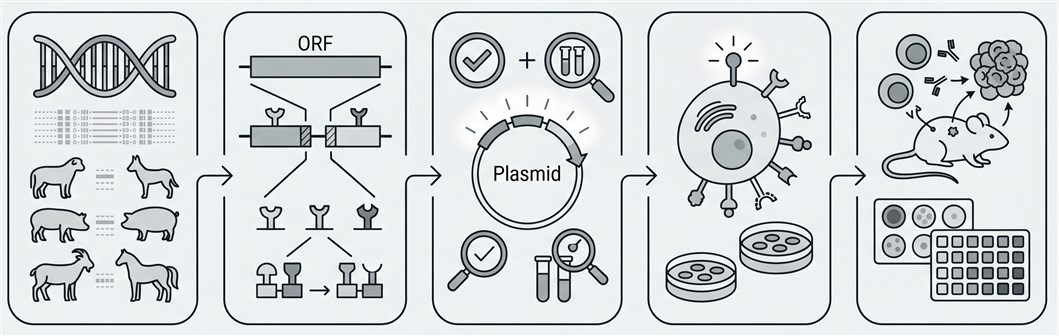
Phase 1 — Target Antigen Profiling & Xenogeneic Species Selection
We perform multi-species sequence alignment of the target tumor antigen to identify xenogeneic homologs within the 85–95% identity window. Computational epitope prediction maps both MHC-I and MHC-II binding profiles across all candidate species. The final species selection accounts for the planned preclinical model (syngeneic, transgenic, or humanized) to ensure downstream in vivo compatibility.
Enabling Technology Platforms for Chimeric DNA Vaccine Design
Why Partner With Creative Biolabs for Chimeric DNA Vaccine Design?
Unlike generic DNA vaccine services, our platform maps every design decision—domain placement, species selection, Treg epitope replacement—to computational predictions and published immunological data, ensuring hypothesis-driven rather than trial-and-error construct engineering.
The choice of xenogeneic species is directly aligned with your planned syngeneic, transgenic, or humanized mouse model, guaranteeing that the vaccine construct can be evaluated in vivo without additional species-mismatch variables.
Every chimeric construct undergoes structural validation to confirm that the intended subdominant and neo-conformational epitopes are solvent-exposed, reducing the risk of negative in vivo results attributable to misfolded immunogen.
You receive full plasmid maps, sequencing data, immunological raw data, statistical analyses, and publication-quality figure panels—whether you engage one module or the complete pipeline.
Research Insight: Chimeric DNA Vaccines Breaching Immune Tolerance
Key Findings from Preclinical Chimeric Vaccine Studies
The chimeric DNA vaccine strategy has been extensively validated in preclinical models, demonstrating its unique capacity to simultaneously engage humoral and cellular immunity against self-tumor antigens that conventional DNA vaccines fail to target.
-
Dual-Origin Synergy: Chimeric vaccines encoding human/rat HER2 fusion proteins induced both T cell and antibody responses against the self-HER2 antigen in tolerant mouse models, whereas vaccines encoding only xenogeneic (rat) or only autologous (human) HER2 failed to achieve comparable breadth. The chimeric construct's ability to present heteroclitic peptides via dendritic cells was identified as the mechanistic basis for this synergy.
-
Subdominant Epitope Exposure: Subtle conformational differences between chimeric and native proteins exposed epitopes not targeted by single-origin vaccination, expanding the B cell repertoire and yielding antibodies with higher apparent affinity for the self-antigen. This epitope spreading was correlated with superior tumor growth inhibition in prophylactic vaccination models.
-
Combination with Checkpoint Inhibition: DNA vaccines encoding model antigens combined with plasmid-encoded PD-1 blockade demonstrated significantly enhanced antitumor efficacy compared to either modality alone, suggesting that chimeric DNA vaccines could serve as an ideal partner for immune checkpoint-targeted combination strategies.
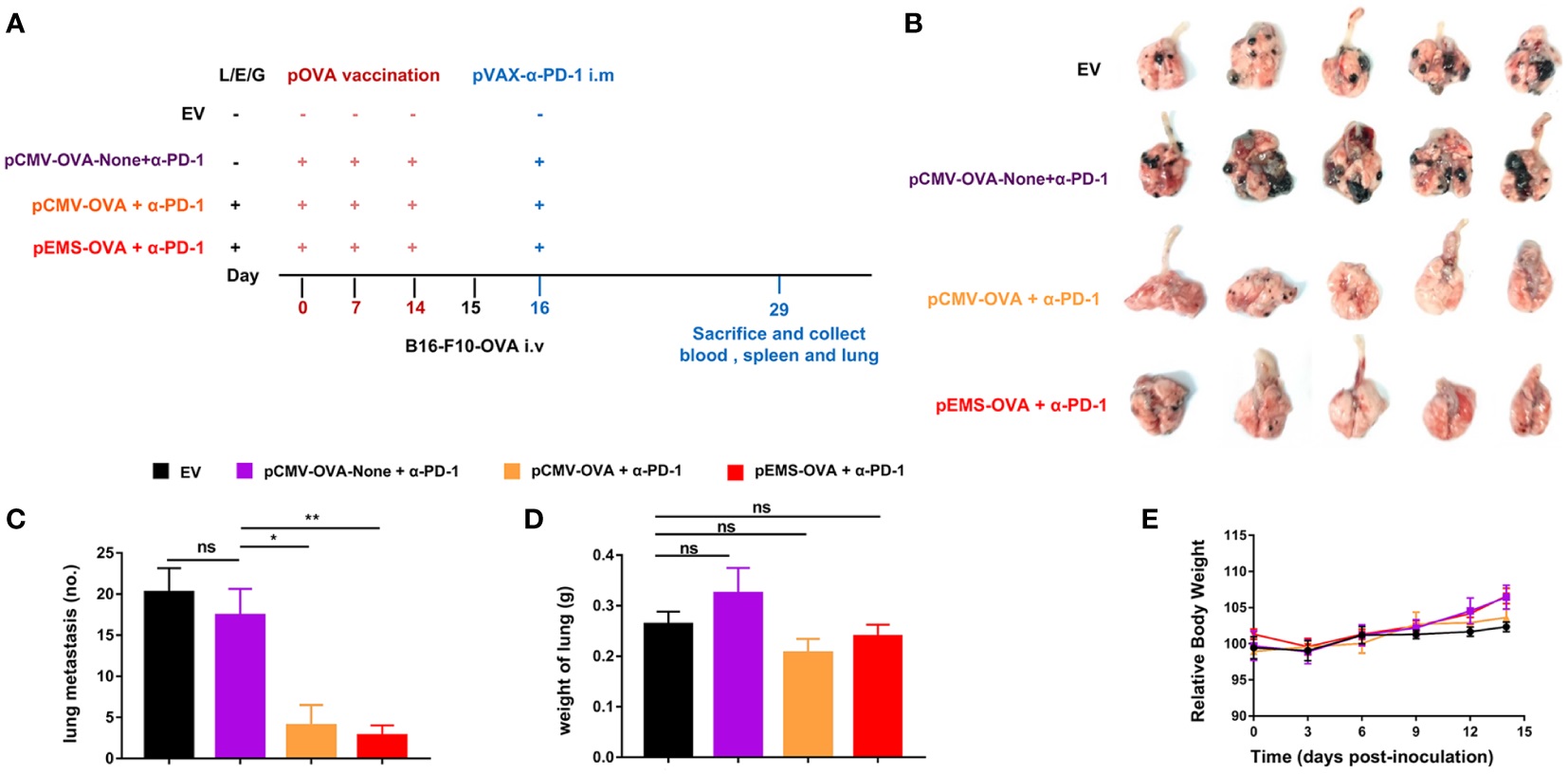
Fig.1 Combined DNA vaccine and intramuscular PD-1 gene therapy inhibits B16F10-OVA lung metastasis.2,4