HSV-1-Based Cancer Vaccine Design: Preclinical Non-Replicative Vector Engineering
Creative Biolabs provides an integrated, end-to-end preclinical platform for the design and development of HSV-1-Based Cancer Vaccines. The herpes simplex virus type 1 (HSV-1) genome, a large double-stranded DNA of approximately 152 kb, offers the largest payload capacity among viral vectors and a unique set of advantages: an episomal and non-integrating lifecycle, broad cell tropism including non-dividing cells, and well-characterized molecular biology. Our platform centers on non-replicative (replication-defective) HSV-1 vectors—engineered through deletion of essential immediate-early genes such as ICP4 and ICP27—that retain the ability to infect target cells and drive robust transgene expression without producing infectious progeny. This safety profile, combined with the vector's capacity to accommodate multiple full-length antigen cassettes and co-stimulatory molecules simultaneously, positions HSV-1 as a uniquely versatile chassis for cancer vaccine development. Our dedicated team supports the full pipeline from backbone selection and BAC-based recombineering through antigen expression validation, immunogenicity profiling, and rigorous in vivo efficacy evaluation.
Non-Replicative HSV-1 Vectors for Durable Tumor Antigen-Specific Immunity
The Engineered HSV-1 Vector: Safety Without Sacrificing Immunogenicity
Herpes simplex virus type 1 (HSV-1) belongs to the Alphaherpesvirinae subfamily and possesses a 152 kb linear dsDNA genome encoding over 80 genes. For vaccine applications, our team employs non-replicative (replication-defective) HSV-1 vectors in which one or more essential immediate-early (IE) genes—most commonly ICP4, ICP27, or both—are deleted. These vectors are propagated in complementing cell lines that provide the missing gene product in trans, yet they cannot produce infectious particles in normal host cells. Critically, despite their inability to replicate, these vectors still enter target cells with high efficiency and drive abundant transcription of the retained viral genes and any inserted transgene. The result is a single-cycle infection that delivers a concentrated pulse of tumor antigen expression together with the inherent immunostimulatory signals of the HSV-1 particle—glycoprotein-mediated entry, tegument protein adjuvant activity, and cytoplasmic DNA sensing—creating an exceptionally potent vaccine platform without the risk of productive viral spread.
HSV-1 vectors combine the largest transgene capacity (~152 kb) of any viral delivery system with a natural tropism for peripheral neurons and epithelial cells. The vector's DNA genome remains episomal and does not integrate into the host chromosome, eliminating insertional mutagenesis risk. Furthermore, the ability to delete multiple IE genes enables tunable attenuation, and the incorporation of tissue-specific or tumor-specific promoters adds an additional layer of expression control.
- Core Preclinical Challenges We Address:
- Designing safe, replication-incompetent HSV-1 vectors without loss of transgene expression.
- Accommodating multi-antigen & co-stimulatory cassettes within the 152 kb genome.
- Minimizing pre-existing anti-HSV-1 immunity that could dampen vaccine take.
- Validating CNS safety for vectors derived from a neurotropic parental virus.
HSV-1 Vectors vs. Adenoviral & DNA Vaccine Platforms
| Key Comparison | Adenoviral / DNA Vaccine Platforms | HSV-1 Non-Replicative Vectors |
|---|---|---|
| Transgene Capacity | Adenovirus: ~8–36 kb; DNA plasmid: variable. | Largest among viral vectors (~152 kb); multi-antigen + co-stimulatory cassettes. |
| Genomic Integration Risk | Adenovirus: none (episomal); DNA: low frequency integration. | Strictly episomal; no chromosomal integration. |
| Innate Immune Activation | Adenovirus: strong but transient; DNA: minimal unless adjuvanted. | Tegument proteins & cytoplasmic DNA sensing provide built-in adjuvant effect. |
| Non-Dividing Cell Transduction | Adenovirus: limited; DNA plasmid: very inefficient. | Efficient transduction of quiescent cells including neurons & dendritic cells. |
End-to-End HSV-1 Cancer Vaccine Design Service Modules
Our preclinical services are organized into flexible, modular packages. Each module addresses a distinct phase of HSV-1-based vaccine development—from backbone engineering through in vivo efficacy—and all modules can be fully customized to align with your tumor indication, target antigens, and vector configuration preferences.
HSV-1 Vector Backbone & Antigen Design
Selection of optimal HSV-1 strain and deletion configuration, paired with antigen cassette design for maximum immunogenicity.
- Strain Selection: Evaluation of parental strains (KOS, F, 17) for specific tumor indications and tropism requirements.
- Deletion Configuration: Single (ICP4) or double (ICP4/ICP27) gene deletion for the desired attenuation profile.
- Antigen Cassette Design: Multi-antigen expression cassettes with optimized promoters (CMV, HSV-1 IE, or tumor-specific).
- Co-Stimulatory Payload: Integration of cytokine genes (GM-CSF, IL-12) and co-stimulatory molecules (B7-1, CD40L).
Recombinant HSV-1 Construction & Rescue
BAC-based recombineering and complementing cell line rescue for precise, marker-free recombinant virus generation.
- HSV-1 BAC Engineering: Site-specific gene deletion and transgene insertion in the full-length HSV-1 BAC genome.
- Recombineering: Homologous recombination in E. coli for scarless modification of IE gene loci.
- Virus Rescue: Transfection into complementing cell lines (e.g., 7b, U2OS-ICP4/27) for infectious virus recovery.
- Plaque Purification: Single-plaque isolation and expansion to establish clonal recombinant stocks.
Vector Production, Purification & Quality Control
Scalable production of high-titer, high-purity recombinant HSV-1 stocks with comprehensive quality release testing.
- Complementing Cell Propagation: Optimized culture of Vero-derived or U2OS-based complementing lines for large-scale production.
- Concentration & Purification: Tangential flow filtration and sucrose cushion/DG gradient ultracentrifugation.
- Titration: Standard plaque assay (PFU/mL) and quantitative PCR for genomic particle-to-infectivity ratio.
- Quality Testing: Sterility (in vitro culture), RCV screening, endotoxin quantification, and identity testing.
Antigen Expression & In Vitro Validation
Confirmation of transgene expression, protein processing, and antigen presentation in target cell types.
- Expression Kinetics: Time-course analysis of antigen expression via Western blot and immunofluorescence.
- Flow Cytometry: Quantification of transgene expression and surface marker changes in infected cells.
- Antigen Processing: MHC class I and II presentation assays using T cell hybridoma reporter systems.
- DC Transduction: Efficiency of human and murine dendritic cell infection and maturation marker profiling.
Immunogenicity & Immune Profiling
Multi-parameter assessment of vaccine-induced cellular and humoral immune responses to tumor antigens.
- T Cell Assays: ELISpot (IFN-γ, granzyme B), intracellular cytokine staining, and proliferation (CFSE).
- Humoral Response: Antigen-specific IgG titers, isotype profiling, and neutralizing antibody assessment.
- Multi-Parameter Flow: Comprehensive immune cell profiling (CD4, CD8, Treg, NK, myeloid populations).
- TCR Repertoire: High-throughput sequencing of T cell receptor diversity before and after vaccination.
In Vivo Efficacy & Safety Evaluation
Rigorous preclinical assessment of vaccine efficacy against tumor challenge and safety profiling, including CNS evaluation.
- Prophylactic Models: Prime-boost vaccination followed by tumor cell challenge (syngeneic or xenograft).
- Therapeutic Models: Established tumor models evaluating vaccine-mediated regression and survival benefit.
- Biodistribution: qPCR-based vector genome quantification in organs including brain and dorsal root ganglia.
- CNS Safety: Neurovirulence assessment, reactivation studies, and histopathology of neural tissues.
Optimized HSV-1 Cancer Vaccine Development Workflow
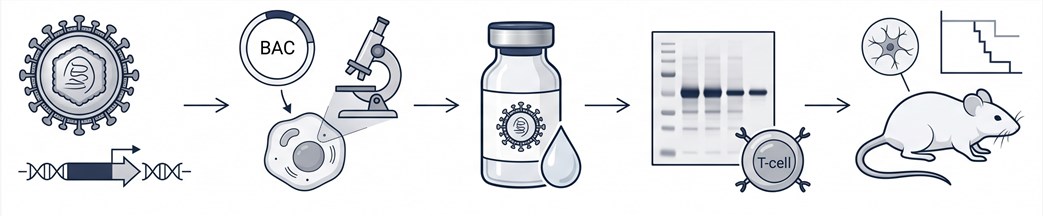
Phase 1 — HSV-1 Backbone Selection & Antigen Cassette Engineering
We begin with consultative selection of the HSV-1 parental strain (KOS, F, or 17) and the deletion configuration (ICP4 single mutant or ICP4/ICP27 double mutant). Tumor antigen sequences and optional co-stimulatory molecules (GM-CSF, B7-1, IL-12) are designed into multi-cassette expression units with optimized promoters for the chosen target cell population.
Enabling Technologies for HSV-1 Cancer Vaccine Engineering
Why Choose Creative Biolabs for HSV-1 Vaccine Development?
Our team possesses extensive hands-on experience with HSV-1 molecular biology, including BAC engineering, IE gene deletion strategies, complementing cell line development, and latency biology—expertise that directly translates into efficient vector design and troubleshooting.
The ~152 kb HSV-1 genome offers unmatched capacity for accommodating multiple full-length tumor antigen genes alongside co-stimulatory molecules and immunomodulatory cytokines, enabling true polyvalent vaccine constructs in a single vector.
We go beyond standard vector safety by providing dedicated neurovirulence assessment, latency and reactivation studies, and comprehensive biodistribution profiling—addressing the unique regulatory considerations of HSV-1-derived vectors.
Whether you need full end-to-end development or a single module—such as BAC engineering, production scale-up, or immunogenicity profiling—our services are fully customizable to match your project phase and resource requirements.
Research Insight: HSV-1 Vector Engineering for Personalized Cancer Vaccines
Preclinical Advances in HSV-1-Based Vaccine Platforms
The application of HSV-1 as a vector for cancer vaccines has advanced considerably, buoyed by improvements in BAC recombineering, IE gene deletion strategies, and the development of complementing cell lines that enable high-titer production of safe, non-replicative vectors. Below we highlight five recent studies that inform our approach to HSV-1-based cancer vaccine design.
-
Recombinant HSV-1 for Personalized Cancer Vaccines: Uche et al. demonstrated the utility of a recombinant HSV-1 vaccine vector backbone for personalized cancer vaccine applications, highlighting the vector's capacity to accommodate patient-specific tumor antigen cassettes and induce robust antigen-specific immune responses in preclinical models.1
-
HSV Pathogenesis & Vaccine Development Review: Bai et al. (2024) comprehensively reviewed HSV pathogenesis, immune evasion mechanisms, and the status of vaccine development, providing a framework for understanding how genetic modifications to HSV-1 vectors can enhance immunogenicity while preserving safety.2
-
Oncolytic HSV Therapy Advances: Zheng et al. reviewed the latest advances in oncolytic HSV therapy, including genetic armament strategies with immunomodulatory payloads that are equally applicable to non-replicative vaccine vectors designed to express tumor antigens and co-stimulatory signals.3
-
VC2 Vaccine Strain Engineering: Clark et al. reported that deletion of the UL37 deamidase domain from the HSV-1 VC2 oncolytic vaccine strain enhances virus replication and GM-CSF secretion, demonstrating how targeted genetic modification can fine-tune the balance between vector attenuation and immunostimulatory cytokine production.4
-
Non-Replicative HSV-1 Vector Technology: Other researcher provided an updated comprehensive review of non-replicative HSV-1 genomic and amplicon vectors for gene therapy, detailing the molecular design principles—IE gene deletion and complementing cell line propagation—that form the foundation of our vaccine vector engineering platform.
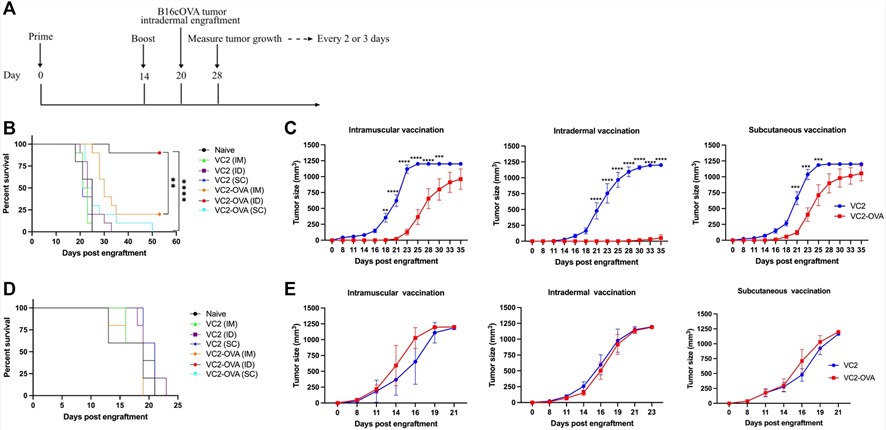
Fig.1 Prophylactic efficacy of HSV-1-OVA in B16cOVA tumor model.1,6