Preclinical Yeast-Based Cancer Vaccine Design & Platform Services
Creative Biolabs is a world leader in preclinical cancer vaccine development, offering a dedicated, end-to-end platform for the rational design of yeast-based vaccines against cancer. Drawing on extensive expertise in recombinant Saccharomyces cerevisiae engineering, our team provides custom-built whole recombinant yeast (WRY) vaccine candidates that express tumor-associated antigens (TAAs), tumor-specific neoantigens, or multi-epitope constructs for robust activation of antigen-specific cytotoxic T lymphocyte (CTL) responses. The natural particulate nature of yeast cells (~2–4 μm) ensures efficient uptake by dendritic cells (DCs) via Dectin-1 and other pattern recognition receptors, while the yeast cell wall—rich in β-glucan, mannan, and chitin—serves as a potent built-in adjuvant, driving DC maturation and cross-presentation without requiring supplemental immune stimulants. Our comprehensive platform spans every stage of preclinical development, from antigen selection and yeast chassis engineering through heat-inactivation optimization, quality control, and in vivo proof-of-concept validation in syngeneic or humanized tumor models, giving your team a reliable, cost-effective, and cold chain-independent path from concept to validated vaccine candidate.
Why Whole Recombinant Yeast? A Self-Adjuvanted Particulate Vector for Tumor Antigen Delivery
Particulate Phagocytosis & Natural DC Tropism
At approximately 2–4 μm in diameter, heat-killed S. cerevisiae particles are optimally sized for phagocytic uptake by professional antigen-presenting cells (APCs), particularly DCs and macrophages. This passive, receptor-mediated internalization—primarily through Dectin-1 recognition of β-1,3-glucan in the yeast cell wall—ensures efficient delivery of recombinant antigen cargo into the phagosome, where it is processed and loaded onto both MHC class I and class II molecules for coordinated CD8+ and CD4+ T cell priming.
The yeast cell wall itself provides a multi-layered pathogen-associated molecular pattern (PAMP) signal—β-glucan (Dectin-1), mannoprotein (mannose receptor, DC-SIGN), and chitin—that simultaneously triggers MyD88-dependent and Syk-dependent pathways, driving DC maturation (upregulation of CD80, CD86, and MHC-II) without the need for extraneous TLR agonists or cytokine supplements.
- Core Preclinical Challenges We Address:
- Optimizing heterologous antigen copy number through genome integration versus episomal plasmid strategies.
- Selecting constitutive, inducible, or rheostatic promoters for balanced antigen expression without toxicity.
- Standardizing heat-inactivation parameters (time/temperature) to preserve antigen integrity while ensuring biosafety.
- Quantifying vaccine-elicited CTL activity and tumor protection in vivo across syngeneic tumor models.
How Yeast Compares to Other Vaccine Vectors
| Key Comparison | Viral & Bacterial Vectors | Yeast-Based Vaccines (WRY) |
|---|---|---|
| Pre-Existing Immunity | Anti-vector neutralizing antibodies common (Ad, poxvirus, Listeria). | Minimal anti-yeast immunity; enables repeat dosing. |
| Built-In Adjuvant | Often requires co-formulated adjuvants (alum, TLR agonists). | Cell wall β-glucan/mannan provides intrinsic PAMP signaling. |
| Cold Chain Requirement | Often requires −80°C or −20°C storage (viral vectors, mRNA). | Heat-killed, lyophilized; stable at room temperature >1 year. |
| Genomic Integration Risk | Lentiviral and some DNA vectors carry host genome integration risk. | Non-replicating, heat-killed; zero risk of genomic integration. |
| Manufacturing Cost | Complex cell culture, purification, and quality testing requirements. | Simple rich-media fermentation; high-density culture; low cost. |
Yeast-Based Vaccine Development Service Modules
Our preclinical service platform is organized into six modular packages covering the full development pipeline. Each module can be engaged independently or combined into an integrated end-to-end workflow, and we work closely with your team to customize every parameter—from strain selection and antigen cassette design to inactivation protocols and in vivo model selection.
Antigen Selection & Cassette Architecture
Strategic design of the heterologous antigen expression cassette tailored to your tumor indication.
- TAA Profiling: Identification of tumor-associated or tumor-specific antigens for your target indication.
- Multi-Epitope Design: Engineering polyepitope cassettes encoding multiple MHC-I and MHC-II restricted epitopes.
- Codon Optimization: Sequence adaptation for optimal translation efficiency in the S. cerevisiae host.
- Fusion Partner Strategy: Evaluating secretion signals or solubility tags to enhance antigen stability.
Yeast Chassis Construction & Plasmid Engineering
Building the recombinant yeast strain with controlled antigen copy number and promoter regulation.
- Genomic Integration: Stable, single- or multi-copy chromosomal integration using homologous recombination; ensures mitotic stability in rich, nonselective media.
- Episomal Plasmid Systems: Engineered 2μ-based or ARS/CEN plasmids with tunable copy number (low to high) via replication origin selection.
- Promoter Engineering: Selection from constitutive (GPD, TEF1), inducible (GAL1, CUP1), or rheostatic promoters for titratable antigen expression.
- Selection Marker Strategy: Auxotrophic complementation (URA3, LEU2, HIS3) or antibiotic-resistance markers for strain maintenance.
Fermentation, Inactivation & Lyophilization
Scalable culture, controlled heat-inactivation, and stabilization of the final whole-cell vaccine product.
- High-Density Fermentation: Fed-batch or continuous culture in defined rich media; reaching >1010 cells per mL, an order of magnitude above selective minimal media.
- Heat-Inactivation Optimization: Systematic screening of time–temperature profiles (56–95°C) to balance complete killing with antigen integrity preservation.
- Lyophilization: Freeze-drying protocols for long-term room-temperature storage, eliminating cold-chain dependence.
- Dose Standardization: Quantification by dry cell weight, optical density (OD600), or yeast unit (YU) counting.
Quality Control & Antigen Characterization
Rigorous analytical characterization of the vaccine product to confirm identity, purity, and potency.
- Antigen Expression Confirmation: Western blot and flow cytometry to verify recombinant protein expression in the yeast cytosol or on the surface.
- Copy Number Quantification: qPCR or digital PCR to determine precise transgene copy number per yeast cell.
- Viability Assurance: Plating assays post heat-inactivation to confirm complete loss of colony-forming capacity.
- Stability Testing: Accelerated and real-time stability studies at multiple storage temperatures, including lyophilized formulations.
In Vitro Immunogenicity & DC Activation Assessment
Evaluating the ability of the WRY vaccine to activate APCs and prime antigen-specific T cells in vitro.
- DC Uptake & Maturation: Flow cytometry quantifying phagocytosis efficiency and maturation markers (CD80, CD86, MHC-II, CD83) on bone marrow-derived DCs.
- DC-T Cell Co-Culture: Autologous T cell priming assays measuring proliferation and activation following DC-mediated antigen presentation.
- ELISpot & ICS: IFN-γ ELISpot and intracellular cytokine staining to enumerate antigen-specific CTL frequencies.
- Cytotoxicity Assays: Chromium-release or real-time impedance-based killing of antigen-positive versus antigen-negative tumor targets.
In Vivo Efficacy & Tumor Challenge Models
Preclinical proof-of-concept studies demonstrating vaccine-mediated tumor protection and immune memory.
- Prophylactic Vaccination: Prime-boost immunization schedule followed by tumor challenge (B16-F10, CT26, TC-1) with tumor growth monitoring.
- Therapeutic Setting: Vaccine administration to established-tumor-bearing mice; assessment of tumor regression and survival benefit.
- Immune Memory: Tumor re-challenge studies confirming durable, antigen-specific memory T cell responses.
- TME Profiling: Multiplex immunohistochemistry and flow cytometry of tumor-infiltrating lymphocytes (CD8+, CD4+, Treg, MDSC, TAM).
Preclinical Yeast Vaccine Development Workflow
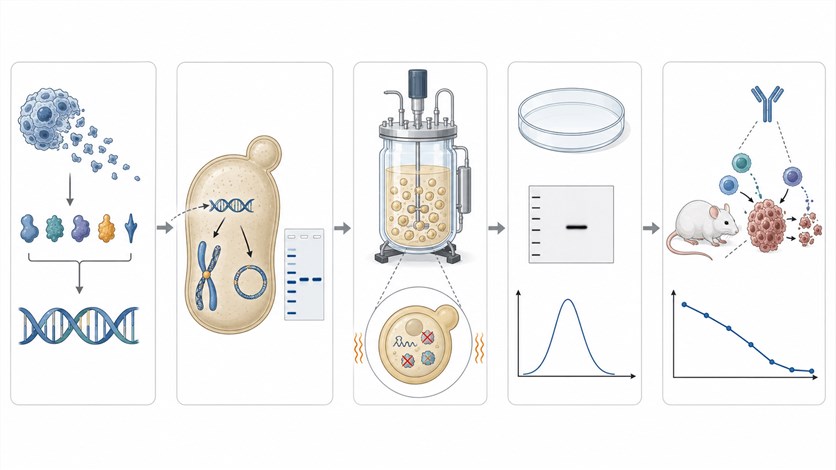
Phase 1 — Antigen Selection & Expression Cassette Architecture
We begin with a thorough analysis of your tumor indication to identify suitable TAAs or neoantigens. Multi-epitope cassettes are designed with codon optimization for S. cerevisiae, and promoter selection (constitutive vs. inducible vs. rheostatic) is matched to the antigen's toxicity profile. For multi-antigen vaccines, we evaluate single-plasmid versus co-transformation strategies.
Enabling Technologies for Yeast-Based Vaccine Development
Why Choose Creative Biolabs?
Our team brings extensive experience in S. cerevisiae molecular biology, including homologous recombination, plasmid engineering, and promoter library design—critical foundations for building reliable vaccine chassis.
We offer genomic integration, episomal plasmid, and surface-display strategies, plus promoter options spanning constitutive, inducible, and rheostatic control, enabling the optimal match for each antigen's properties.
From antigen expression verification through DC activation profiling to syngeneic tumor efficacy studies, every vaccine candidate is rigorously characterized for defined immune correlates.
The heat-killed, lyophilized format eliminates cold-chain logistics and enables repeat dosing without anti-vector neutralizing responses—ideal for iterative preclinical optimization.
Research Insight: Yeast-Based Immunotherapy for Cancer
Key Findings from Preclinical & Review Studies
Whole recombinant yeast vaccines represent a unique intersection of microbial immunology and cancer vaccine engineering, combining intrinsic pathogen-associated molecular pattern (PAMP) signaling with programmable antigen delivery.
-
Dectin-1/Syk-Driven DC Maturation: Yeast cell-wall β-glucan nanoparticles activate DCs through the Dectin-1/Syk and TLR2/MyD88 pathways, with smaller particles (~50 nm) preferentially accumulating in tumor-draining lymph nodes and achieving 100% tumor clearance when combined with anti-PD-L1 in B16-F10 melanoma models.1
-
β-Glucan Immunomodulation in Melanoma: Yeast-derived β-glucan extract treatment of B16-F10-bearing mice significantly increased survival, elevated splenic DC, NK, and NKT cell frequencies, enhanced CD4+ and CD8+ T cell IFN-γ/TNF-α production, and preserved splenic white-pulp architecture with germinal center formation.3
-
Standardization Roadmap for WRY Vaccine Development: A comprehensive review identifies key parameters requiring standardization—yeast species selection, inactivation method (56–95°C heat treatment), antigen quantification, dose unit definition (YU, dry weight, or OD600), and lyophilization protocols—that collectively determine the translational readiness of whole yeast vaccine candidates.2
-
Broad Platform Versatility: Whole recombinant yeast and yeast surface display platforms have been successfully applied to cancer antigens, viral epitopes, and bacterial targets, demonstrating that the same core S. cerevisiae chassis can be redirected to diverse immunological challenges by simply swapping the recombinant antigen cassette.4
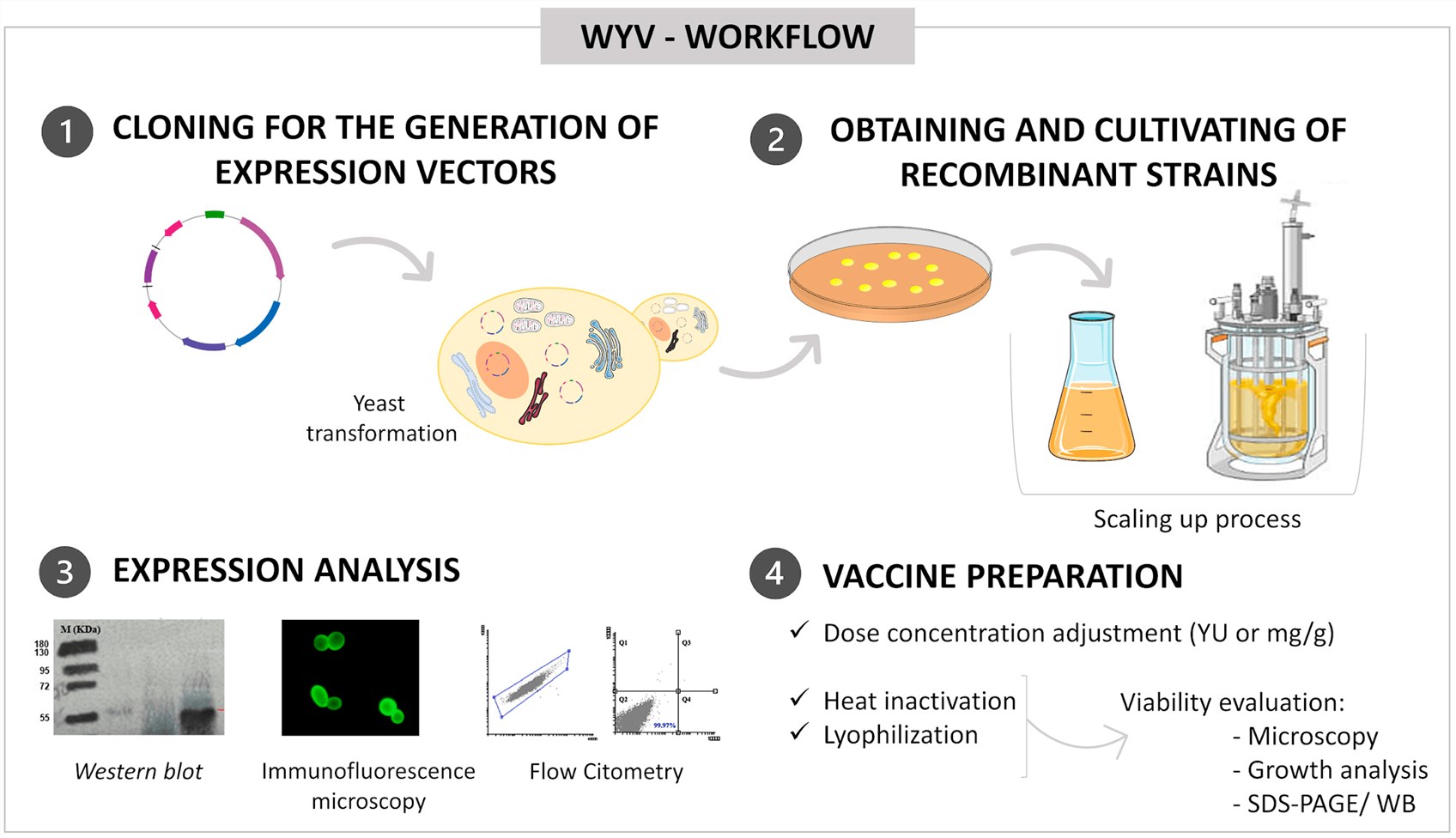
Fig.1 Pre-immunological assay workflow for whole yeast vaccine preparation.2,5