
Alphavirus-Based Cancer Vaccine Design: Preclinical saRNA Platform Services
Creative Biolabs delivers a comprehensive preclinical platform for the rational engineering of Alphavirus-Based Cancer Vaccines. Alphavirus vectors, derived from single-stranded RNA viruses of the Togaviridae family, represent a uniquely powerful vaccine modality: their self-amplifying RNA replicon enables massive, sustained cytoplasmic expression of encoded tumor antigens without any risk of genomic integration. Our platform spans the three major alphavirus backbones—Sindbis virus (SIN), Semliki Forest virus (SFV), and Venezuelan equine encephalitis virus (VEE)—each offered in three delivery formats: naked self-amplifying RNA, replication-deficient viral replicon particles (VRPs), and layered DNA plasmids for plasmid immunization. Whether your goal is prophylactic tumor protection or therapeutic immune tolerance breaking, our team provides end-to-end services from epitope selection and replicon engineering through in vitro validation and in vivo preclinical proof-of-concept in syngeneic tumor models.
Harnessing Self-Amplifying RNA: The Alphavirus Advantage
Cytoplasmic Self-Amplification Without Integration Risk
Alphavirus vectors deliver a single-stranded positive-sense RNA genome encoding the viral non-structural replicase complex (nsP1–4) in cis with a transgene of interest. Once inside the host cell cytoplasm, the replicase complex drives exponential amplification of the subgenomic RNA, producing extraordinarily high levels of tumor antigen—often 100- to 1000-fold above conventional mRNA expression levels. Critically, the entire replication cycle remains confined to the cytoplasm; there is no DNA intermediate and therefore zero risk of host genome integration. This inherent safety profile, combined with the built-in adjuvant effect of double-stranded RNA replication intermediates that activate innate immune sensors, makes alphavirus replicons a fundamentally distinct and advantageous vaccine platform.
Our platform supports naked self-amplifying RNA (transcribed in vitro from plasmid DNA), replication-deficient VRP particles (produced in BHK-21 packaging cells), and layered DNA vectors (plasmid DNA driven by a CMV promoter → transcribed into replicon RNA in situ). This format flexibility enables researchers to compare delivery routes and immunization strategies within a single project.
- Core Preclinical Challenges We Address:
- Selecting the optimal alphavirus serotype (SIN, SFV, VEE) for target tissue tropism and expression kinetics.
- Engineering replicon constructs that balance antigen expression with replicase fidelity for sustained immunogenicity.
- Choosing between naked RNA, VRPs, and DNA-launched replicons for maximal in vivo delivery efficiency.
- Overcoming anti-vector immunity in heterologous prime-boost regimens for durable antitumor protection.
Why Alphavirus Replicons Outperform Conventional mRNA?
| Key Comparison | Conventional mRNA Vaccines | Alphavirus Replicon Vaccines |
|---|---|---|
| Antigen Expression Level | Moderate; determined solely by input RNA dose and cap-dependent translation. | 100–1000× amplification via self-replicating RNA. |
| Duration of Expression | Short (hours); rapid RNA degradation in cytoplasm. | Prolonged (days); sustained by replicase-driven amplification. |
| Innate Immune Activation | Minimal unless synthetic adjuvants are co-formulated. | Self-adjuvanting: dsRNA intermediates activate TLR3/RIG-I/MDA5. |
| Genomic Integration Risk | None (RNA-based); safe cytoplasmic compartment. | Identical safety: RNA-only, no DNA intermediate, no integration. |
End-to-End Alphavirus Vaccine Design Service Packages
Our preclinical services are structured into modular packages that can be freely combined. Every module is fully customizable—from the alphavirus backbone and delivery format to the specific tumor antigen(s) encoded—ensuring alignment with your target indication and immunization strategy.
Target Antigen & Vector Selection
Rational selection of tumor antigens and compatible alphavirus backbones for maximal immunogenicity.
- Antigen Profiling: Evaluation of tumor-associated antigens (TAAs), neoantigens, or oncofetal antigens for alphavirus expression.
- Serotype Matching: Comparative analysis of SIN, SFV, and VEE backbones for your target tissue and species.
- Format Recommendation: Data-driven decision on naked RNA, VRP, or layered DNA format.
- Heterologous Strategy: Prime-boost regimen design using distinct alphavirus serotypes to circumvent anti-vector immunity.
Replicon Construct Engineering
Molecular cloning and optimization of the self-amplifying RNA cassette encoding your antigen of interest.
- Gene Synthesis: Codon-optimized synthesis of tumor antigen sequences for alphavirus expression context.
- Replicon Assembly: Cloning into SIN, SFV, or VEE replicon backbones with subgenomic promoter control.
- Replicase Optimization: Verification of nsP1–4 polyprotein integrity and subgenomic RNA production fidelity.
- Helper System Design: For VRP format: split-helper construct design ensuring single-cycle infectivity without recombination.
RNA Production & VRP Packaging
Scalable production of high-quality naked self-amplifying RNA or replication-deficient viral particles.
- In Vitro Transcription: T7/SP6-driven production of capped self-amplifying RNA from linearized replicon plasmids.
- VRP Packaging: Co-transfection of replicon and helper RNAs into BHK-21 cells; harvest and concentration of single-cycle VRPs.
- Layered DNA Vector: Construction of CMV-promoter-driven DNA-launched replicon plasmids for direct immunization.
- Quality Control: Agarose gel electrophoresis, RNA integrity analysis, VRP titer determination by infectious unit assay.
In Vitro Antigen Expression & Immune Activation
Functional validation of antigen expression levels and innate immune sensor activation in target cells.
- Expression Kinetics: Time-course analysis of tumor antigen expression by western blot and immunofluorescence.
- Replicon Activity: Quantitative RT-PCR measurement of subgenomic RNA copy numbers over 24–96 hours.
- Innate Activation: IFN-β reporter assays and ISG profiling to quantify self-adjuvanting dsRNA intermediate activity.
- DC Transduction: Evaluation of VRP-mediated antigen delivery to bone marrow-derived dendritic cells (BMDCs).
Preclinical Immunogenicity Assessment
Comprehensive profiling of vaccine-induced humoral and cellular immune responses.
- Antibody Response: ELISA-based quantification of antigen-specific IgG titers and isotype subtyping (IgG1/IgG2a).
- T Cell Profiling: ELISpot (IFN-γ) and intracellular cytokine staining (ICS) for CD8+ and CD4+ T cells.
- Cross-Presentation: Assessment of MHC-I and MHC-II pathway utilization via epitope-specific tetramer staining.
- Anti-Vector Immunity: Measurement of neutralizing antibody titers against alphavirus envelope glycoproteins.
In Vivo Tumor Challenge & Therapeutic Efficacy
Preclinical proof-of-concept in syngeneic mouse tumor models with comprehensive endpoint analysis.
- Prophylactic Model: Prime-boost immunization prior to tumor cell inoculation; monitoring tumor-free survival.
- Therapeutic Model: Vaccination after palpable tumor establishment; tumor volume regression tracking.
- Metastasis Model: Experimental or spontaneous metastasis evaluation with whole-organ quantification.
- Combination Therapy: Co-administration with immune checkpoint inhibitors or other immunomodulators for synergy assessment.
Alphavirus Vaccine Engineering Workflow
Phase 1 — Tumor Antigen Selection & Alphavirus Serotype Matching
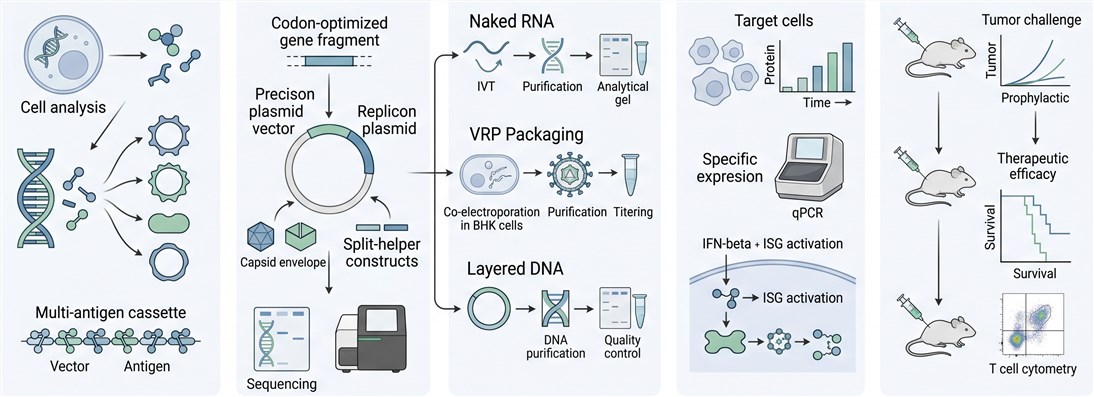
We evaluate your candidate tumor antigen(s) for compatibility with alphavirus expression. Based on antigen size, hydrophobicity profile, and intended immunization species, we recommend the optimal alphavirus backbone (SIN, SFV, or VEE) and delivery format (naked RNA, VRP, or layered DNA). For multi-antigen strategies, we design polycistronic replicon cassettes utilizing subgenomic promoter duplication elements.
Enabling Technologies for Alphavirus Vaccine Engineering
Why Choose Creative Biolabs for Alphavirus Vaccine Design?
Our team has extensive experience engineering SIN, SFV, and VEE replicons across diverse tumor antigen classes, from small peptide epitopes to full-length multi-pass transmembrane proteins.
We do not bias toward one delivery format. Our triple-format platform lets data, not dogma, determine whether naked RNA, VRPs, or DNA-launched replicons work best for your antigen.
Every vaccine candidate is profiled for innate immune activation (TLR3/RIG-I/MDA5 pathways), giving you a readout on the self-adjuvanting potential that defines the alphavirus advantage.
From replicon sequence verification to tumor growth curves, every data point is delivered with raw files, detailed methods, and statistical analysis—no black boxes.
Research Insight: Alphavirus Replicons for Cancer Immunotherapy
Key Findings from Preclinical Alphavirus Vaccine Studies
Alphavirus replicon vectors have emerged as one of the most versatile platforms in preclinical cancer vaccine research, supported by a growing body of open-access literature demonstrating their unique mechanistic advantages.
-
Self-Amplification as a Built-In Adjuvant: Alphavirus replicon RNA produces double-stranded RNA intermediates during self-amplification, which are detected by cytoplasmic pattern recognition receptors including RIG-I and MDA5, triggering type I interferon responses that serve as a natural immunological adjuvant without requiring exogenous formulations.1,2
-
LAMR-Targeted Tumor Delivery: Sindbis virus vectors exploit the natural tropism of the viral envelope for the 67 kDa laminin receptor (LAMR), which is overexpressed on many tumor cell types. This intrinsic tumor-targeting property enables preferential transduction of malignant cells while sparing normal tissue, making SIN vectors particularly attractive for in vivo cancer gene delivery.3
-
Low-Dose Complete Protection: Remarkably, a single intramuscular injection of only 1 µg of naked SFV RNA replicon encoding a model antigen (LacZ) conferred complete tumor protection in syngeneic mouse models. The self-amplifying nature of the replicon means therapeutic antigen levels are reached with substantially lower input doses than conventional mRNA.4
-
Immune Tolerance Breaking in Melanoma: SIN-based layered DNA vectors expressing both mouse and human tyrosinase-related protein-1 (TRP-1) successfully broke immune tolerance and provided protection against B16 melanoma challenge when administered intramuscularly just five days before tumor inoculation, demonstrating the platform's capacity to overcome self-tolerance to endogenous tumor antigens.4
-
saRNA Platform Evolution: Recent advances in self-amplifying RNA (saRNA) design have addressed key bottlenecks including replicon size constraints, innate immune suppression of transgene expression, and scalable manufacturing, positioning alphavirus-derived saRNA as a next-generation vaccine format with clear advantages over non-replicating mRNA for cancer indications.5
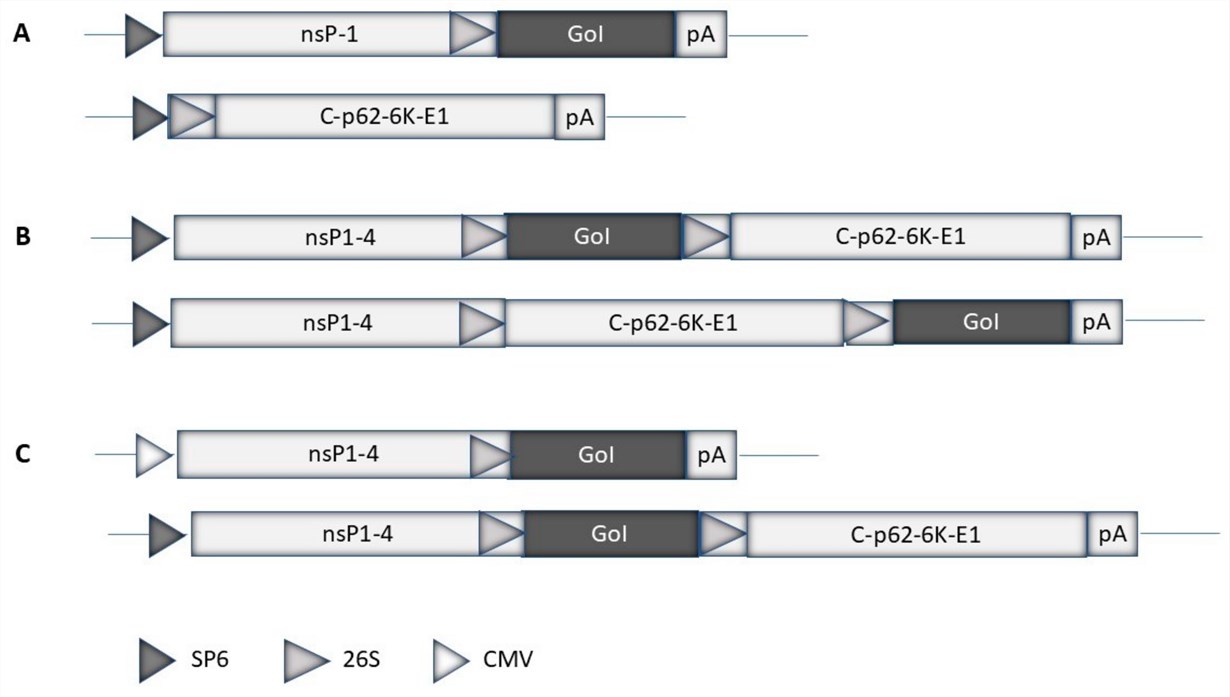
Fig.1 Schematic of alphavirus expression systems.4,6