Frameshift Peptide Vaccine Construction for MSI-H Cancers
Microsatellite instability (MSI) arises when the DNA mismatch repair (MMR) system fails to correct replication errors in short repetitive sequences. The resulting frameshift mutations generate novel C-terminal peptide sequences—frameshift peptides (FSPs)—that are entirely absent from normal tissue yet displayed on the surface of MSI-high (MSI-H) tumor cells via MHC molecules. This tumor-restricted expression profile, combined with the shared nature of many frameshift mutations across independent MSI-H tumors, positions FSPs as uniquely attractive targets for off-the-shelf cancer vaccine design. Creative Biolabs offers a comprehensive preclinical development platform for FSP-based cancer vaccines, spanning shared neoantigen discovery, multi-epitope construct engineering, formulation optimization, and functional immunogenicity validation in relevant in vivo models of MSI-H malignancy.
Why FSPs Represent a Distinct Class of Shared Neoantigens
Tumor-Specific yet Universally Shared
Unlike patient-specific point mutations that require individualized manufacturing, the most frequent frameshift mutations in MSI-H cancers—such as those affecting TGFBR2, BAX, and ACVR2—recur across patients, tumor types, and even species. A panel of as few as 20 shared FSPs can theoretically cover over 90% of MSI-H colorectal, endometrial, and gastric carcinomas. This shared immunogenicity profile enables a semi-universal, off-the-shelf vaccine approach that dramatically simplifies preclinical development and reduces per-patient manufacturing complexity.
FSPs are not merely tumor-associated—they are truly tumor-specific. Because the frameshift-generated C-terminal sequence never exists in healthy cells, the risk of on-target off-tumor autoimmunity is minimal, a key differentiator from shared tumor-associated antigens like HER2 or MUC1.
- Core Preclinical Challenges We Address:
- Prioritizing shared FSPs with confirmed MHC presentation across common HLA alleles.
- Overcoming immune tolerance to chronically expressed frameshift neoantigens in established tumors.
- Designing multi-epitope constructs that coordinate CD4+ helper and CD8+ cytotoxic T cell responses.
- Integrating FSP vaccines with immune checkpoint blockade in in vivo efficacy models.
How FSP Vaccines Differ from Conventional Neoantigen Approaches
| Key Comparison | Patient-Specific Neoantigen Vaccines | FSP-Based Shared Neoantigen Vaccines |
|---|---|---|
| Antigen Sharing | Private mutations; unique to each patient. | Recurrent across patients; off-the-shelf feasible. |
| Manufacturing Timeline | Weeks per individual; requires fresh tumor biopsy. | Pre-manufactured construct pools; same-day administration. |
| Safety Profile | Variable; depends on predicted epitope specificity. | Tumor-exclusive expression; minimal off-target risk. |
| Immune Tolerance Risk | Low for clonal neoantigens; high for subclonal. | Addressed via adjuvant co-formulation and multi-epitope design. |
End-to-End FSP Vaccine Development Service Packages
Our preclinical services are organized into six interconnected modules, each tailored to the unique biology of MSI-H tumors and frameshift neoantigens. All modules can be fully customized—from FSP panel composition to adjuvant selection—to match your tumor indication and research objectives.
Shared FSP Identification & Prioritization
Systematic mining of MSI-H tumor genomics data to pinpoint recurrent, immunogenic frameshift peptides with broad patient coverage.
- MSI Profiling: Microsatellite marker analysis and MMR status confirmation in tumor samples.
- FSP Mining: Computational identification of recurrent frameshift mutations from whole-exome and targeted panel data.
- Immunogenicity Ranking: HLA binding prediction across common alleles combined with published immunogenicity data.
- Patient Coverage: Estimation of population-level coverage for the selected FSP panel.
Multi-Epitope Construct Engineering
Rational design of poly-epitope vaccine constructs encoding multiple shared FSP sequences for broad T cell activation.
- Poly-Epitope Architecture: Linker optimization and epitope ordering for balanced MHC-I/II presentation.
- Platform Selection: Synthetic long peptide (SLP) pools, DNA plasmid, or mRNA vaccine formats.
- Codon Optimization: Sequence engineering for maximum expression in the chosen delivery system.
- Construct Validation: In vitro expression confirmation and antigenicity screening.
Adjuvant Selection & Delivery Optimization
Formulating FSP constructs with immune-potentiating adjuvants and delivery systems to overcome pre-existing tolerance.
- Adjuvant Screening: Evaluation of Toll-like receptor (TLR) agonists, STING agonists, and saponin-based adjuvants.
- Delivery Vehicles: Lipid nanoparticle (LNP) encapsulation or emulsion-based depot systems.
- Dose-Ranging: Systematic dose-response studies to define the minimum immunogenic dose.
- Stability Testing: Formulation integrity under storage and administration conditions.
Cellular & Humoral Immune Response Evaluation
Multi-parameter assessment of vaccine-induced immunity using both cellular and humoral readouts.
- ELISpot Assays: IFN-γ and IL-2 secretion profiling for FSP-specific T cell responses.
- Intracellular Cytokine Staining: Multi-color flow cytometry for CD4+/CD8+ T cell polyfunctionality.
- CTL Killing Assays: Antigen-specific cytotoxicity against MSI-H target cells in vitro.
- Antibody Profiling: Evaluation of FSP-specific humoral responses by ELISA.
Combination Strategy with Checkpoint Blockade
Designing and evaluating FSP vaccine combinations with immune checkpoint inhibitors for synergistic antitumor activity.
- Anti-PD-1/PD-L1 Combinations: Scheduling optimization for vaccine priming followed by checkpoint release.
- TIL Analysis: Post-treatment quantification of CD8+ T cell infiltration in tumor tissue.
- Synergy Assessment: Statistical evaluation of combination vs. monotherapy efficacy in in vivo models.
- Biomarker Discovery: Correlation of MSI burden and MMR status with treatment response.
QC Data & Translational Documentation
Comprehensive quality control and data packages to support downstream translational and regulatory planning.
- Peptide Quality: Purity, identity, and endotoxin testing for synthetic FSP batches.
- Construct Verification: Sequence confirmation and expression validation for DNA/mRNA constructs.
- Potency Assays: Established in vitro correlates for lot-to-lot consistency assessment.
- Study Reports: GLP-compliant documentation of all preclinical immunogenicity and efficacy data.
Optimized Preclinical FSP Vaccine Development Workflow
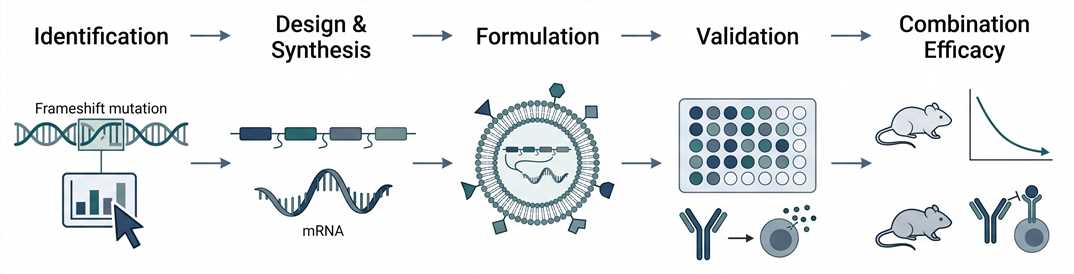
Phase 1 — Shared FSP Identification & Immunogenicity Prioritization
We analyze MSI-H tumor sequencing datasets to identify recurrent frameshift mutations in microsatellite loci of cancer-associated genes. Each candidate FSP is scored for HLA binding affinity across common alleles, predicted immunogenicity, and patient coverage frequency. Published immunopeptidomics data is cross-referenced to confirm which FSPs are naturally processed and presented on tumor cell surfaces.
Enabling Technologies for High-Potency FSP Vaccines
Why Choose Creative Biolabs?
Our team brings focused experience in MMR-deficient tumor biology, understanding the unique immune microenvironment of MSI-H cancers and its implications for vaccine design.
Unlike platforms built solely for patient-specific neoantigens, our FSP service is purpose-built for the identification, validation, and formulation of shared, off-the-shelf frameshift neoantigens.
From FSP panel composition to adjuvant selection and delivery platform, every component of the vaccine construct can be tailored to your specific tumor indication and preclinical endpoints.
We offer built-in capacity to evaluate FSP vaccines alongside checkpoint blockade or other immunomodulators, delivering combination efficacy data essential for translational decision-making.
Research Insight: Efficacy of Personal vs. Shared Frameshift Neoantigen Vaccines
Key Findings from Peterson et al. (2020) Preclinical Evaluation
The therapeutic feasibility of FSP-based cancer vaccines is demonstrated through a direct preclinical comparison between customized Personal Cancer Vaccines (PCVs) and a generic off-the-shelf shared vaccine—termed Frameshift Antigen Shared Therapeutic (FAST).
-
RNA-Based Neoantigen Predictability: Frameshift peptides (FSPs) arising from transcriptional errors or mis-splicing in RNA production offer an abundant, highly predictable source of neoantigens. Using high-density FSP microarrays, immunogenic FSPs can be mapped rapidly, facilitating both quick PCV customization and shared antigen target selection.1
-
Equivalent Anti-Tumor Efficacy: The shared BC-FAST vaccine—assembled from the most prevalent FSPs across subjects—exhibits similar therapeutic power to customized PCVs. When delivered as monotherapies or in tandem with checkpoint inhibitors (such as anti-PD-L1 and anti-CTLA-4), both options significantly restrict primary tumor growth and extend survival.1
-
Independent Metastasis Suppression: FAST vaccines show outstanding capabilities in reducing spontaneous pulmonary metastases. Interestingly, FAST-driven control over metastases operates independently of primary tumor arrest, showing robust systemic immunity even in the presence of established primary tumors.1
-
Robust and Polyfunctional Immune Response: Both vaccines successfully overcome self-tolerance to induce highly active T-cell responses. Re-stimulated lymphocytes display a favorable Th1-biased profile, with polyfunctional CD4+ and CD8+ T cells producing IFN-γ, TNF-α, IL-2, and cytotoxic Granzyme B.1
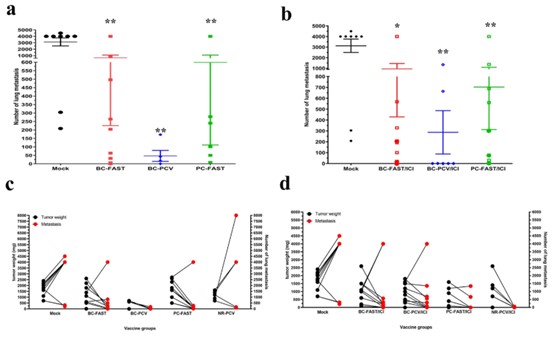
Fig.1 PFs vaccines inhibit spontaneous lung metastasis.1, 2