
Poxvirus-Based Cancer Vaccine Design: Preclinical MVA & Vaccinia Vector Engineering
Creative Biolabs provides an integrated end-to-end platform for the preclinical design and engineering of poxvirus-based cancer vaccines. Harnessing the defining advantages of the Poxviridae family—a ~190 kb double-stranded DNA genome capable of accommodating large multi-transgene cassettes, cytoplasmic replication that eliminates genomic integration risk, and inherent tropism for professional antigen-presenting cells including dendritic cells (DCs)—our team engineers recombinant Vaccinia, Modified Vaccinia Ankara (MVA), and Avipox vectors tailored to your tumor antigen of interest. We go beyond standard vector construction by integrating optimized heterologous prime-boost regimens to circumvent anti-vector neutralizing antibodies, and by co-expressing rationally selected co-stimulatory molecules (B7-1, ICAM-1, LFA-3) that amplify T cell priming through prolonged APC–T cell synapse formation and activation of non-redundant intracellular signaling cascades. Each project is supported by rigorous in vitro and in vivo immunogenicity profiling, ensuring your vaccine candidate is thoroughly characterized before advancing to downstream efficacy studies.
Why Poxvirus Vectors Are Uniquely Suited for Cancer Vaccines
Large Capacity, Cytoplasmic Safety, and Natural Immunogenicity
Poxvirus vectors offer a combination of attributes that are unmatched by smaller viral platforms. Their linear ~190 kb dsDNA genome provides ample space for inserting multiple full-length tumor antigen genes together with immunomodulatory payloads in a single vector—an impossibility for vectors with limited packaging capacity. Because poxviruses complete their entire replication cycle in the host cell cytoplasm without entering the nucleus, they carry zero risk of insertional mutagenesis. Equally important, poxviruses intrinsically encode proteins that interfere with host antiviral defense pathways, yet their infection simultaneously triggers potent innate sensing (cGAS-STING, TLR) and inflammatory cytokine release, creating a self-adjuvanted microenvironment that favors antigen cross-presentation by DCs and robust priming of tumor-specific CD8+ and CD4+ T cells.
Vaccinia Virus (replication-competent, ~7-day infection window) delivers maximal immunostimulation. MVA (500+ passages in chicken embryo fibroblasts, ~10% genome loss, replication-incompetent in human cells) offers an elevated safety profile while retaining transgene expression. Avipoxvirus (canarypox/fowlpox, abortive infection in mammals, 14–21 day transgene expression) provides the highest biosafety tier ideal for repeated boosting.
- Core Preclinical Challenges We Address:
- Overcoming rapid anti-Vaccinia neutralizing antibody via heterologous Avipox boosting.
- Selecting optimal vector serotype and replication tier for each tumor indication.
- Engineering multi-transgene cassettes with co-stimulatory molecules (B7-1/ICAM-1/LFA-3).
- Quantifying tumor-specific T cell responses and antigen spreading in vivo.
Poxvirus Vectors vs. Other Viral Platforms for Cancer Vaccines
| Key Comparison | Other Viral Vectors (Adeno, Lenti, AAV) | Poxvirus Vectors (Vaccinia / MVA / Avipox) |
|---|---|---|
| Transgene Insert Capacity | Limited (~5–8 kb for Adeno; ~4.7 kb for AAV). | ~25 kb; supports multiple full-length antigens + immunomodulators. |
| Genomic Integration Risk | Lentivirus integrates; AAV has low-level integration risk. | Exclusively cytoplasmic replication; zero integration. |
| Innate Immune Activation | Often requires exogenous adjuvant; some vectors are immunologically "silent." | Self-adjuvanted via cGAS-STING/TLR sensing and inflammatory cytokine induction. |
| Repeat Dosing via Heterologous Boost | Anti-vector immunity limits homologous boosting. | Vaccinia prime + Avipox boost: clinically validated heterologous regimen. |
Integrated Poxvirus Vaccine Engineering Service Modules
Our preclinical services are structured into six modular packages that can be combined or used independently. Every module is fully customizable—from vector serotype selection to co-stimulatory molecule combinations—enabling maximal flexibility for your cancer vaccine research.
Target Antigen & Vector Selection
Rational matching of tumor antigens to the optimal poxvirus vector tier and prime-boost architecture.
- Antigen Profiling: Evaluation of tumor-associated and tumor-specific antigen candidates.
- Vector Tier Selection: Matching replication competence (Vaccinia, MVA, Avipox) to safety requirements.
- Prime-Boost Architecture: Designing Vaccinia-prime/Avipox-boost or multi-vector regimens.
- Feasibility Roadmap: Customized preclinical timeline and risk assessment.
Recombinant Poxvirus Genome Construction
High-efficiency engineering of the poxvirus genome to encode tumor antigens and immunomodulatory payloads.
- Homologous Recombination: Classic and marker-assisted recombination for stable transgene insertion.
- Multi-Locus Engineering: Simultaneous insertion at multiple genomic sites for polycistronic constructs.
- Promoter Optimization: Selection of early, late, or early/late poxvirus promoters for desired expression kinetics.
- Clonal Isolation: Multi-round plaque purification and genetic stability verification.
Co-Stimulatory Cassette Integration
Enhancing T cell priming by co-expressing B7-1, ICAM-1, and LFA-3 alongside tumor antigens.
- B7-1 (CD80) Integration: Provides the essential Signal 2 for naive T cell activation.
- ICAM-1/LFA-3 Co-Expression: Prolongs APC–T cell synapse duration and activates non-redundant signaling.
- Triple Combination (TRICOM): Optimized stoichiometry of all three co-stimulatory molecules.
- Tandem Expression Cassettes: Coordinated expression timing for maximal T cell priming.
Vector Amplification & Quality Control
Scalable production of high-titer recombinant poxvirus stocks with rigorous quality characterization.
- Cell Culture Amplification: Optimized production in permissive cell lines (BHK-21, CEF, HeLa).
- Purification: Sucrose cushion or gradient ultracentrifugation for high-purity viral particles.
- Titration: Plaque assay and quantitative PCR-based infectious titer determination.
- Quality Metrics: Sterility, endotoxin, transgene sequence fidelity, and replication competency verification.
Preclinical Immunogenicity Profiling
Multi-parametric assessment of vaccine-induced innate, humoral, and cellular immune responses.
- Humoral Response: Antigen-specific IgG titers and isotype profiling by ELISA.
- Cellular Response: IFN-γ ELISpot, intracellular cytokine staining, and tetramer analysis.
- CTL Activity: Chromium-release or flow-based killing assays against antigen-expressing targets.
- Innate Sensing: cGAS-STING pathway activation and type I IFN response quantification.
In Vivo Tumor Challenge & Data Package
Rigorous preclinical efficacy testing in syngeneic mouse tumor models with comprehensive reporting.
- Tumor Challenge: Prophylactic and therapeutic vaccination in B16, CT26, and TC-1 models.
- Metastasis Models: Experimental and spontaneous metastasis endpoints.
- Combination Testing: Co-administration with immune checkpoint inhibitors (anti-PD-1/PD-L1).
- Data Package: Tumor growth curves, survival analysis, TIL quantification, and cytokine profiling.
Preclinical Poxvirus Vaccine Engineering Workflow
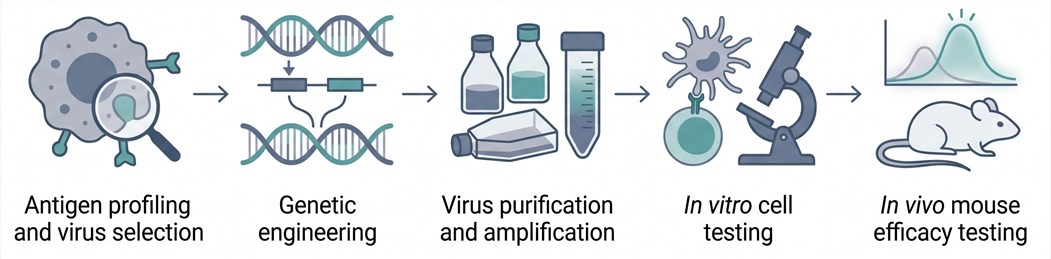
Phase 1 — Antigen Profiling & Vector Tier Selection
We evaluate your tumor antigen(s) of interest and recommend the optimal poxvirus vector tier—Vaccinia for maximum immunogenicity, MVA for an elevated safety profile, or Avipox for heterologous boosting—along with a tailored prime-boost architecture and co-stimulatory molecule configuration.
Enabling Technology Platforms for Poxvirus Vaccine Design
Why Choose Creative Biolabs for Poxvirus Vaccine Engineering?
Our team brings years of hands-on experience in poxvirus molecular biology, from genomic engineering and plaque purification to in vivo vaccination studies, ensuring scientifically sound vector design at every step.
We offer Vaccinia, MVA, and Avipox vectors with distinct replication and safety profiles, enabling you to select the ideal vector tier for your target indication and biosafety requirements.
Beyond antigen delivery, our co-stimulatory molecule co-expression platform (B7-1/ICAM-1/LFA-3) transforms the vector into a self-amplifying immune stimulus that enhances T cell priming quality.
From vector construction records to raw ELISpot counts and tumor growth curves, every data point is documented and delivered in a fully traceable final report, ready for publication or regulatory submission.
Research Insight: Poxvirus Vectors in Cancer Immunotherapy
Key Preclinical Findings Supporting Poxvirus Vaccine Platforms
Poxvirus-based vectors have undergone decades of iterative optimization for cancer immunotherapy, and recent preclinical studies continue to validate their unique advantages as vaccine platforms.
-
CRISPR-Accelerated Vector Engineering: Whelan et al. demonstrated CRISPR/Cas9-assisted recombinant vaccinia virus engineering (CARVE), achieving 50–88% recombination efficiency and enabling triple-locus insertion within seven days. The resulting STINGPOX vector, expressing a bacterial c-di-AMP synthase, combined with anti-PD-1 increased survival from 20% to 50% in the colorectal cancer model.1
-
Enhanced Antitumor Immunity via cGAS-STING Activation: Riederer et al. showed that deleting the viral cGAMP-specific nuclease (B2R gene) from oncolytic vaccinia virus significantly enhanced antitumor activity in CT26 colon and B16 melanoma models, with increased intratumoral CD8+ and CD4+ T cell infiltration without compromising viral replication.2
-
Improved Vector Safety for Intravenous Administration: Okita et al. engineered a novel oncolytic vaccinia virus (LC16m8 backbone) with multiple gene modifications that maintained cancer cell proliferative potential while dramatically improving safety for intravenous delivery in preclinical models.3
-
Poxvirus Vectors as Core Viral Vaccine Platforms: Wang et al. comprehensively reviewed viral vectored vaccines including poxviruses, highlighting the unparalleled transgene capacity, cytoplasmic safety, and potent induction of both humoral and cellular immunity that distinguish poxvirus vectors from alternative platforms.4
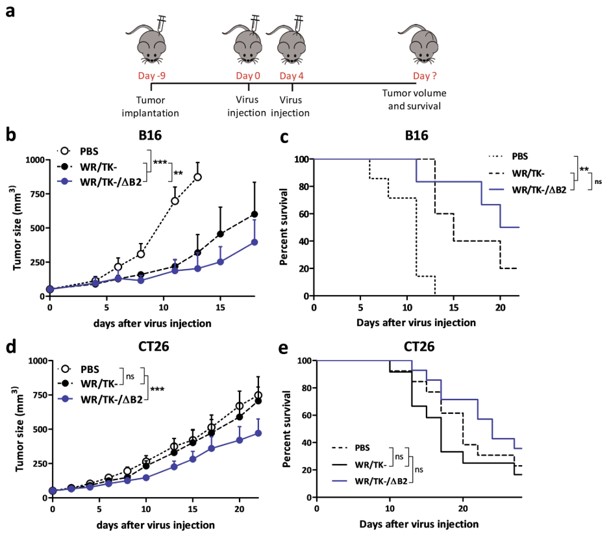
Fig.1 Enhanced antitumor activity of cGAMP nuclease-deleted oncolytic VACV in mouse tumor models.2,6