Preclinical Ganglioside Vaccine Development Services & Solutions
Creative Biolabs provides a dedicated, end-to-end preclinical platform for the development of ganglioside-based cancer vaccines. Gangliosides—sialic acid-containing glycosphingolipids such as GM2, GD2, GD3, GM3, and NGcGM3—represent a distinctive class of tumor-associated carbohydrate antigens (TACAs) preferentially expressed on neuroectodermal and epithelial tumor cell surfaces. Because native gangliosides are inherently poor immunogens, their successful translation into vaccine candidates demands specialized expertise in carbohydrate antigen synthesis, carrier protein conjugation, adjuvant screening, and robust humoral response assessment. Our integrated service modules span the full preclinical pipeline—from ganglioside profiling and chemical synthesis of structurally defined antigen constructs to carrier bioconjugation, formulation optimization, and comprehensive in vitro and in vivo antibody potency evaluation. Whether your research targets melanoma, neuroblastoma, small cell lung cancer, breast cancer, or other ganglioside-expressing malignancies, our team delivers customized vaccine development solutions that convert low-immunogenicity carbohydrate epitopes into high-titer, functionally relevant antibody responses.
Why Gangliosides Are High-Value Targets for Cancer Vaccines
The Biology of Ganglioside Antigens
Gangliosides are molecules composed of one or more sialic acid residues attached to a glycosphingolipid core, anchored into the outer leaflet of the plasma membrane via their ceramide moiety. First named by German scientist Ernst Klenk in 1942 from ganglion cell isolates, gangliosides exhibit striking differential expression between tumor and matched normal tissue. GM2, GD2, and GD3 are predominantly found in tumors of neuroectodermal origin—melanoma, sarcoma, and neuroblastoma—while fucosyl GM1 is characteristic of small cell lung cancer. GM2 has also been identified in a growing number of epithelial cancers. More recently, NGcGM3 has emerged as a privileged target because the human CMAH gene is inactivated, making NGc-containing gangliosides essentially absent from normal human tissue while they accumulate in breast, lung, colon, and renal carcinomas through dietary metabolic incorporation.
Gangliosides are T cell-independent antigens. In their native state, they fail to recruit CD4+ T cell help and induce only transient, low-affinity IgM responses. Converting these carbohydrate epitopes into robust, class-switched IgG antibody responses requires precise control over antigen valency, carrier selection, and adjuvant design—the central focus of our ganglioside vaccine platform.
- Critical Preclinical Hurdles We Address:
- Overcoming the inherently low immunogenicity of carbohydrate antigens.
- Avoiding carrier-induced epitope suppression (CIES) in conjugate vaccines.
- Selecting adjuvants that drive IgG class-switching without excessive reactogenicity.
- Quantifying functional anti-ganglioside antibody activity via CDC and ADCC assays in vitro.
Ganglioside Vaccines vs. Conventional Protein/Peptide Vaccines
| Key Comparison | Conventional Peptide/Protein Vaccines | Ganglioside Conjugate Vaccines |
|---|---|---|
| Antigen Nature | Linear peptide sequences; MHC-restricted. | Three-dimensional carbohydrate epitopes; MHC-independent. |
| Immune Effector Mechanism | Primarily CD8+ CTL-mediated cytotoxicity. | Antibody-driven CDC/ADCC; no MHC down-regulation escape. |
| Innate Immunogenicity | Moderate to high; can prime T cells directly. | Requires extrinsic adjuvant + carrier; highly tunable. |
| Tumor Evasion Risk | Susceptible to MHC-I down-regulation and antigen loss. | Targets surface glycolipids; less prone to rapid antigen escape. |
End-to-End Ganglioside Vaccine Development Service Packages
Our preclinical services are structured into flexible, modular packages. We understand that each ganglioside target—whether GM2, GD2, GD3, fucosyl GM1, GM3, or NGcGM3—poses unique challenges in synthesis, conjugation, and immunogenicity. All modules are fully customizable to match your antigen selection, carrier preference, adjuvant strategy, and tumor indication.
Ganglioside Antigen Profiling & Selection
Rational antigen target selection based on tumor ganglioside expression profiling and immunogenicity feasibility.
- Expression Profiling: Analysis of GM2, GD2, GD3, fucosyl GM1, and NGcGM3 in tumor specimens.
- Tumor Indication Mapping: Melanoma, neuroblastoma, sarcoma, SCLC, breast, lung, colon, and renal cancers.
- Antigen Prioritization: Ranking targets by surface density, shedding rate, and immune accessibility.
- Feasibility Assessment: Evaluating antigen synthesis complexity and predicted conjugate immunogenicity.
Carbohydrate Antigen Synthesis & Modification
High-purity chemical and chemoenzymatic synthesis of structurally defined ganglioside antigens.
- Chemical Synthesis: Multi-step assembly of GM2, GM3, GD2, GD3 oligosaccharide epitopes.
- Chemoenzymatic Routes: Enzymatic sialylation for regio- and stereoselective glycan construction.
- Linker Engineering: Incorporation of functionalized linkers for site-selective carrier conjugation.
- Quality Control: HPLC, MS, and NMR characterization of all synthetic intermediates and final products.
Carrier Bioconjugation & Adjuvant Screening
Optimized conjugation of ganglioside haptens to immunogenic carrier proteins with tailored adjuvant selection.
- Carrier Options: KLH, CRM197, or tetanus toxoid conjugation with controlled hapten density.
- Conjugate Characterization: MALDI-TOF and SEC-HPLC to confirm carbohydrate-to-protein ratio and homogeneity.
- Adjuvant Screening: Saponin-based (QS-21 analogues), TLR agonists, or glycolipid-based (α-GalCer) adjuvants.
- Self-Adjuvanting Constructs: Direct conjugation of ganglioside to immunostimulatory lipids (e.g., MPLA).
Vaccine Formulation & Stability Assessment
Liposomal and particulate formulation strategies to enhance ganglioside antigen multivalency and immune uptake.
- Liposomal Encapsulation: DSPC/cholesterol-based liposomes for multivalent ganglioside display.
- Particulate Carriers: Virus-like particles (VLPs) or synthetic nanoparticles as alternative scaffolds.
- Formulation Stability: Accelerated stability testing under various storage and buffer conditions.
- Sterility & Endotoxin: Quality release testing per preclinical research standards.
Antibody Response & Efficacy Evaluation
Comprehensive humoral immune profiling to quantify anti-ganglioside antibody titer, isotype, and functional activity.
- ELISA Titration: IgM and IgG subclass quantification against individual ganglioside antigens.
- Cell-Based Binding: Flow cytometry on ganglioside-positive tumor lines (e.g., MCF-7, SK-MEL-28).
- CDC Assays: Complement-dependent cytotoxicity against ganglioside-expressing target cells.
- In Vivo POC: Tumor challenge studies in syngeneic or xenograft mouse models.
Data Package & Preclinical Documentation
Comprehensive reporting and quality documentation to support your preclinical research and translational planning.
- Characterization Report: Full analytical data for synthesized antigens and conjugates.
- Immune Profiling: Complete antibody titer kinetics, isotype distribution, and functional assay results.
- Study Summary: Integrated efficacy report with statistical analysis and benchmark comparisons.
- Documentation: Standardized SOP documentation for all synthesis, conjugation, and assay procedures.
Preclinical Ganglioside Vaccine Development Workflow
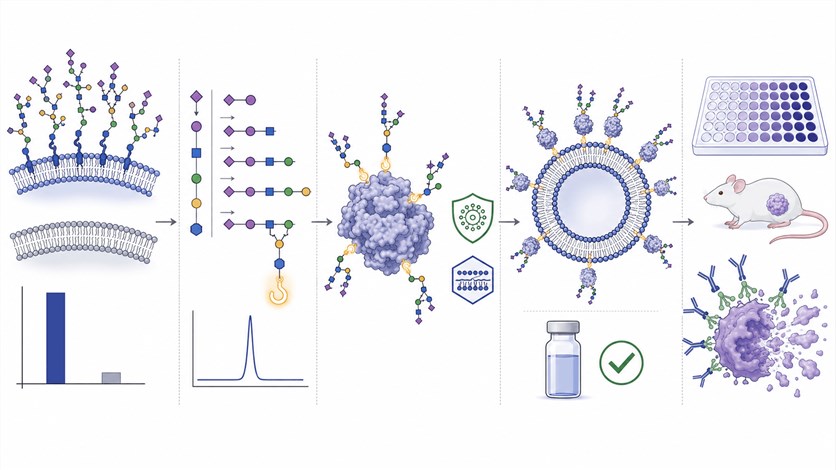
Phase 1 — Ganglioside Expression Profiling & Target Selection
We evaluate tumor specimens for ganglioside expression using immunohistochemistry and mass spectrometry-based glycolipid profiling. Key targets—GM2, GD2, GD3, fucosyl GM1, GM3, and NGcGM3—are identified and ranked by surface density and tumor specificity relative to matched normal tissue.
Enabling Technologies for Ganglioside Vaccine Development
Why Choose Creative Biolabs?
Our team has extensive experience in the multi-step synthesis of complex ganglioside glycans, including challenging sialylated structures, with rigorous analytical characterization at every step.
We support the full spectrum of ganglioside targets—GM2, GD2, GD3, fucosyl GM1, GM3, and NGcGM3—enabling both single-antigen and polyvalent vaccine strategies.
From traditional KLH conjugates to self-adjuvanting MPLA-linked constructs, we offer flexible carrier and adjuvant options tailored to your immunogenicity goals.
Our potency evaluation is purpose-built for carbohydrate vaccines, emphasizing quantitative humoral response profiling and functional CDC/ADCC assessment.
Research Insight: Optimizing Anti-GD2 Antibody Response in Neuroblastoma Vaccines
Key Findings from GD2/GD3 Ganglioside Vaccine Studies
Bivalent GD2/GD3-KLH conjugate vaccines adjuvanted with saponin-based immunostimulants and oral β-glucan have demonstrated substantial anti-ganglioside IgG1 responses in high-risk neuroblastoma patients. Recent analyses reveal that vaccine schedule optimization dramatically influences antibody magnitude and durability.
-
Prime-Boost Interval Effect: A prolonged interval between primary vaccination and re-vaccination (>16 months) yielded a >10-fold increase in peak anti-GD2 IgG1 titers compared to short-interval boosts, rising from ~751 ng/mL to over 4,000 ng/mL after re-vaccination.
-
Adjuvant Synergy: Oral β-glucan during the priming phase significantly enhanced antibody responses, with titers correlating with dectin-1 receptor polymorphisms. This highlights the importance of host genetics in adjuvant selection.
-
Safety Profile: Despite achieving anti-GD2 IgG1 levels in the range of therapeutic monoclonal antibodies, vaccine-induced antibodies did not produce the neuropathic pain or neurotoxicity associated with anti-GD2 antibody infusion therapy.
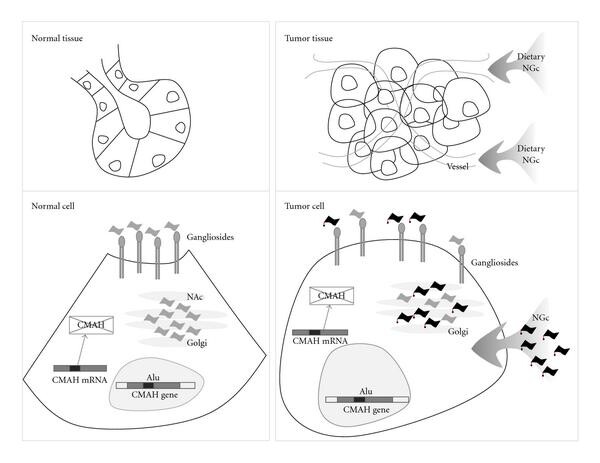
Fig.1 NGc gangliosides in human tumor biology.2,3