VaxBody™ DNA Vaccine Platform: Antibody-Scaffolded Tumor Antigens for APC Targeting
Creative Biolabs introduces VaxBody™, a next-generation DNA vaccine platform that encodes tumor T cell epitopes within an engineered human antibody scaffold. Instead of delivering linear peptides or free mRNA, VaxBody™ replaces the complementarity-determining region (CDR) genes of an antibody with carefully selected MHC-I (CTL) and MHC-II (Th) restricted epitopes. The Fc region is further modified to bind CD64 (FcγRI), a high-affinity Fc receptor preferentially expressed on activated dendritic cells and other antigen-presenting cells (APCs). This dual-engineering strategy achieves coordinated CD4+ and CD8+ T cell activation through both direct and cross-presentation pathways. By combining the inherent immunostimulatory properties of plasmid DNA, the targeting precision of antibody engineering, and the power of APC-mediated immune orchestration, VaxBody™ addresses the limited immunogenicity that has historically constrained peptide-based and conventional DNA cancer vaccines. Our preclinical service pipeline encompasses epitope discovery, antibody scaffold engineering, DNA construct assembly, in vitro expression validation, and in vivo potency testing in syngeneic or humanized mouse models, providing a comprehensive solution from concept to validated construct.
Reimagining DNA Vaccines — From Linear Epitopes to Antibody-Scaffolded Antigens
The Antibody Scaffold Advantage
Conventional DNA vaccines rely on the host cell to express a linear antigen sequence that must compete for limited MHC loading and often fails to engage both T cell arms simultaneously. VaxBody™ takes a fundamentally different approach: by embedding T cell epitopes into the CDR loops of a human IgG scaffold, each DNA construct generates a secreted, dimeric antibody-like protein. This format stabilizes the epitope cargo, enables native-like processing within APCs, and routes antigen through the same endosomal and cytosolic pathways that drive physiological MHC-I and MHC-II loading. The result is broader, deeper T cell activation compared to epitopes delivered as free peptides or as unstructured mini-genes.
Unlike linear peptide or nucleotide vaccines, the antibody scaffold simultaneously provides structural stability, Fc-mediated APC targeting, and dual-pathway antigen presentation — three features that collectively amplify the magnitude and duration of antitumor T cell responses in preclinical models.
- Key Challenges VaxBody™ Is Designed to Address:
- Limited immunogenicity of free peptide vaccines due to rapid degradation.
- Insufficient CD4+ T cell help when only MHC-I epitopes are delivered.
- Inefficient APC targeting with unmodified DNA or protein constructs.
- Quantifying epitope-specific T cell responses in vitro and in vivo with single-pathway vaccines.
What Makes Antibody-Formatted DNA Vaccines Superior?
| Key Comparison | Conventional DNA / Peptide Vaccines | VaxBody™ Antibody-Format DNA |
|---|---|---|
| Antigen Stability | Free peptides susceptible to rapid proteolysis and clearance. | Epitopes stabilized within IgG scaffold for prolonged bioavailability. |
| APC Targeting | Passive uptake; no receptor-mediated delivery mechanism. | Fc-modified to bind CD64 (FcγRI) on activated APCs for targeted delivery. |
| T Cell Activation Breadth | Often biased toward MHC-I (CD8+) or MHC-II (CD4+) alone. | Co-encodes MHC-I (CTL) and MHC-II (Th) epitopes for coordinated dual activation. |
| Presentation Pathways | Single-pathway processing; reliance on direct presentation only. | Supports direct presentation AND cross-presentation for amplified T cell activation. |
End-to-End VaxBody™ DNA Vaccine Development Services
Our preclinical services are organized into flexible, modular packages covering the complete VaxBody™ development pipeline. Every module can be individually configured — from epitope selection and CDR engineering to Fc modification and delivery optimization — to align with your specific tumor indication and experimental objectives.
Epitope Discovery & Computational Ranking
Systematic identification and prioritization of tumor T cell epitopes for optimal immunogenicity.
- Tumor Profiling: Multi-omics analysis (WES and RNA-seq) to identify tumor-specific mutations.
- HLA Binding Prediction: Computational ranking of candidate epitopes by MHC-I and MHC-II affinity.
- Immunogenicity Scoring: Integration of proteasomal processing, TAP transport, and TCR recognition likelihood.
- Epitope Selection Report: Curated shortlist of CTL and Th epitopes with rationale and predicted scores.
Antibody Scaffold Engineering
Design and construction of the VaxBody™ antibody scaffold with CDR epitope replacement and Fc modification.
- CDR Epitope Insertion: Genetic replacement of CDR loops with MHC-I and MHC-II epitope sequences.
- Fc Engineering: Targeted modification of Fc residues to enhance CD64 (FcγRI) binding.
- Codon Optimization: Species-specific codon adaptation for high-level expression in mammalian cells.
- Linker Design: Flexible glycine-serine linker placement to preserve epitope processing and MHC loading.
DNA Construct Assembly & QC
Professional cloning, amplification, and quality control of VaxBody™ plasmid DNA for preclinical use.
- Vector Construction: Cloning into optimized eukaryotic expression vectors with strong promoters.
- Plasmid Amplification: Endotoxin-free large-scale plasmid preparation for in vivo studies.
- Identity Verification: Restriction digest mapping and full-plasmid Sanger sequencing confirmation.
- Purity Assessment: A260/A280 ratio, endotoxin level testing, and agarose gel electrophoresis.
In Vitro Expression & Functional Validation
Confirming VaxBody™ construct expression and processing in mammalian cells before animal studies.
- Transient Expression: HEK293 or CHO transfection with SDS-PAGE and Western blot verification.
- Secretion Assay: ELISA-based quantification of secreted VaxBody™ protein from culture supernatant.
- CD64 Binding Validation: Surface plasmon resonance (SPR) or ELISA to confirm Fc-CD64 interaction.
- Epitope Processing Assessment: MHC-peptide complex detection via T cell activation co-culture assays.
In Vivo Immunogenicity & Efficacy Testing
Comprehensive evaluation of T cell responses and antitumor activity in preclinical animal models.
- ELISpot / ICS: IFN-γ ELISpot and intracellular cytokine staining for epitope-specific T cell quantification.
- In Vivo Tumor Models: Prophylactic and therapeutic efficacy studies in syngeneic or humanized mouse models.
- Tetramer Staining: MHC multimer-based enumeration of epitope-specific CD8+ T cell frequencies.
- Tumor-Infiltrating Lymphocyte (TIL) Analysis: Flow cytometry profiling of immune cell populations within tumors.
Data Package & Reporting
Comprehensive documentation and raw data delivery for publication and regulatory reference.
- Construct Report: Full plasmid maps, sequencing chromatograms, and QC certificates.
- Expression Data: Western blot images, ELISA quantification, and SPR binding curves.
- Immunogenicity Summary: ELISpot counts, ICS flow plots, and statistical analysis with P-values.
- Efficacy Data Package: Tumor growth curves, survival analysis, and TIL profiling results.
VaxBody™ Preclinical Development Workflow
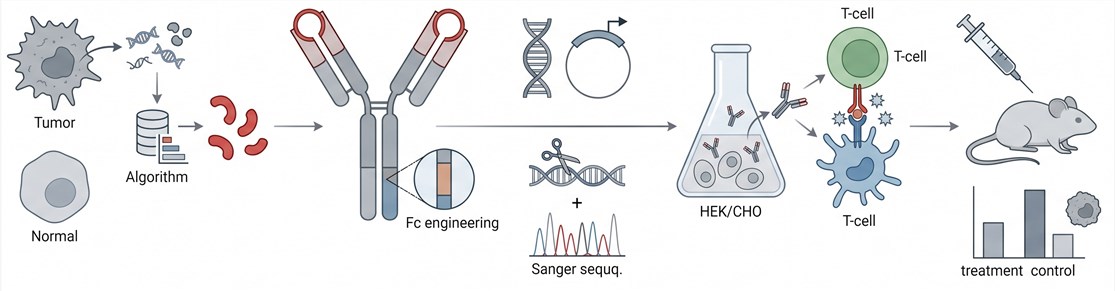
Phase 1 — Tumor Epitope Discovery & Computational Selection
We begin with integrated multi-omics profiling of tumor versus normal tissue to identify somatic mutations. Candidate neoepitopes are computationally ranked by predicted MHC-I and MHC-II binding affinity, proteasomal cleavage probability, and TAP transport efficiency, yielding a curated shortlist of the most immunogenic CTL and Th epitopes for CDR insertion.
Core Technologies Powering VaxBody™
Why Partner With Creative Biolabs for VaxBody™?
Our VaxBody™ platform is one of the few preclinical services that delivers tumor antigens embedded within an engineered antibody scaffold, offering structural stability, APC targeting, and dual-pathway presentation in a single construct.
With over a decade of experience in DNA vaccine design and plasmid construction, our team ensures each construct is codon-optimized, sequence-verified, and functionally validated before delivery.
Choose the full pipeline or individual modules. Every aspect — from epitope selection criteria to Fc engineering targets — can be tailored to your tumor indication and experimental model.
We deliver more than constructs. Each project includes comprehensive QC documentation, raw expression data, immunogenicity readouts, and efficacy endpoint analysis ready for publication or grant applications.
Research Insight: APC-Targeted DNA Vaccines Drive Early-Onset T Cell Responses
Key Findings from Recent Preclinical Studies
Recent advances in APC-targeted DNA vaccine design have validated the rationale behind strategies like VaxBody™. Studies demonstrate that fusing tumor antigens to chemokine domains that bind APC-expressed receptors substantially accelerates the onset of the adaptive immune response by recruiting dendritic cells to the vaccination site and promoting antigen uptake.
-
CCL19-Mediated APC Recruitment: Fusion of cancer neoantigens to the chemokine CCL19 preserved both its signaling and chemotactic properties, leading to significantly faster T cell priming in vivo compared to unfused antigen controls.1
-
Cross-Presentation Adjuvants: Vaccine formulations incorporating adjuvants that engage the cross-presentation pathway, such as TLR3 and STING agonists, effectively funnel exogenous antigens into the MHC-I loading machinery, a mechanism directly relevant to VaxBody™'s dual-pathway design.5
-
DNA Platforms for Cancer: A comprehensive 2025 review of DNA cancer vaccines concluded that electroporation-delivered DNA constructs encoding both MHC-I and MHC-II epitopes consistently outperform single-epitope or peptide-only vaccines across multiple preclinical tumor models.3
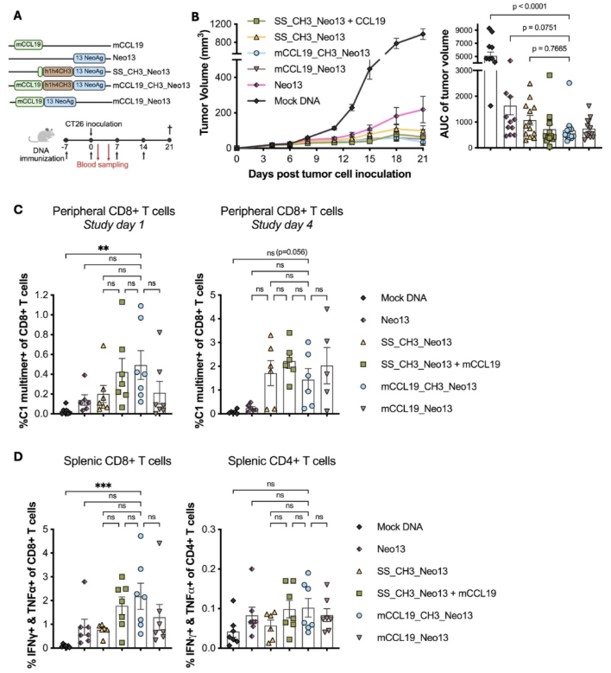
Fig.1 CCL19 and h1h4CH3 improve neoantigen immunogenicity and antitumor efficacy.1,3