Expert evaluation of environmental and biological triggers that initiate cellular transformation, providing deep insights into early-stage oncogenic development for research teams.
Learn More →Basic Oncology Research Services
Creative Biolabs' basic oncology research provides an end-to-end framework for exploring the biological drivers of malignancy. By combining multi-modal data streams with advanced computational modeling, we offer researchers a clearer view of cellular behavior and microenvironment interactions. Our clients expect to gain a deep understanding of target mechanisms, improved accuracy in biomarker identification, and a robust evidentiary basis for moving research assets into the next phase of development.
Introduction What We Can Offer How We Can Help Why Choose Us Customer Reviews FAQs Related Services Contact Us
Core Principles of Modern Basic Oncology Research
Basic Oncology Research at Creative Biolabs is built on the principles of cellular hallmarks and the immune cycle. By analyzing how cells sustain proliferative signaling while evading destruction, we identify the specific factors that determine research success. Recent literature highlights the convergence of cellular senescence, metabolic reprogramming, and epigenetic plasticity as vital areas of study. We conclude that successful discovery requires an integrated, multi-modal approach that accounts for the complexity of the microenvironment.
Request a Consultation→
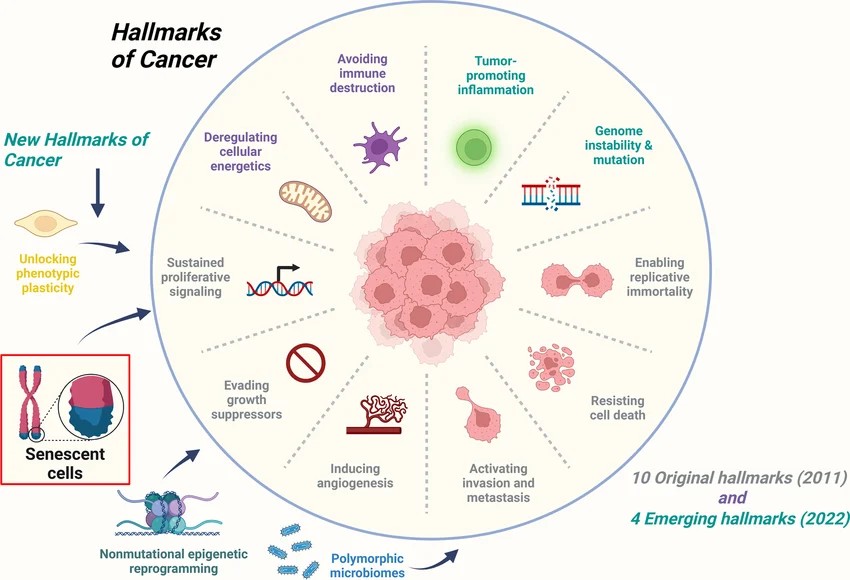 Fig.1 The hallmarks of cancer and new additions. 1
What We Can Offer
Bespoke Model Engineering
We facilitate the custom development of sophisticated cell-based models that precisely incorporate your target-relevant stromal components, such as specific fibroblast subtypes or vascular elements.
Target Validation
Our team performs detailed mapping of novel targets against biological hallmarks to provide a robust and definitive biological rationale for your future research filings.
Tailored Spatial Profiling
We provide custom-designed spatial transcriptomics panels to track your asset's deep penetration and local modulatory effects within the complex architecture of the biological microenvironment.
Adaptive Computational Simulations
Our experts utilize proprietary computational models customized with your unique data to accurately predict potential evolutionary resistance pathways and adaptive survival mechanisms during discovery.
How Creative Biolabs Can Assist Your Project
Carcinogenic Factor Analysis Services
Integrated Genome Instability & Mutation Analysis Services
Detailed assessment of chromosomal aberrations and mutation rates, helping researchers identify the genetic drivers that accelerate cellular diversity and adaptation.
Learn More →Oncogene & Tumor Suppressor Profiling Services
High-resolution mapping of gene activation and silencing patterns to clarify the fundamental drivers of sustained proliferative signaling in models.
Learn More →Cancer Epigenetic Mapping Services
Investigation of DNA methylation and histone modifications to understand non-mutational changes that govern cellular plasticity and therapeutic resistance mechanisms.
Learn More →Integrated Non-coding RNA Characterization Services
Advanced analysis of microRNA and lncRNA regulatory networks, identifying critical post-transcriptional modulators that influence disease progression and cellular hallmark acquisition.
Learn More →Integrated Cell Cycle Dysregulation Analysis Services
Precise monitoring of cell cycle checkpoints and regulatory protein imbalances to determine how cells evade growth suppressors and death.
Learn More →Integrated Cancer Stem Cell Research Services
Specialized identification and characterization of self-renewing cell populations that drive long-term research resistance and recurrence in diverse biological models.
Learn More →Integrated Tumor Angiogenesis & Vascular Evaluation Services
Morphological and molecular analysis of vessel formation, providing critical data on how cellular environments acquire independent nutrient and oxygen supplies.
Learn More →Cancer Invasion & Metastasis Analysis Services
Comprehensive tracking of cellular mobility and extracellular matrix degradation to map the biological pathways involved in distal site colonization.
Learn More →Cancer Signaling Pathway Mapping & Validation Services
Systematic validation of intracellular communication nodes, offering a clear mechanistic view of how cells coordinate survival and growth signals.
Learn More →Cancer Metabolic Reprogramming Analysis Services
Evaluation of shifts in nutrient uptake and aerobic glycolysis, revealing how cellular systems adapt their energy production for rapid growth.
Learn More →Tumor Energy Metabolism Analysis Services
Focused study of mitochondrial function and alternative energy pathways, serving as a vital tool to guide and monitor research experiments.
Learn More →Highlights
Integrated Biological Expertise
Creative Biolabs stands at the intersection of classical biology and futuristic computation, ensuring that every research finding is rooted in rigorous scientific methodology and expert-led analysis.
Advanced AI Insights
While standard providers deliver raw data, we provide explainable intelligence through proprietary AI frameworks that offer transparent and logical chains of evidence for every prediction made.

Hallmark-Based Validation
Our experts ensure that every target we validate is grounded in established biological principles, mapping your research findings against the fundamental hallmarks of cellular evolution and growth.
Predictive Analytical Power
We utilize state-of-the-art computational tools to transform complex biological inputs into actionable insights, helping you anticipate resistance mechanisms and optimize your discovery pipeline with confidence.
Reach out to our experts to discuss your specific targets and receive a customized service quote today.
Customer Reviews
-
Enhanced Immune Insight
Our understanding of the cell exclusion phenotype was greatly facilitated by Creative Biolabs' basic research. Because the spatial mapping was so precise, we were able to pivot our lead design successfully before finalizing the research phase. - Dr. A*n. S. -
Target Validation Success
Creative Biolabs' basic oncology research helped us improve our lead compound screening efficiency. We found the 'why' behind our results thanks to the AI report, which proved critical for our project documentation. - Prof. M**l. K.
FAQs
How does Creative Biolabs handle difficult targets?
Our team specializes in addressing complex molecular interactions and signaling pathways by identifying alternative network nodes that allow researchers to achieve their desired experimental goals effectively.
Can you model the aging biological environment?
Yes, we incorporate specific environmental factors and markers of cellular decline into our models to ensure targets are validated within the context of older biological systems.
Related Services
Small-Molecule Drug Discovery Services
This comprehensive platform utilizes advanced chemical modeling and screening to identify and optimize potent lead compounds that effectively modulate specific biological targets.
Learn More →Biologic Therapeutics Development
This service focuses on the engineering and optimization of large-molecule assets, including antibodies and cell therapies, to ensure high specificity and superior research outcomes.
Learn More →How to Contact Us
Creative Biolabs offers an extensive suite of basic oncology research services. By merging biological principles with the power of generative ai and quantum analytics, we provide the mechanistic clarity required to support your research pipeline.
For detailed project discussions, technical data sheets, or to schedule a meeting with our lead research team, please contact us.
Reference
- Zhao, Binghao et al. "Aging microenvironment and antitumor immunity for geriatric oncology: the landscape and future implications." Journal of hematology & oncology vol. 16,1 28. 21 Mar. 2023, doi:10.1186/s13045-023-01426-4. Distributed under an Open Access license CC BY 4.0, without modification. https://doi.org/10.1186/s13045-023-01426-4
 Download our brochure
Loading case studies...
Online Inquiry