We define the optimal injection rate, contrast dosage, and temporal sampling frequency based on the specific permeability characteristics of the target tissue.
Vascular Perfusion & Permeability Evaluation Service
Vascular perfusion & permeability evaluation service at Creative Biolabs helps you obtain high-quality physiological insights and validate therapeutic delivery through advanced Dynamic Contrast-Enhanced (DCE) imaging and rigorous compartmental modeling. Creative Biolabs transforms raw kinetic data into actionable evidence of vascular normalization and barrier function using proprietary computational pipelines.
Overview What We Can Offer Workflow Required Materials Application Highlights Customer Reviews FAQs Related Services
Introduction of Vascular Perfusion & Permeability Evaluation Service
Vascular functionality is a primary determinant of therapeutic success, as structural presence does not guarantee nutrient or drug delivery. Recent scientific evidence suggests that permeability coefficients like Ktrans are superior to volumetric measurements in predicting early treatment response. Furthermore, standardizing the volume transfer constant between blood plasma and the extracellular space is essential for de-risking anti-angiogenic compounds. Creative Biolabs integrates these gold-standard pharmacokinetic parameters to provide a comprehensive assessment of microvascular hemodynamics, ensuring your project meets the highest levels of scientific and regulatory scrutiny.
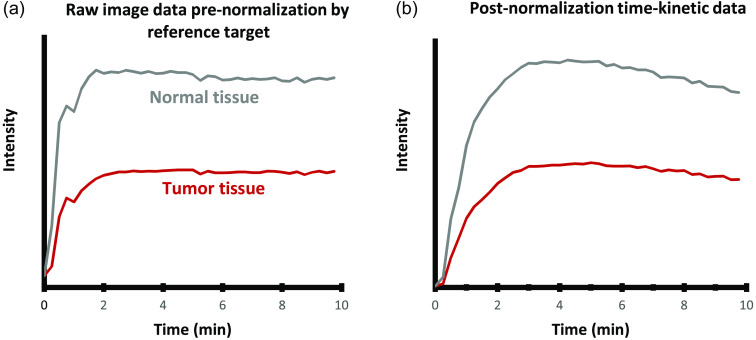 Fig.1 Illustration of ICG kinetics image data normalization using a fixed external fluorescent reference to compensate for system gain variations.1
Creative Biolabs employs a multi-tiered strategic approach to capture the ephemeral nature of microvascular exchange, ensuring every study yields reproducible physiological insights.
- Kinetic Model Selection: We utilize both adavanced models to mathematically decouple blood flow from endothelial permeability, allowing for the precise measurement of vascular leakiness.
- Temporal Resolution Optimization: Our strategy involves high-frequency data acquisition to capture the critical contrast "wash-in" phase, which is essential for calculating the initial rate of extravasation accurately.
- Physiological Parameter Mapping: We focus on the fractional volume of the extravascular extracellular space (Ve), providing a non-invasive window into tissue interstitial pressure and edema progression.
Empower Your Research with Creative Biolabs — Begin Your Expert Consultation Today
What We Can Offer
Dynamic Contrast-Enhanced (DCE) Modeling:
We offer specialized expertise in longitudinal permeability mapping, quantifying Ktrans and kep to track the stabilization or disruption of the endothelial barrier.
Blood-Brain Barrier (BBB) Integrity Profiling:
Our team provides specialized protocols for neurovascular research, detecting subtle barrier leaks that precede structural damage in neurodegenerative models.
Advanced Perfusion-Weighted Imaging (PWI):
We provide detailed maps of mean transit time (MTT) and cerebral blood volume (CBV), essential for assessing collateral circulation and hemodynamic reserve.
Automated Arterial Input Function (AIF) Analysis:
Creative Biolabs utilizes proprietary algorithms to identify the ideal AIF from imaging data, reducing variability and ensuring the mathematical accuracy of the resulting kinetic curves.
Voxel-wise Heterogeneity Assessment:
Our technical team generates high-impact parametric heatmaps that reveal the spatial distribution of hyper-permeable "hot spots" within the tissue of interest.
Workflow
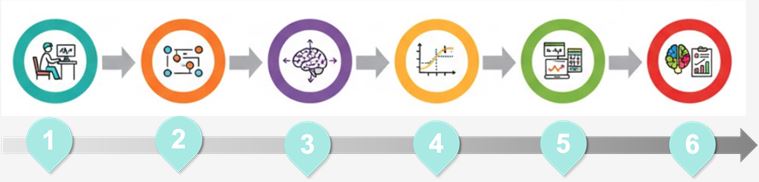
Protocol Design and Sequence Optimization
Dynamic Image Acquisition and Monitoring
During the scan, we track the real-time transit of the contrast agent, ensuring that the signal-to-noise ratio is sufficient for reliable kinetic modeling.
Motion Correction and Spatial Co-registration
To ensure voxel-wise consistency, we apply 3D rigid and non-rigid registration to align all temporal frames with a high-resolution baseline anatomical scan.
Arterial Input Function (AIF) Identification
We extract the time-intensity curve from a major feeding vessel, providing the necessary mathematical input for deconvolution and compartmental analysis.
Pharmacokinetic Parameter Estimation
Our scientists apply the most appropriate mathematical model to derive quantitative constants, including Ktrans, plasma volume fraction (Vp), and Ve.
Parametric Mapping and Statistical Reporting
You receive a detailed technical dossier including quantitative heatmaps, signal-intensity curves, and a summary of the vascular barrier status.
Required Materials
- High-temporal resolution dynamic imaging datasets.
- Detailed contrast agent specifications, including molarity, injection volume, and the precise timing of the bolus delivery.
- Specific anatomical regions of interest (ROIs) or coordinates to guide the targeted voxel-wise kinetic analysis.
Application
- Oncology Research: Identifying the window of vascular normalization to optimize the timing of combination therapies.
- Neurovascular Biology: Quantifying blood-brain barrier leakage in models of stroke, Multiple Sclerosis, or Alzheimer's disease.
- Ischemic Limb Models: Tracking the restoration of blood flow and capillary recruitment following pro-angiogenic treatment.
- Drug Delivery Science: Assessing the extravasation efficiency of large-molecule therapeutics or nanocarriers into the interstitial space.
- Organ Transplant Monitoring: Utilizing perfusion drops as an early non-invasive marker for microvascular rejection or ischemia-reperfusion injury.
Highlights
Real-Time Hemodynamic Visualization
Our service allows for the observation of blood flow as it happens, providing a dynamic view of physiology that static markers cannot offer.
Standardized Kinetic Pipelines
Creative Biolabs utilizes validated modeling software to ensure your permeability constants are accurate and comparable across different study cohorts.
High-Sensitivity Barrier Detection
We capture the critical early phases of contrast transit, ensuring that even subtle changes in vascular leakiness are detected with high confidence.
Voxel-level Heterogeneity Mapping
We go beyond average values by mapping the spatial distribution of perfusion, identifying resistant or necrotic regions within tissues.
Experience the Creative Biolabs Difference — Contact Us for a Tailored Quote
Customer Reviews
- "Sensitive Barrier Integrity Metrics: Using Creative Biolabs's Vascular Perfusion & Permeability Evaluation Service in our research has significantly improved our ability to detect early BBB breakdown. The Ktrans maps revealed leaks that were completely invisible on standard T2-weighted imaging, allowing for much earlier intervention in our neuro-inflammation model." 2 weeks ago, Dr. Sa***h J.
- "Reliable Hemodynamic Endpoints: Using Creative Biolabs's Vascular Perfusion & Permeability Evaluation Service in our research has facilitated the validation of our lead anti-angiogenic candidate. The automated AIF selection reduced the inter-operator variability we faced previously, providing a stable baseline for our phase Ib trial. 1 month ago, Mark R****ds.
- "Quantifying Vascular Normalization: Using Creative Biolabs's Vascular Perfusion & Permeability Evaluation Service in our research has significantly facilitated the study of drug delivery windows. By correlating Ve with nanoparticle accumulation, we were able to confirm the optimal timing for our combination therapy protocol."5 weeks ago, Prof. El***a W.
FAQs
Is it possible to perform this analysis on historical data from a different facility?
Yes, as long as the data was acquired with sufficient temporal resolution. Creative Biolabs specializes in harmonizing retrospective datasets, though we may require specific acquisition parameters to ensure the accuracy of the kinetic modeling.
What imaging modality provides the best data for permeability evaluation?
DCE-MRI is currently the gold standard for measuring Ktrans due to its excellent soft-tissue contrast and well-validated pharmacokinetic models. However, Perfusion-CT is a highly effective alternative for imaging the lungs or liver where motion is a concern.
How do you handle motion artifacts during long dynamic acquisitions?
We utilize a combination of prospective gating during acquisition and retrospective 4D non-rigid registration. This ensures that the time-intensity curve for each voxel represents the same anatomical coordinate throughout the entire scan duration.
Can this service quantify blood flow without the use of contrast agents?
For specific neurological applications, we can utilize Arterial Spin Labeling (ASL) to measure blood flow. However, for evaluating permeability and barrier integrity, contrast-enhanced methods remain the most precise and widely accepted approach in the field.
Related Services
Microfluidic Vascular Modeling & Extravasation Simulation Service
This service offers microfluidic-based vascular modeling to simulate vessel formation, barrier function, and cellular extravasation in physiologically relevant environments.
Learn More →3D Tumor Vascular Network Bioprinting & Perfusion Evaluation Service
This service delivers bioprinted 3D tumor vascular networks integrated with perfusion systems to assess vascular architecture, flow dynamics, and functional connectivity.
Learn More →Creative Biolabs provides a comprehensive Vascular Perfusion & Permeability Evaluation Service that serves as a critical bridge between anatomical observations and functional physiological reality. Our expertise ensures that your project benefits from the highest standards of kinetic modeling and analytical rigor.
For detailed project discussions, technical consultations, or to receive a tailored proposal regarding our Vascular Perfusion & Permeability Evaluation Service, please reach out to our imaging and vascular biology team.
Reference
- Reed, Matthew S et al. "Mapping estimates of vascular permeability with a clinical indocyanine green fluorescence imaging system in experimental pancreatic adenocarcinoma tumors." Journal of biomedical optics vol. 28,7 (2023): 076001. Distributed under Open Access license CC BY 4.0, without modification. https://doi.org/10.1117/1.JBO.28.7.076001
 Download our brochure
Loading case studies...
Online Inquiry