Organoid & Cell based Carcinogen Mechanistic Validation Service
Creative Biolabs' service provides unparalleled insight into the molecular events driving carcinogenicity. We move beyond simple toxicity detection to deliver a clear, actionable profile of your compound's interaction with human tissue at the cellular and genetic level. You can expect a clear mechanism of action (MoA) establishment, reliable tissue-specific risk stratification, and data packages ready for regulatory submission. This capability is essential for mitigating risk in late-stage development and supporting the non-clinical safety evaluation for new chemical entity approval.
The Organoid Revolution: Modeling Carcinogenesis In Vitro
Organoids—3D, self-assembling micro-organs—are the cutting edge for human-relevant carcinogenesis modeling. Their superiority lies in physiological recapitulation (e.g., intestinal villus structure) and high-fidelity genotyping & phenotyping of patient-derived organoids (PDOs), which show strong concordance with primary tumors. Crucially, organoids exhibit metabolic competence by expressing xenobiotic-metabolizing enzymes (XMEs), allowing for accurate activation of pro-carcinogens and tissue-specific risk assessment. They maintain the original tumor's genomic fidelity and heterogeneity, enabling precise tumorigenesis modeling and providing a vast portfolio of diverse tissues (liver, colon, lung) for targeted testing.
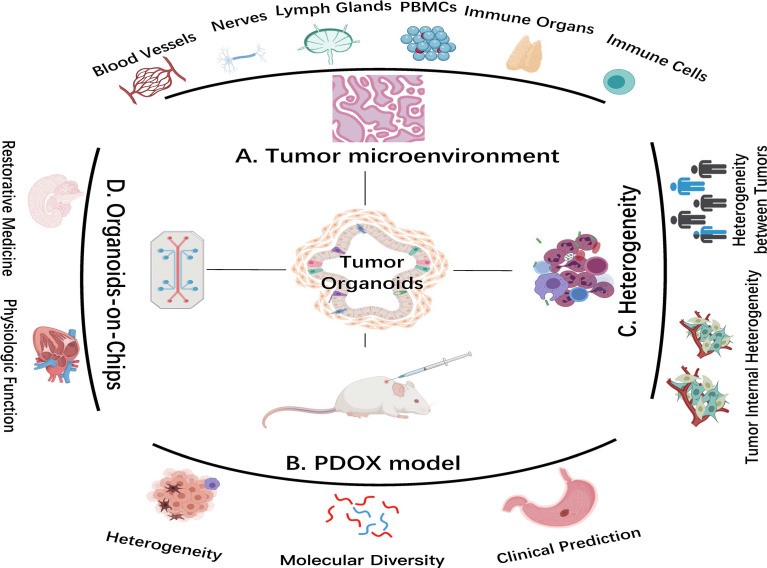 Fig.1 Cancer research transformed by advanced organoids. 1, 3
Comprehensive Mechanistic Validation Endpoints
Our service is designed to elucidate the precise molecular pathways and cellular events that drive carcinogenicity, providing data essential for regulatory submissions and risk mitigation strategies.
| Category | Mechanistic Endpoints (Assays) | Key Readouts & Technology |
|---|---|---|
| Genotoxicity & DNA Repair | Comet Assay, γH2AX Staining, Micronucleus Test (MNT), DNA Adduct Formation | High-Content Imaging, Flow Cytometry, Mass Spectrometry |
| Cellular Transformation | Anchorage-Independent Growth (Soft Agar Assay), Colony Formation Efficiency | Automated Cell Counting, Bright-field Microscopy |
| Pathway Activation | NF-κB, Wnt/β-catenin, TGF-β Signaling activation | Luciferase Reporter Assays, Western Blotting |
| Cell Fate Determination | Caspase Activation (Apoptosis), Cell Cycle Analysis (G1/S/G2-M arrest) | IHC, Immunofluorescence, Flow Cytometry |
| Angiogenesis/Invasion | Tube Formation Assay, Transwell Invasion/Migration Assays | Confocal Microscopy, Time-lapse Imaging |
| Molecular Profiling | WES, RNA-seq, Proteomics, Single-Cell RNA-seq (scRNA-seq) | NGS Platforms, Mass Spectrometry |
Contact Creative Biolabs today to schedule a confidential discussion about your oncology research.
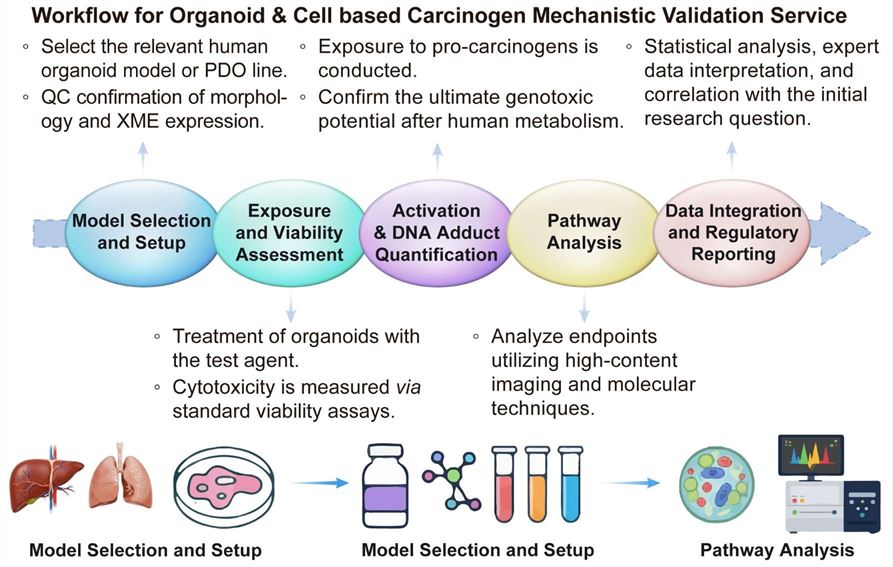
Workflow for Mechanistic Carcinogen Assessment
The implementation of Creative Biolabs' organoid and cell based carcinogen mechanistic validation service follows a rigorous, multi-step process designed for maximum data reliability and regulatory utility.
Publication
This review highlights how human organoids—derived from patients or iPSCs—are transforming cancer and toxicology research. By better mimicking human tissue than 2D cultures, they enable high-fidelity disease modeling, chemical screening, and carcinogenesis studies. When integrated with CRISPR editing, single-cell omics, and animal models, organoids form a powerful platform for identifying driver mutations and testing therapies. The article details their application in pancreatic cancer and discusses both the potential and current limitations of this fast-evolving technology for advancing personalized medicine.
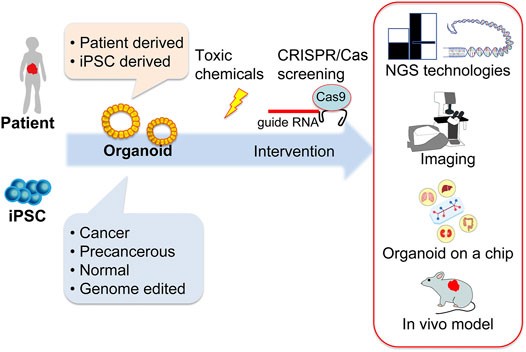 Fig.2 Schematic of human organoid and supporting technologies for cancer and toxicological research. 2, 3
Why Choose Us?
Creative Biolabs is a global leader in advanced in vitro toxicology, providing scientifically validated organoid platforms that overcome the predictive limitations of traditional models. Our key advantages include validated metabolic competence, where our organoids (especially liver models) proficiently metabolize pro-carcinogens, leading to tissue-specific DNA adduct formation. We utilize high-fidelity PDOs (patient-derived organoids) for personalized risk assessment, enabling the screening of rare mutational susceptibilities. Furthermore, we overcome static culture limitations using organoids-on-a-chip (OOC) microfluidic systems, which restore physiological fluid flow for accurate long-term chronic exposure modeling crucial for non-genotoxic agents. Our comprehensive mechanistic suite includes endpoints for stable cellular transformation, chronic inflammation, and signal transduction.
To learn how our OOC and co-culture technologies can unlock the complex MoA of your compound, reach out to Creative Biolabs today.
FAQs
Why should I use 3D organoids instead of standard 2D hepatocyte cultures for carcinogen testing?
Our 3D organoids, especially those from the liver and colon, retain high levels of XMEs and exhibit tissue-specific responses, providing a much more physiologically relevant and predictive model.
Can you study non-genotoxic carcinogens using these models?
Absolutely. While Creative Biolabs excels at DNA adduct quantification, our platform is fully equipped to analyze non-genotoxic mechanisms, including chronic pathway activation, cellular transformation assays, and the role of the tumor microenvironment (TME) via our co-culture services.
Is the high variability often associated with primary cells an issue for regulatory data?
We mitigate variability through strict quality control (QC) of organoid lines and high-throughput automation. Furthermore, while static organoids may lack certain TME components, our advanced OOC systems reduce variability by simulating a controlled, dynamic physiological microenvironment.
Customer Review
-
Unparalleled Accuracy
The quantification of DNA adducts by mass spectrometry in their liver organoids was far more predictive than our previous S9-based assays, which failed to activate our pro-carcinogen adequately. – A*. Smith -
Critical Mechanistic Insight
The ability of Creative Biolabs to co-culture our PDOs with immune components provided the critical evidence needed to differentiate between direct genotoxicity and inflammation-driven non-genotoxic transformation. – Dr. L. K**b
Related Services
To achieve comprehensive safety and efficacy goals, customers often complement their research with the following services:
Treg Functional Profiling in Tumors
Creative Biolabs offers an advanced Treg functional profiling service to comprehensively investigate the roles and characteristics of Tregs within the TME, crucial for understanding cancer progression and treatment resistance.
Learn More →Protease Assay Service
Creative Biolabs offers a protease assay service for precise measurement of immune-relevant proteases. Services include ABP profiling and HTS for tool compound identification in immuno-oncology.
Learn More →How to Contact Creative Biolabs
Creative Biolabs offers the highest standard of precision toxicology, ensuring your safety data is human-relevant, predictive, and regulatory-ready. By leveraging organoids, OOCs, and advanced mass spectrometry, we are defining the future of carcinogen risk assessment and de-risking your product development.
Transform your preclinical toxicology with the power of precision. Contact Creative Biolabs today to consult with our expert team and design a custom mechanistic validation study for your critical assets.
Reference
- Wang, Z., et al. "Application of Organoids in Carcinogenesis Modeling and Tumor Vaccination." Front Oncol 12 (2022): 855996. https://doi.org/10.3389/fonc.2022.855996
- Sekine, K. "Human Organoid and Supporting Technologies for Cancer and Toxicological Research." Front Genet 12 (2021): 759366. https://doi.org/10.3389/fgene.2021.759366
- Distributed under Open Access license CC BY 4.0, without modification.
 Download our brochure