Multi-Omics Data Integration for Gene-Environment Interaction Analysis Service
Creative Biolabs' specialized multi-omics data integration for gene-environment interaction analysis service transforms complex, multi-layered data into actionable intelligence, moving beyond simple correlation to establish causality and mechanism. By seamlessly integrating genomics, transcriptomics, epigenomics, and metabolomics, we define how specific environmental factors—such as chemical exposures or lifestyle—interact with genetic predispositions to drive disease or resistance. This high-resolution mapping identifies the molecular initiating events (MIEs) and downstream adverse outcome pathways (AOPs), providing a robust scientific foundation for drug discovery, safety pharmacology, and regulatory compliance.
Introduction: Bridging the Gap in Cancer Etiology
The relationship between genetic susceptibility and environmental carcinogens represents the critical missing link in understanding cancer prognosis and etiology. Traditional research focusing on single omics layers (e.g., only transcriptomics) or simple parallel integration often fails to capture the true gene-environment (G×E) interaction—the non-additive effect where an environmental factor actively modulates a genetic component's contribution to risk. This mediation results in exponential risk shifts that are invisible to conventional analyses. Creative Biolabs' service is engineered to solve this limitation by delivering a statistically robust and biologically interpretable solution, directly fulfilling the scientific community's urgent need for methods that implement hierarchical integration and explicitly model the G×E term for precision medicine.
Strategic Research Solutions
Precision Subject Stratification
We utilize a proprietary two-stage vertical integration approach to identify individuals whose genetic profiles make them exponentially susceptible to specific environmental exposures. This enables the design of targeted prevention trials based on unique G×E interaction signatures.
Mechanistic Target Validation
By modeling the interaction term, we pinpoint biological vulnerabilities where environmental factors drive carcinogenic activity. This identifies highly validated targets that interrupt the critical G×E feedback loop, offering a stronger rationale for drug development than simple main-effect markers.
Robust Regulatory Evidence
Our vertical integration maps the entire molecular cascade—from upstream genetic changes (e.g., DNA methylation or CNA) to downstream gene expression and protein levels. This complete molecular narrative supports regulatory submissions and intellectual property claims.
Superior Prognostic Modeling
We employ penalized survival regression to build models that explicitly incorporate G×E interaction terms. These multi-factor risk score models achieve significantly higher prognostic power (C-index) than single-omics approaches.
Uncover the hidden G×E drivers of your target cancer. Discover How We Can Help - Request a Consultation Today
Workflow: A Two-Stage Vertical Integration Approach
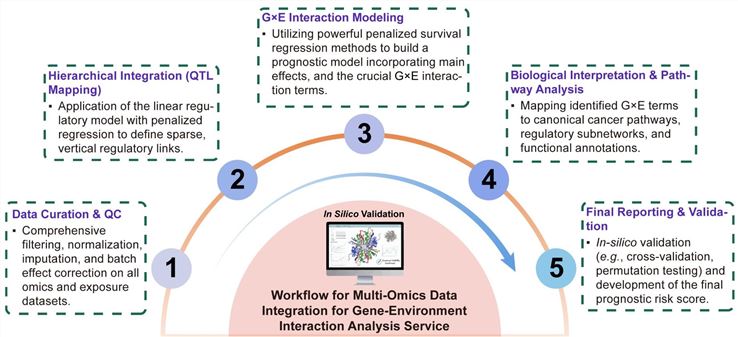
The workflow for our multi-omics G×E interaction analysis is a comprehensive, multi-step process designed for maximum clarity, interpretability, and rigor:
Publication
This review provides a systematic overview of computational methods for integrating multi-omics data in precision medicine. It categorizes and explains key unsupervised, supervised, and semi-supervised integration techniques, highlighting specific tools for each approach. The article further discusses the application of these methods for improving biological discovery and, importantly, for enhancing the prediction of clinical outcomes such as patient survival.
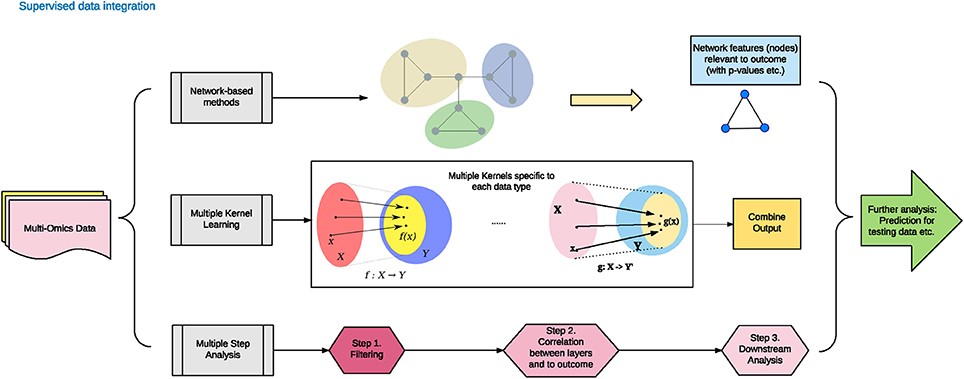 Fig.1 A supervised methodology for data integration. 1
Why Choose Us?
Creative Biolabs leads the industry in advanced multi-omics integration, moving beyond simplified parallel approaches to utilize exclusive hierarchical (vertical) integration. This methodology models the true biological regulatory cascade, identifying genetic factors functioning as molecular quantitative trait loci (QTLs) for superior predictive accuracy. Our two-stage model explicitly quantifies non-additive G×E interaction terms, detecting synergistic effects between genetics and environmental exposures that traditional models miss. To master high-dimensional data, we employ advanced penalized regression techniques during our two-stage process. This ensures precise feature selection and noise mitigation, providing high-signal, biologically relevant insights that are essential for validating complex drug targets and biomarkers.
Are you ready to elevate your cancer research with scientifically validated, integrated insights? Experience the Creative Biolabs Advantage - Get a Quote Today
FAQs
What types of omics data can Creative Biolabs integrate, and what is the minimum requirement?
We routinely handle genomics, epigenomics (e.g., DNA methylation), transcriptomics (e.g., mRNA, miRNA), and proteomics data. We require a minimum of two omics platforms per sample for vertical integration to be effective.
Why is your "Vertical Integration" model superior to other methods I've seen?
While many methods use "parallel integration," ignoring the biological chain of command, our vertical integration explicitly models this regulatory hierarchy. This approach yields results that are both more accurate prognostically and significantly more meaningful mechanistically.
What kind of environmental or exposure data (E-factor) is required for the G×E analysis?
The quality of the E-factor is crucial. We require high-resolution, subject-matched data for optimal model performance, such as detailed study history (e.g., smoking status, lifetime exposure data), laboratory measurements (e.g., viral load), or specific questionnaire data.
Customer Review
-
Superior Predictive Power
Using Creative Biolabs' analysis in our research has significantly improved the C-index of our breast cancer survival model by integrating methylation and expression data, leading to a much more reliable subject risk stratification. – Dr. An*Jn -
Handling High-D Data
The two-stage vertical integration successfully deconvoluted our high-dimensional pan-cancer dataset, solving our problem of compounding noise that previous parallel methods couldn't handle, and delivered a clear, biologically interpretable regulatory map. – Prof. Sh*Tn
Related Services
Creative Biolabs offers several specialized services designed to accelerate your precision oncology project:
Immune Cell Surface Marker Identification Service
Creative Biolabs identifies immune cell surface markers (e.g., CD molecules, MHC) to evaluate phenotypic changes and distinguish specific cell populations, accelerating effectiveness analysis in immunology research.
Learn More →Engineering Lung Cancer Cells for Self-destruction
Creative Biolabs offers lung cancer cell engineering to trigger self-destruction via cytokine overexpression in SCLC and NSCLC (A549, H358) cell lines, supporting novel immunotherapy research.
Learn More →How to Contact Creative Biolabs
Creative Biolabs' multi-omics data integration for gene-environment interaction analysis service offers a powerful and necessary leap forward in cancer research. By championing vertical integration and meticulously modeling the crucial gene-environment interaction, we provide the precise mechanistic insights required to accelerate drug discovery, refine subject stratification, and lead the charge in personalized oncology.
Contact Creative Biolabs today for a confidential consultation and a tailored proposal for your next G×E analysis project.
Reference
- Huang, Sijia, Kumardeep Chaudhary, and Lana X. Garmire. "More is better: recent progress in multi-omics data integration methods." Frontiers in genetics 8 (2017): 84. Distributed under Open Access license CC BY 4.0, without modification. https://doi.org/10.3389/fgene.2017.00084
 Download our brochure