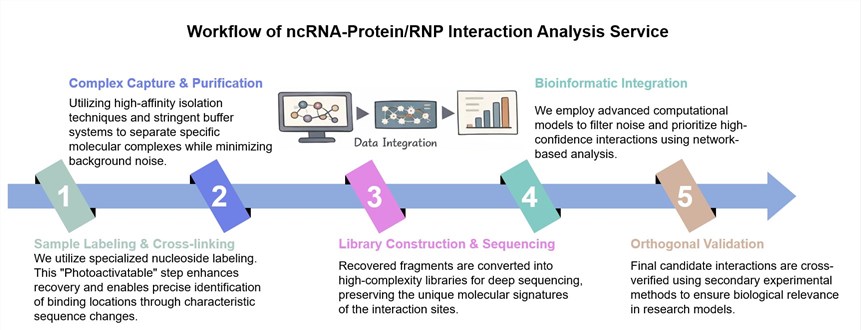
We offer bespoke optimization of chemical labeling concentrations and light-induced cross-linking intensities. These parameters are tuned based on your specific cell lines or research samples to ensure maximum interaction capture.
ncRNA-Protein/RNP Interaction Analysis Service
Creative Biolabs provides an end-to-end analytical platform for the discovery and validation of regulatory RNA-protein interactions. Our service combines sophisticated labeling techniques with advanced bioinformatics to map the physical contact points between transcripts and their protein partners. Clients can expect to gain interaction datasets, validated binding motifs, and high-confidence lead prioritization. By partnering with us, researchers achieve a deeper mechanical understanding of cellular regulation, streamlining the transition from initial identification to functional characterization in fundamental biological studies.
Introduction What We Can Offer Workflow Why Creative Biolabs Customer Reviews FAQs Related Services Contact Us
Introduction of ncRNA-Protein/RNP Interaction Analysis
The study of RNA-protein complexes is essential for understanding gene regulation. Scientific literature highlights that traditional cross-linking often lacks the sensitivity to detect transient interactions. Advances in light-sensitive labeling and intelligent computational frameworks have revolutionized the field, allowing for high-resolution mapping and sequence-based accuracy in research applications. Creative Biolabs integrates these peer-reviewed methodologies into a unified service to provide the most credible analysis for basic science.
To facilitate a highly customized analytical approach, request a consultation.
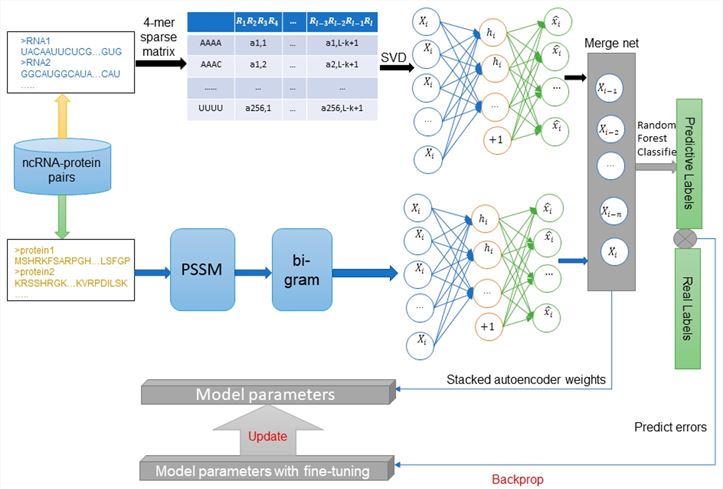 Fig.1 Workflow of a deep learning model for ncRNA-protein interaction predictions.1
What We Can Offer
Fully Customized Experimental Design
End-to-End Characterization
Our one-stop service transitions seamlessly from laboratory-scale pilot validation to high-throughput, large-scale mapping. We provide comprehensive coverage across the entire transcriptome, ensuring no regulatory interaction is missed during the discovery process.
Precision Probe Optimization
Benefit from our deep expertise in optimizing antisense probe design to maximize capture efficiency. This is particularly crucial for low-abundance RNA targets where signal-to-noise ratios must be carefully managed for success.
High-Standard Quality Control
We implement quality-driven principles and rigorous internal protocols throughout our workflow. This ensures maximum sample purity and data reproducibility, providing you with high-confidence results that stand up to scientific scrutiny.
Professional Applications and Research Support Provided by Creative Biolabs
Why Choose Us?
| Key Advantages | Unique Features |
|---|---|
| Hybrid Validation Strategy | We offer a multi-layered approach where physical experimental results are strictly cross-verified against evolutionary conservation data. This dual-track strategy increases the biological credibility of every identified interaction. |
| Intelligent Feature Learning | Our platform utilizes deep representation learning to identify hidden high-level patterns within molecular sequences. This allows for the discovery of non-canonical binding events that standard analytical methods typically overlook. |
| High-Confidence Benchmarking | Our predictive models are rigorously tested against extensive research datasets to ensure superior accuracy. This precision helps researchers prioritize the most significant regulatory hubs for their specific biological applications. |
Utilize the specialized capabilities of the Creative Biolabs platform and request a formal quotation to support your research objectives.
Customer Reviews
-
Unmatched Precision in Mapping
Using Creative Biolabs' specialized capture service in our neurobiology research has facilitated the identification of binding sites on rare circular RNAs. The specific sequence transition scoring provided a level of precision we couldn't achieve with standard methods. - Dr. A***n. L. -
Predictions Grounded in Reality
Implementing the predictive modeling in our screening improved our hit rate for follow-up experiments. The interpretable analysis allowed us to focus only on high-confidence regulatory nodes, saving us months of bench work. - Prof. S***e. M.
FAQs
How does this method differ from standard sequencing approaches?
Our approach uses light-sensitive nucleoside labeling which increases capture efficiency and provides a specific molecular signature. This allows researchers to identify exact binding sites through characteristic sequence transitions after cross-linking.
Can you identify interactions for molecules with no known structure?
Yes. Our advanced computational frameworks predict interactions with high accuracy using sequence data and evolutionary probability matrices. This enables the discovery of functional targets for RNAs that lack established structural models.
Related Services
Antibody Engineering Services
Our experts provide engineering services to optimize antibody affinity and specificity. We offer advanced solutions for modifying molecular scaffolds to ensure high-performance research tools for precise protein isolation.
Learn More →Target Genome Editing Service
We provide sophisticated gene modification services using advanced molecular tools to create precise knockouts or knock-ins. This platform enables the functional validation of identified RNA-protein regulatory hubs within custom cellular environments.
Learn More →How to Contact Us
Creative Biolabs is your premier partner for decoding the complexities of the non-coding interactome. By fusing high-sensitivity laboratory techniques with state-of-the-art predictive modeling, we provide a solution that moves your project from sequence to functional insight with unprecedented speed and accuracy in basic biological research.
For technical inquiries or to receive a custom project plan, please reach out to our specialists.
Reference
- Zhan, Zhao-Hui et al. "BGFE: A Deep Learning Model for ncRNA-Protein Interaction Predictions Based on Improved Sequence Information." International journal of molecular sciences vol. 20,4 978. 23 Feb. 2019. Distributed under an Open Access license CC BY 4.0, without modification. https://doi.org/10.3390/ijms20040978
 Download our brochure
Loading case studies...
Online Inquiry