Our team defines the physiological parameters and vascular bed of interest to align the model with your specific research objectives.
Vascular Evaluation Profiling & Reporting Service
Vascular evaluation profiling service at Creative Biolabs helps you obtain high-resolution physiological data to de-risk your pipeline through advanced micro-physiological systems and high-throughput morphometric screening. We solve the challenge of translating in vitro data to in vivo success by providing a thorough map of vascular integrity, barrier function, and transport kinetics using state-of-the-art microfluidic platforms.
Overview What We Can Offer Workflow Required Materials Application Highlights Customer Reviews FAQs Related Services
Overview
The vascular system acts as the primary gateway for systemic therapies, making its integrity a critical factor in pharmaceutical success. Recent research indicates that subtle changes in endothelial junctional proteins and shear stress responsiveness serve as early indicators of both therapeutic efficacy and potential adverse effects. Studies highlight that traditional static cultures lack the mechanical cues necessary for accurate vascular assessment. We conclude that an integrated profiling approach, combining real-time perfusion data with molecular expression patterns, is essential for predicting how candidates interact with the intricate human circulatory network under various disease states.
Our primary strategy centers on replicating the native biomechanical environment of the human vasculature. We utilize dynamic flow systems to induce physiological shear stress, which is vital for maintaining the mature endothelial phenotype. By integrating multi-omic profiling with physical barrier measurements, we identify the specific molecular pathways that govern vessel stability. Another key strategy involves the use of organ-specific endothelial cells, allowing us to map how a drug might behave differently in the blood-brain barrier versus the peripheral vasculature, ensuring a tailored evaluation for every project.
Empower Your Research with Creative Biolabs — Begin Your Expert Consultation Today
What We Can Offer
High-Resolution Vascular Morphometry
We quantify hundreds of structural parameters, including vessel branching, tortuosity, and diameter distributions, to identify microscopic changes in vascular architecture.
Endothelial Barrier Integrity Analysis
Using Trans-Endothelial Electrical Resistance (TEER) and solute flux assays, we provide precise measurements of the vascular seal and junctional stability.
Flow-Mediated Response Profiling
We assess how endothelial cells react to varying shear stress levels, monitoring the release of vasoactive factors and changes in gene expression under flow.
Leukocyte-Endothelial Interaction Mapping
This service evaluates the recruitment and adhesion of immune cells to the vascular wall, a critical metric for inflammatory and immuno-oncology research.
Quantitative Perfusion and Transport Kinetics
We track the movement of labeled molecules across the vascular wall to calculate permeability coefficients and determine the efficiency of drug delivery.
Workflow
Project Specification and Design
Endothelial Maturation under Flow
Primary human endothelial cells are seeded into specialized micro-physiological scaffolds and cultured under defined shear stress to achieve a quiescent, mature state.
Baseline Physiological Characterization
We establish the initial state of the vascular barrier through TEER measurements and baseline permeability assays to ensure model validity.
Controlled Therapeutic Exposure
Candidate molecules or inflammatory stimuli are introduced into the perfusate at specific concentrations to observe real-time vascular responses.
High-Content Data Acquisition
Automated imaging and sensor arrays capture dynamic shifts in vessel morphology, junctional protein localization, and transport rates throughout the exposure period.
Required Starting Materials
- Target Molecular Profile: Detailed information regarding the drug class and its intended mechanism (e.g., small molecule inhibitor or therapeutic antibody).
- Desired Tissue Context: Specifications on the vascular bed of interest, such as pulmonary, cerebral, or hepatic endothelial cell sources.
- Benchmark Control Data: Known reference compounds or previous in-house data points to assist in the calibration of the sensitivity thresholds.
Application
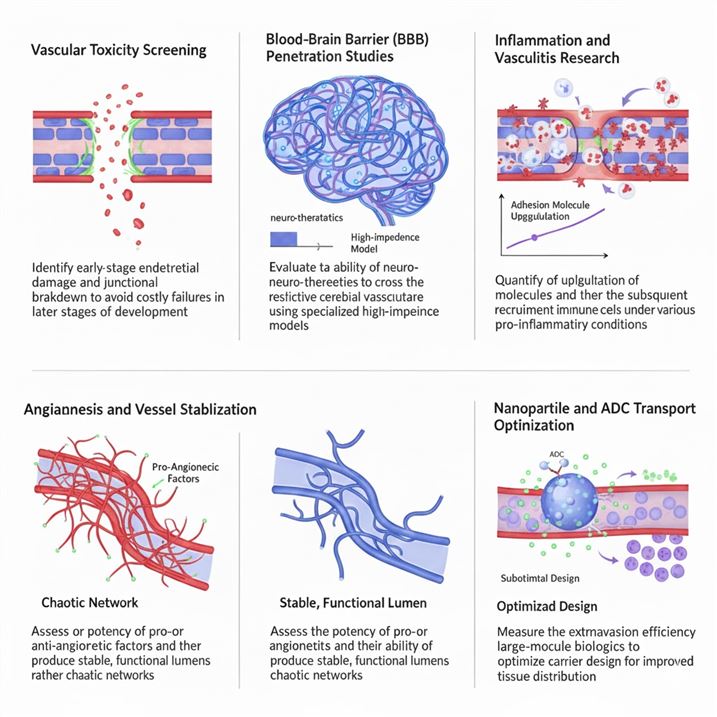
Highlights
Physiological Shear Stress Replication
Our systems recreate the exact fluid mechanical environment of human vessels. By applying precise shear stress, we ensure endothelial cells maintain mature barrier properties and junctional protein localization. This method predicts drug transport more accurately than plate-based assays, showing how candidates behave under realistic circulatory conditions.
Organ-Specific Vascular Beds
Creative Biolabs profiles drugs against specialized environments, such as the blood-brain barrier or pulmonary microvasculature. This organ-specific focus captures the metabolic and structural nuances of different tissues. Using organ-specific human cells, we deliver high-fidelity data on localized vascular integrity that animal models often miss.

Radiomic and High-Content Analytics
We use radiomic biomarkers to detect subtle structural changes invisible to standard microscopy. Automated morphometry extracts quantitative features like vessel tortuosity and fractal branching. This deep analytics suite identifies therapeutic benefits or toxicity at earlier time points and lower dosages than visual assessments.
Integrated Molecular-Perfusion Dossiers
Our service synchronizes molecular expression with physical barrier kinetics. We link shifts in gene expression, such as junctional protein downregulation, directly to changes in permeability and stability. This integration provides a complete narrative of a drug's vascular impact, serving as a robust base for critical project milestones.
Experience the Creative Biolabs Difference — Contact Us for a Tailored Quote
Customer Reviews
- "[Detailed Barrier Analysis] Using Creative Biolabs' Vascular Evaluation Profiling Service in our research has facilitated a much deeper understanding of our compound's impact on the BBB. The TEER measurements were incredibly stable, providing a level of sensitivity that allowed us to detect junctional weakening long before cell death occurred." -3 months ago, Dr. S***an R.
- "[Precise Morphometric Data] Using Creative Biolabs' Vascular Evaluation Profiling Service in our research has facilitated the objective quantification of vessel tortuosity in our diabetic models. The automated morphometry extracted data that was far more consistent than our manual counting, giving us the statistical power we needed for our publication." -2 months ago, Dr. J***ne K.
FAQs
How do your microfluidic models simulate the high pressure of solid tumors?
We use programmable syringe pumps to maintain specific interstitial fluid pressures within the matrix surrounding the printed vessels. This mimics the physical resistance found in malignancies, which is crucial for evaluating how well a drug can penetrate from the bloodstream into the tumor tissue.
Can your service distinguish between healthy and tumor-derived angiogenesis?
Yes, we can adjust the signaling environment by incorporating specific tumor-derived growth factors and fibroblasts. This allows us to compare how a compound affects the chaotic growth of tumor vessels versus the stable structure of healthy vasculature.
Related Services
Angiogenesis Regulatory Network & Pathway Integration Analysis Service
This service integrates key angiogenesis-related signaling networks and pathways to analyze regulatory mechanisms controlling vascular formation and remodeling. It supports systematic evaluation of pathway interactions in response to genetic or pharmacological modulation.
Learn More →Angiogenesis-Tumor Microenvironment Interaction Modeling Service
This service models angiogenic processes within tumor-associated microenvironments by assessing interactions between endothelial cells and surrounding tumor components. It enables functional analysis of microenvironment-driven vascular regulation and tumor–vasculature crosstalk.
Learn More →Creative Biolabs provides a thorough suite of Vascular Evaluation Profiling Service designed to address the complexities of the tumor-vessel interface. By combining advanced flow-based microfluidics with deep molecular and structural analytics, we provide the high-fidelity data necessary to understand vascular health and drug transport. Our team is dedicated to helping you translate biological insights into therapeutic success through rigorous, human-relevant modeling.
Contact Our Team to Discuss Your Vascular Evaluation Profiling Project and Technical Requirements.
 Download our brochure
Loading case studies...
Online Inquiry