Neoepitope Specific T Cell Isolation Service
How Our Neoepitope-specific T Cell Isolation Service Can Assist Your Project
Neoepitope-specific T Cell Isolation Service at Creative Biolabs furnishes researchers with highly purified, functional neoantigen-specific T cells. This enables more precise and effective cancer immunotherapy research. Our service delivers ready-to-use T cells. These are optimized for downstream applications. Such applications include in vitro assays, in vivo studies, and adoptive cell therapy (ACT) development. We offer solutions to the challenges of identifying and isolating these rare, yet critical, T cells. Precise isolation of neoantigen-specific T cells is essential for dissecting tumor-immune dynamics and advancing immunotherapeutic development. At Creative Biolabs, we not only deliver these critical cell populations but also provide comprehensive phenotypic and functional characterization. This ensures their experimental validity and supports diverse downstream applications, from mechanistic studies to translational research. This in turn enables scientists to focus on their core research questions. They can thus avoid spending valuable time and resources on the laborious process of cell isolation and validation.
Strategies
Our service employs a multi-faceted strategy to ensure optimal results:
MHC Multimer Technology
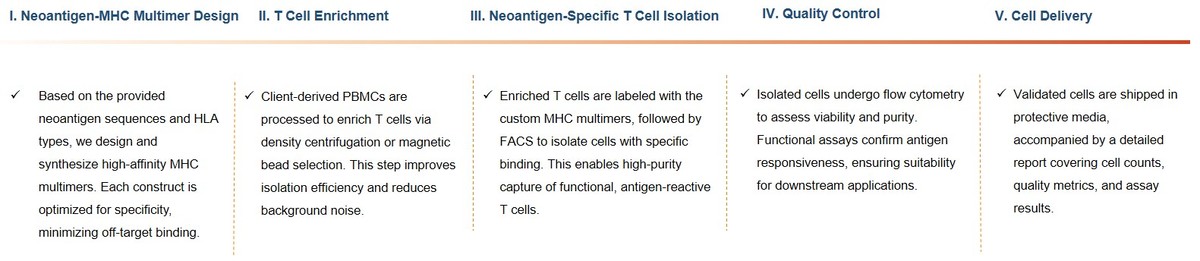
We utilize high-affinity MHC multimers. These specifically bind and isolate neoantigen-specific T cells. MHC multimers are synthetic complexes, which mimic the natural interaction between MHC molecules on antigen-presenting cells and T cell receptors (TCRs) on T cells. We can selectively target and bind to T cells by precisely engineering these multimers to present specific neoantigen peptides. These T cells express TCRs capable of recognizing those neoantigens. Our expertise in MHC multimer design and synthesis is crucial. It allows achieving high specificity and sensitivity in T cell isolation. We optimize factors such as HLA allele selection, peptide loading, and multimer valency. This ensures optimal binding. It also minimizes off-target effects.
Flow Cytometry
We employ advanced FACS. This achieves high purity and yield during cell sorting. These include size, granularity, and the expression of specific surface markers.
Customization
We tailor our service. We aim to meet the specific needs of each project. Needs include neoantigen specificity and HLA restriction. Recognizing that each research project has unique requirements, we offer a high degree of customization in our Neoepitope-specific T Cell Isolation Service. This includes the ability to design and synthesize MHC multimers. These target any neoantigen of interest, restricted by any HLA allele.
Quality Control
We employ a comprehensive suite of quality control assays to assess the viability, purity, and functionality of the isolated neoantigen-specific T cells. These assays include flow cytometry analysis. This confirms cell surface marker expression and viability.
Experience the Creative Biolabs Advantage - Get a Quote Today
Workflow
Our neoepitope-specific T cell isolation service follows a streamlined and efficient workflow. It is designed to deliver high-quality T cells tailored to your specific research needs.
Required Starting Materials:
-
Tumor Tissue or Viable Tumor Cells
Fresh or cryopreserved samples to enable antigen identification and downstream T cell processing. -
Patient-Matched PBMCs
Peripheral blood mononuclear cells from the same patient, essential for generating autologous immune responses. -
Neoantigen Information
Specific details on the target neoantigen(s), including peptide sequence and HLA restriction, to guide antigen presentation and T cell recognition strategies.
Why Choose Us?
At Creative Biolabs, the neoepitope-specific T cell isolation service distinguishes itself through technical rigor, scientific expertise, and a strong focus on client collaboration. By combining state-of-the-art methodologies with a team of skilled immunologists, we prioritize both precision and reproducibility throughout our workflow. Our commitment to quality control and tailored support ensures that researchers receive functionally validated, high-purity T cells optimized for downstream applications.
- Expertise: These individuals possess extensive experience. Their experience lies in T cell isolation and characterization.
- Advanced Technology: This guarantees optimal binding affinity and specificity for the target neoantigens. Our FACS instruments are equipped with the latest innovations. They allow for the precise separation of cells. This is based on multiple parameters.
- Customization: We offer a flexible approach and adapt our protocols and methodologies to align precisely with your research objectives.
- Quality Assurance: Our quality control protocols are designed to be comprehensive, encompassing every stage of the isolation process, from initial sample processing to final cell delivery. We employ a range of rigorous assays. These assays assess cell viability, purity, and functionality. This ensures that the T cells you receive meet the most demanding criteria and are ready for your downstream applications.
What We Can Offer
- High-purity neoantigen-specific T cells: We are committed to delivering T cells with the highest possible purity.
- Comprehensive quality control data: We provide detailed quality control data with every cell shipment.
- Customized solutions: We understand that every research project is unique. This flexibility extends to various aspects of the service.
- Expert consultation and support: Our team of experienced scientists will assist in experimental design, optimization of downstream assays, and interpretation of results.
Customer Reviews
Experience the Creative Biolabs Advantage - Get a Quote Today
FAQs
Q: What level of purity can I expect from the isolated T cells?
A: Our service is designed to achieve high purity. Typically, this exceeds 90%. This level of purity results from our optimized isolation. protocols and stringent quality control measures. We employ advanced techniques. These include high-affinity MHC multimer staining and flow cytometry. We use them to selectively isolate neoantigen-specific T cells. Our quality control process involves multiple steps. These ensure that the final cell population is highly enriched. It is enriched for the desired T cell specificity. It also has minimal contamination from other cell types. This high degree of purity is critical. It is key to the success of downstream applications. It improves the accuracy and reliability of experimental results. Reach out to our team. You can then get detailed specifications and data on the purity levels achieved in previous isolations.
Q: Can you accommodate custom neoantigen and HLA restrictions?
A: Yes, we offer customized solutions. These solutions aim to meet your specific research needs. We understand that researchers often work with unique neoantigens and HLA alleles. These are specific to their study population or disease model. Therefore, we have the capability to design and synthesize MHC multimers. These target any neoantigen of interest, restricted by any HLA allele. Our team works closely with you. We aim to obtain the necessary sequence information and HLA typing data. You can then discuss your project requirements. You can also explore the possibilities for custom neoantigen and HLA restriction.
Q: How does your service compare to other T cell isolation methods?
A: Our MHC multimer-based isolation method offers superior specificity and purity. This is in comparison to other methods, such as antibody-based selection. Antibody-based methods rely on targeting cell surface markers. They can sometimes result in the isolation of T cells that are not truly specific for the neoantigen of interest. This leads to off-target effects and reduced purity. In contrast, our MHC multimer technology directly targets the interaction between the T cell receptor and the neoantigen-MHC complex. This ensures a much higher degree of specificity. These applications require high precision. We are happy to provide detailed comparisons and data. These will come from published studies and our own internal validation experiments upon request. This will further illustrate the advantages of our method.
Q: What happens to the data generated from my project? Is it kept confidential?
A: We understand the importance of data confidentiality and security. All data generated from your project is handled with the utmost care. It is also handled in accordance with strict confidentiality agreements. We employ robust data management systems and security protocols. These protect your information. We can also work with you. This will help establish specific data sharing agreements if required.
Extended Services
-
TCR Identification: Our TCR sequencing service identifies and characterizes T cell receptors (TCRs) of your T cells of interest. This provides valuable insights. Insights into their function and potential therapeutic applications. We utilize advanced sequencing technologies. This helps deliver accurate and comprehensive TCR sequence information. This service can be particularly useful for researchers. Especially those studying T cell responses to cancer and developing TCR-based immunotherapies. For example, TCR sequencing can help in:
- Identifying unique TCR sequences. These are associated with specific neoantigen recognition.
- Understanding the diversity and clonality of T cell responses.
- Facilitating the development of TCR-engineered T cells. These are for adoptive cell therapy.
- Monitoring T cell responses during clinical trials.
-
Cellular Assays: To fully characterize the function of isolated neoantigen-specific T cells, it is often necessary to perform a variety of cellular assays, including cytokine release assays, cytotoxicity assays, and proliferation assays.
- Cytokine release assays (ELISA, ELISPOT, multiplex cytokine analysis) to measure the production of key effector molecules.
- Cytotoxicity assays (chromium release, flow cytometry-based assays) to assess the ability of T cells to kill target cells.
- Proliferation assays to evaluate T cell expansion upon stimulation.
- Activation marker analysis (flow cytometry) to track changes in T cell phenotype.
Contact Our Team for More Information and to Discuss Your Project
 Download our brochure