Cancer Stem Cell Nanoparticle Biodistribution Analysis Service
Creative Biolabs addresses the "delivery gap" in oncology by proving nanocarriers navigate the complex tumor microenvironment (TME) to reach resilient cancer stem cell (CSC) niches. We move beyond bulk accumulation metrics, providing high-resolution spatial mapping and quantitative "cellular dose" data to optimize ligand functionalization. Whether developing polymeric or lipid-based carriers, our insights ensure your therapy reaches the specific cells responsible for recurrence, effectively overcoming the median 0.67% delivery efficiency barrier for data-driven preclinical success.
Scientific Foundation of CSC Targeting
The CSC paradigm necessitates a fundamental shift from bulk tumor reduction to targeted eradication. Current research highlights that a staggering average of only ~0.67% of injected nanoparticles actually reach the tumor site, with an even smaller fraction successfully penetrating the protected CSC niche. This delivery failure is primarily attributed to high interstitial fluid pressure, dense extracellular matrix barriers, and rapid clearance by the mononuclear phagocyte system. Furthermore, the formation of a protein corona can mask synthetic targeting ligands, leading to unintended sequestration in metabolic organs. Effective biodistribution analysis must therefore employ single-cell resolution and spatial mapping to validate that therapeutics are not just localized within the tumor mass, but are internalized by the specific cells responsible for chemoresistance and metastasis.
Comprehensive Analysis Offerings
To provide a 360-degree view of nanoparticle behavior in vivo, Creative Biolabs offers an integrated suite of analytical platforms:
Macro-Level Pharmacokinetics & Systemic Distribution
We utilize ICP-MS/OES and radiolabeling (PET/SPECT/CT) to quantify nanoparticle concentrations across all major organs. This identifies the "MPS Sink", where particles are often sequestered by the liver (~10.69% ID/g) and spleen (~6.93% ID/g), allowing you to refine "stealth" coatings.
Protein Corona Characterization
We analyze the in vivo biological identity of your particles. By identifying the adsorbed serum proteins that mask targeting ligands, we help you understand and circumvent unexpected clearance pathways.
Single-Cell Resolution Intratumoral Mapping
Utilizing 3D tissue clearing and light-sheet microscopy, we visualize penetration depth. This reveals whether nanoparticles are clustering near leaky vessels or successfully reaching the hypoxic CSC niches.
Subcellular Localization & Endosomal Escape
Through TEM and flow cytometry, we quantify the "nanoparticle-per-cell" count and observe the trafficking of your formulation within isolated CSC subpopulations.
Bridge the Gap to Clinical Success — Inquire for a Detailed Project Proposal
Workflow
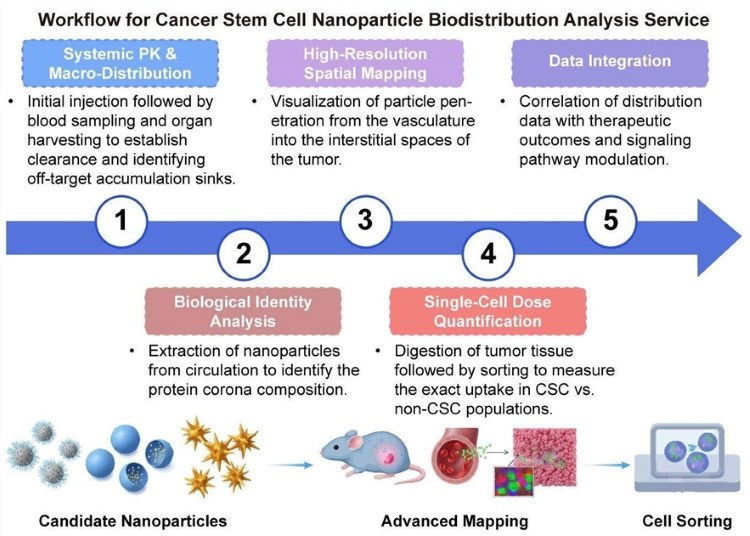
To ensure the highest accuracy, we follow a rigorous, standardized workflow designed for pharmaceutical-grade reporting.
Publication
This study develops a novel stem cell-nanoparticle system (SNS) for targeted gadolinium neutron capture therapy (Gd-NCT) against glioblastoma. By magnetizing umbilical cord mesenchymal stem cells with engineered nanoparticles, the SNS achieves enhanced blood-brain barrier penetration and specific tumor accumulation. In rat models, the system significantly improves the tumor-to-blood ratio, suppresses tumor progression, and extends survival using an ultra-low gadolinium dose, presenting a promising cell-based strategy for brain tumor therapy.
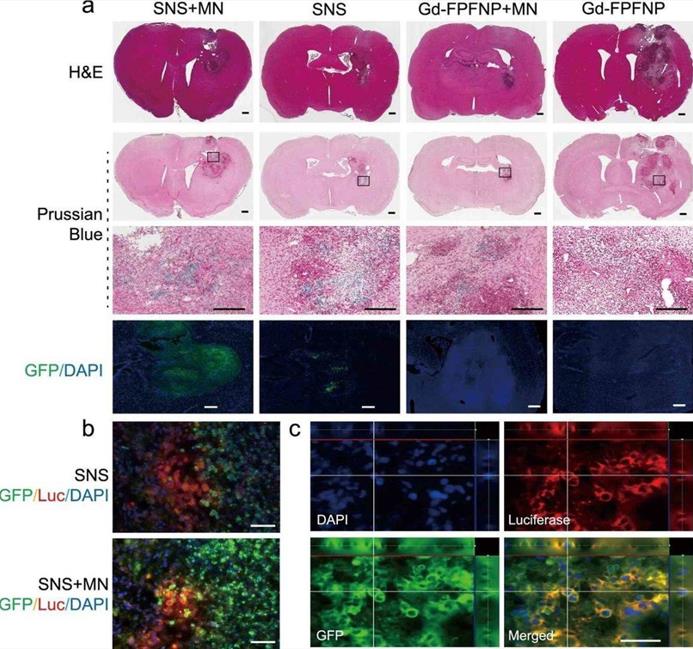 Fig.1 Comparative distribution of a SNS and Gd-Fu@IO@PVA/Fu nanoparticles (Gd-FPFNP) in F98 glioma tissues. 1
Why Choose Us?
Creative Biolabs stands at the intersection of nanotechnology and stem cell biology. Our unique advantage lies in our ability to simulate the human TME more accurately than standard CROs. We utilize patient-derived xenograft (PDX) and orthotopic models to ensure that biological barriers, such as the Blood-Brain Barrier or high interstitial fluid pressure, are realistically represented. Furthermore, we bridge the gap between "bulk delivery" and "cellular dose." By incorporating single-cell resolution data, we help you overcome the intratumoral heterogeneity that often causes clinical trials to fail. Our success stories include helping partners increase tumor-to-liver ratios by 3x and validating the delivery of epigenetic drugs to prevent non-CSC-to-CSC conversion.
Experience the Creative Biolabs Advantage — Get a Tailored Quote Today
FAQs
How do you differentiate between nanoparticles stuck in the vasculature vs. those internalized by CSCs?
We use a combination of saline perfusion to remove blood-pool particles and high-plex immunofluorescence to confirm intracellular localization within the CSC niche.
Can you track nanoparticles without fluorescent or radioactive labels?
Yes, for inorganic particles like gold, silica, or iron oxide, we use ICP-MS to track the elemental signature with extreme sensitivity without altering the particle's surface chemistry.
What is the benefit of characterizing the "protein corona" in a distribution study?
The corona determines the "biological identity." Knowing what proteins are adsorbed helps us explain why a particle might be heading to the liver instead of the tumor.
Customer Review
-
Single-Cell Precision Validation
Using Creative Biolabs' biodistribution service in our research has significantly improved our understanding of how protein corona formation was neutralizing our anti-CD44 ligands. The spatial mapping was eye-opening. - Prof. S***e M -
PDX Model Accuracy
The transition from cell-line models to PDX was seamless. Using the CSC analysis platform facilitated the validation of our pH-responsive polymeric NPs in a truly heterogeneous environment. - Dr. R***t K
Related Services
Cancer Stem Cell targeted Antibody modified Nanoparticle Development
Creative Biolabs provides smart platforms to eliminate quiescent CSCs. By bypassing ABC transporters and delivering on-demand payloads, we overcome resistance and toxicity to achieve total tumor clearance.
Learn More →Physical and Chemical Property Analysis Service
Creative Biolabs provides physicochemical analysis for ADEPT, evaluating solubility, stability, and pKa. We utilize HPLC/MS and CD to ensure structural integrity and binding kinetics, optimizing formulations for enhanced bioavailability and specificity.
Learn More →How to Contact Creative Biolabs
Creative Biolabs offers the industry's most comprehensive CSC nanoparticle biodistribution analysis service, combining macro-scale pharmacokinetics with single-cell spatial insights. Our expertise helps you navigate the complexities of the protein corona and the tumor microenvironment to ensure your precision oncology leads achieve their maximum potential.
For detailed project discussions or to receive a custom protocol design, please reach out to our team.
Reference
- Lai, Yen-Ho, et al. "Stem cell–nanomedicine system as a theranostic bio-gadolinium agent for targeted neutron capture cancer therapy." Nature Communications 14.1 (2023): 285. Distributed under Open Access license CC BY 4.0, without modification. https://doi.org/10.1038/s41467-023-35935-0
 Download our brochure