We provide tailored marker selection and assay designs specifically optimized for your unique research models or proprietary cell lines to ensure relevance.
Cancer Stem Cell Quiescence/Cell Cycle Arrest Detection Service
Creative Biolabs provides an end-to-end analytical platform for the detection and characterization of quiescent cancer stem cells (CSCs) in preclinical research. Our service delivers high-resolution molecular and metabolic data, enabling researchers to identify dormant cell populations that evade standard anti-proliferative screening. By partnering with us, clients gain a deeper understanding of the survival mechanisms driving tumor regrowth in experimental models, allowing for the strategic selection of lead compounds that effectively target non-cycling cells.
Introduction What We Can Offer How We Can Help Why Choose Us Customer Reviews FAQs Related Services Contact Us
Scientific Foundations of Cancer Stem Cell Quiescence Detection
Quiescence is a reversible G0-arrest state that allows CSCs to survive metabolic stress, mechanical shear in experimental circulatory models, and cytotoxic compounds. Literature supports the finding that this state is an active, rewired program involving cholesterol metabolism and autophagy rather than simple metabolic "shutdown." Creative Biolabs integrates these genomic hallmarks to provide a high-fidelity map of tumor dormancy, ensuring that drug development targets the most resilient cellular fractions to prevent regrowth in laboratory models.
Request a Consultation →
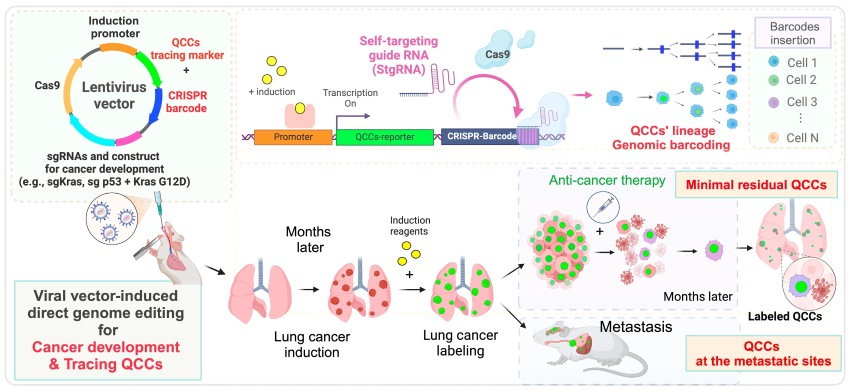 Fig.1 Potential advancements in next-generation in vivo QCC tracing system. 1
What We Can Offer
Highly Customized Detection Protocols
One-stop Multi-parametric Analysis
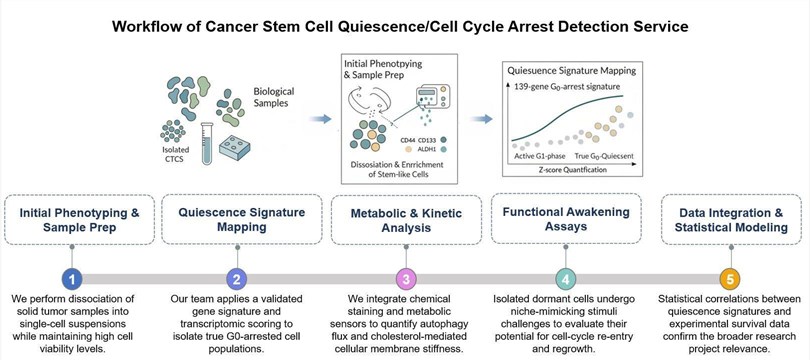
Our team integrates single-cell transcriptomics, metabolic flux, and mechanical membrane profiling into a unified workflow for a deep understanding of dormancy.
Proprietary G0-Z-Score Scoring
We utilize a validated gene signature and advanced bioinformatics to precisely quantify deep quiescence across diverse experimental tissue types and conditions.
Flexible Scaling
Our facility offers the capacity to handle high-throughput screening of lead compounds or deep-dive longitudinal studies on various experimental xenograft samples.
How Creative Biolabs Can Assist Your Project
Why Choose Us?
Creative Biolabs stands at the forefront of computational and experimental oncology. Our unique advantage lies in our ability to detect "Deep Quiescence" - states that traditional Ki-67 staining often overlooks. By combining mechanical force resistance assays with molecular profiling, we provide a holistic view of the metastatic cascade in research models.
Proprietary G0-Z-Score
Our validated genomic algorithm offers higher precision than standard cell-cycle markers.
Niche Mimicry
We utilize high-density cultivation models to simulate the crowded primary tumor environment for in vitro studies.
Published Data Support
Our methodology is grounded in established research linking G0 arrest to cholesterol metabolism and autophagy-mediated fitness.
Reach out to our experts to secure a precision-driven evaluation of your therapeutic candidates and gain the technical clarity needed to overcome tumor regrowth challenges.
Customer Reviews
-
Reliable Dormancy Mapping
Using Creative Biolabs' detection service in our research has facilitated the identification of p38/ERK-regulated dormancy in our head and neck cancer models. The depth of the Z-score analysis provided far more clarity than traditional flow cytometry. - Dr. A*a. M. -
Metabolic Insights
We found that the cholesterol flux assays were vital for understanding why our candidates failed in the circulatory system models. Creative Biolabs helped us see that our 'dead' cells were actually just quiescent and physically robust. - Prof. R*n. S.
FAQs
How does your service distinguish between quiescence and senescence?
Unlike senescence, which is largely irreversible, we use "Awakening Assays" and epigenetic markers to confirm that the arrested cells maintain their potential to re-enter the cell cycle.
Can I use this service for existing scRNA-seq datasets?
Yes. Creative Biolabs offers a "Computational Retrofit" option where we apply our 139-gene Z-score algorithm to your existing research data to identify dormant populations.
Related Services
Cancer Microenvironment-mediated Drug Resistance Analysis
We analyze how tumor microenvironment factors and stromal interactions protect cells from treatment, identifying specific biochemical and physical resistance pathways.
Learn More →Cancer Cell Resistant Strain Construction Services
We provide specialized services to develop stable, drug-resistant cancer cell lines to facilitate the study of long-term therapeutic evasion mechanisms in research.
Learn More →How to Contact Us
Creative Biolabs provides the molecular and functional toolkit necessary to solve the challenge of tumor dormancy in drug discovery. From transcriptomic Z-scoring to mechanical stress testing, we enable our partners to identify, track, and target the cells responsible for regrowth in experimental pipelines.
Ready to eliminate the "hidden" threat in your oncology pipeline? Contact our specialists for a detailed project proposal tailored to your research area.
Reference
- Kim, Moon Jong. "Tracing Quiescent Cancer Cells In Vivo." Cancers vol. 16,22 3822. 14 Nov. 2024. Distributed under an Open Access license CC BY 4.0, without modification. https://doi.org/10.3390/cancers16223822
 Download our brochure
Loading case studies...
Online Inquiry