Cancer Stem Cell targeted Nano-Drug Efficacy & Toxicity Assessment Service
Creative Biolabs provides a specialized analytical framework to validate the eradication of quiescent cancer stem cells (CSCs). We move beyond bulk screens, delivering quantitative data on self-renewal inhibition and niche disruption. Utilizing high-content imaging and molecular profiling, we track the intracellular fate of your nanoparticles from binding to lysosomal escape. Our service ensures your therapeutic candidates are rigorously evaluated against resilient cell fractions, providing the definitive evidence of "stemness" inhibition required for successful clinical development.
Foundational Introduction to CSC-Targeted Nanotoxicity
CSCs are a sub-population of tumor cells characterized by their ability to self-renew and differentiate into various cell types within a tumor. Because they are often slow-cycling or quiescent, they are inherently resistant to traditional chemotherapies that target rapidly dividing cells. Nanotechnology offers a solution by enabling the targeted delivery of high-potency agents directly to CSCs via surface marker recognition. However, the unique metabolism of CSCs, including upregulated cytochrome P450 enzymes and ABC transporters, presents a "biological barrier" that nanoparticles must overcome.
Precision Platforms
Our service portfolio is built upon multidimensional assays that move beyond simple cell death to explore the complex bio-interface of nanomaterials:
High-Throughput CSC Spheroid Screening
We utilize 3D culture systems that better mimic the physical architecture of tumors, allowing for the assessment of nanoparticle penetration and gradient-dependent efficacy within the hypoxic core.
Intracellular Trafficking & Fate Mapping
Using FRET-based sensors and hyperspectral imaging, we determine the exact rate of endosomal escape and the subsequent sub-cellular distribution of your payload, ensuring it reaches the intended nucleus or mitochondrial target.
Metabolic & Redox Profiling
Given that CSCs often exhibit distinct metabolic signatures (the Warburg effect), we offer real-time metabolic flux analysis to see how your nano-drug modulates mitochondrial respiration and glycolysis in targeted cells.
Comprehensive Immunotoxicity Panels
We evaluate the risk of complement activation-related pseudoallergy (CARPA) and cytokine release, ensuring your formulation is safe for systemic administration.
Optimize Your Nano-Drug Delivery - Request a Detailed Technical Offering
Workflow
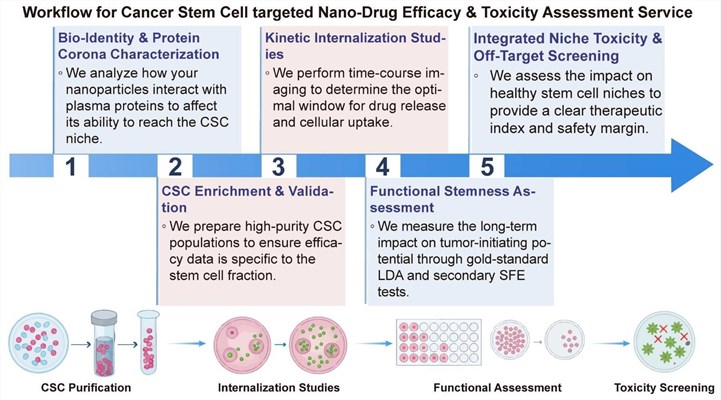
To ensure the most accurate translation of your nano-therapeutic concepts into validated data, Creative Biolabs employs a streamlined, five-stage operational framework.
Publication
This comprehensive review examines the functional roles and defining characteristics of CSCs as key drivers of tumor initiation, progression, and therapy resistance. It explores their metabolic plasticity, interactions with the tumor microenvironment, and emerging therapeutic strategies, including targeted inhibitors and immunotherapies, aimed at overcoming CSC-mediated challenges in clinical oncology.
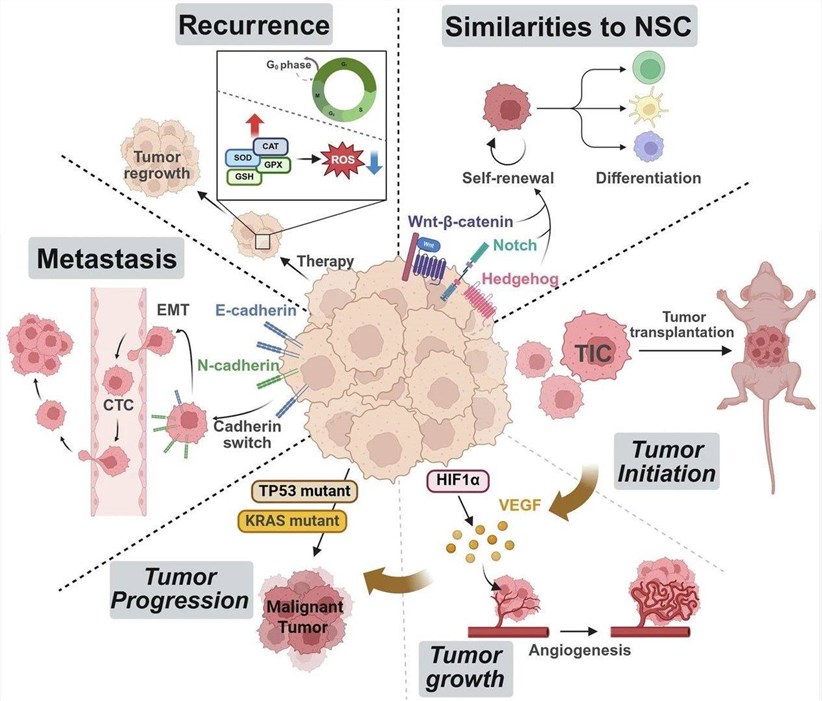 Fig.1 The multifaceted functional roles and core traits of CSCs. 1
Why Choose Us?
Creative Biolabs provides an unparalleled advantage by combining two decades of antibody engineering expertise with advanced nanotechnology assessment. Our "niche-simulation" platform is a unique differentiator; we don't just test cells in a dish; we recreate the acidic, hypoxic, and nutrient-deprived conditions of the CSC microenvironment. This results in data that correlates significantly higher with downstream in vivo performance. According to published data, our integrated efficacy/toxicity framework has helped researchers achieve a 40% higher success rate in moving from in vitro lead selection to successful animal model validation.
Experience the Creative Biolabs Advantage - Secure Your Project Quote Today
FAQs
How does Creative Biolabs distinguish between bulk tumor killing and CSC-specific inhibition?
We use multi-marker flow cytometry and ALDH activity assays to isolate the CSC population and perform comparative viability and sphere-forming assays against the non-stem progeny.
Can your platform assess the impact of the protein corona on targeting?
Yes, we simulate various physiological fluids (plasma, interstitial fluid) to determine how protein adsorption affects the ligand-receptor binding affinity of your nanoparticles.
What types of toxicity do you screen for besides cell death?
We look for "hidden" toxicities, including DNA double-strand breaks, mitochondrial membrane potential loss, and the induction of a pro-inflammatory secretome.
Customer Review
-
Enhanced Internalization Clarity
Using Creative Biolabs' service in our research has significantly facilitated our understanding of endosomal escape kinetics for our gold-nanostar platforms. - Dr. Julianne S*** -
Superior CSC Specificity
The limiting dilution analysis provided by Creative Biolabs gave us the first definitive proof that our nano-drug was actually eliminating the stem cell niche rather than just the progenitors. Their technical expertise is unmatched. - Prof. Marcus H***
Related Services
Cancer Stem Cell Nanoparticle Stability & Release Testing
Creative Biolabs validates LNPs and micelles to ensure payloads reach dormant CSC "seeds". By simulating TME interactions, we overcome delivery hurdles and optimize bioavailability, bridging the gap between prototypes and clinical success.
Learn More →Venom Peptides Synthesis Service
Creative Biolabs provides customized venom peptide synthesis and recombinant expression. We offer diverse modifications, cyclization, and high-throughput library services to accelerate your drug discovery and structural research.
Learn More →How to Contact Creative Biolabs
Creative Biolabs offers the industry's most robust suite of tools for validating the next generation of CSC-targeted nanomedicines. Our integrated efficacy and toxicity assessments provide the clarity you need to move your project forward with confidence.
For detailed project discussions or to receive a customized quote, please reach out to our oncology specialist team.
Reference
- Lee, Haksoo, et al. "Cancer stem cells: landscape, challenges and emerging therapeutic innovations." Signal transduction and targeted therapy 10.1 (2025): 248. Distributed under Open Access license CC BY 4.0, without modification. https://doi.org/10.1038/s41392-025-02360-2
 Download our brochure