CAR-T In Vivo Pharmacology Service
We provide a robust testing framework designed to validate the therapeutic window of your CAR-T leads. Our expertise allows you to visualize cell trafficking, quantify tumor eradication, and predict human-equivalent doses with precision. Whether you are developing traditional viral-transduced cells or cutting-edge in vivo engineering platforms like mRNA-LNPs, we provide the evidence needed for a strong IND filing. By evaluating expansion kinetics and the "on-target, off-tumor" potential in physiological environments, Creative Biolabs ensures your lead candidate is optimized for therapeutic impact rather than just laboratory potency.
Introduction of CAR-T In Vivo Pharmacology
The paradigm of CAR-T cell therapy has undergone a transformative evolution, shifting from simple adoptive cell transfer to sophisticated in vivo genomic engineering. While in vitro assays provide essential snapshots of cytotoxic potential, they cannot replicate the dense extracellular matrix of solid tumors or the systemic inflammatory networks of a living organism. Current literature highlights that the success of these "living drugs" depends on their ability to traffic, expand, and survive within a hostile tumor microenvironment. Recent breakthroughs in gene delivery platforms, such as circular RNA (circRNA) and targeted nanoparticles, have further complicated the pharmacological landscape, requiring specialized tracking of transient vs. permanent expression.
In Vivo Pharmacology Services for Cellular and Gene Therapy Products
Creative Biolabs is committed to offering exactly what clients need with integrated solutions, accelerated timelines to make a difference. Our scientists are dedicated to helping our clients to overcome challenges, avoid risks, and expedite CGT drug development with a broad array of pharmacology studies, such as ADME, PK, PD, toxicology, MoA, etc. Individual studies and customized integrated solutions will be designed with our clients’ goals in mind. In addition, our regulatory experts will ensure that all studies meet global requirements for quality and compliance, which can smooth the path to market.
Key Considerations for Cellular and Gene Therapy
| CT product fate post-administration | CT product with implantable scaffolds | GT product |
|
|
|
Specific Studies for Cellular and Gene Therapy Products
| Proof of Concept studies | ☆ We offer POC studies to define the dose range and timing, optimize the route of administration, and characterize the mechanism of action. |
| Dose determination studies | ☆ We provide appropriate models to help determine dose regimen and route of administration via measurements of biological activities. |
Pharmacological Measurements for Cellular and Gene Therapy Products
| ✔ Cell phenotype | ✔ Cell source | ✔ Ex vivo manipulation |
| ✔ Minimal effective dose | ✔ Limiting dose | ✔ Cell fate |
| ✔ Possibility of host immune response | ✔ Local and systemic toxicities | |
Endpoint Analysis Capabilities
| ✔ Clinical chemistry, coagulation and hematology | ✔ Histopathology and immunohistochemistry | ✔ Deep sequencing |
| ✔ Replication-competent virus detection | ✔ Neutralizing antibody assays | ✔ Total and infectious titer assays |
| ✔ High-throughput bioanalysis | ✔ Immunogenicity | ✔ Biomarker analysis |
Considerations of Gene Therapy products
| ✔ Safety/activity via the intended clinical ROA | ✔ Aberrant localization to non-target cells/tissues | ✔ Level and/or persistence of vector and transgene expression |
| ✔ Level of viral replication in non-target cells/tissues | ✔ Inappropriate immune activation | ✔ Immune response directed against the vector |
| ✔ Phenotype/activation state of target cell(s) | ✔ Potential for insertional mutagenesis and/or oncogenicity | ✔ Transgene-related concerns |
Ready to bridge the gap from lab to clinic? Request a Consultation with Our Scientists
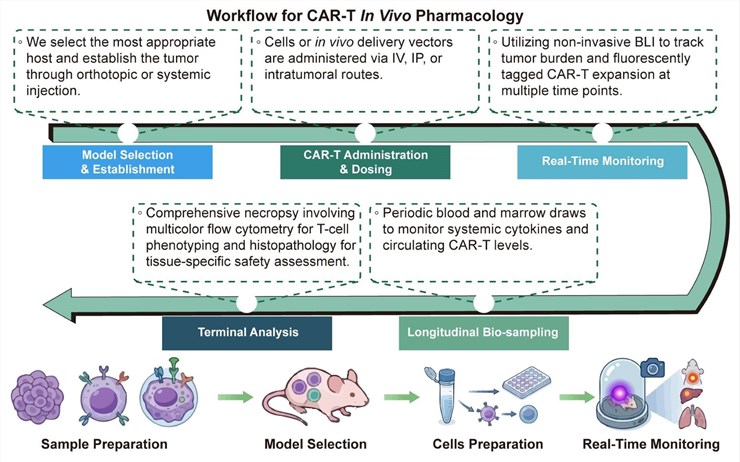
Workflow
To initiate a project, we maintain a streamlined and communicative process at Creative Biolabs to ensure your specific research goals are met.
Publication
This review examines in vivo CAR-T engineering as an alternative to traditional adoptive therapy, highlighting its potential to overcome manufacturing complexity and high costs. It covers current delivery platforms (viral vectors, nanoparticles, implants), key challenges including immunogenicity and safety concerns, and discusses enhancement strategies derived from adoptive therapy experience. The paper emphasizes the promising clinical advances and transformative potential of this approach.
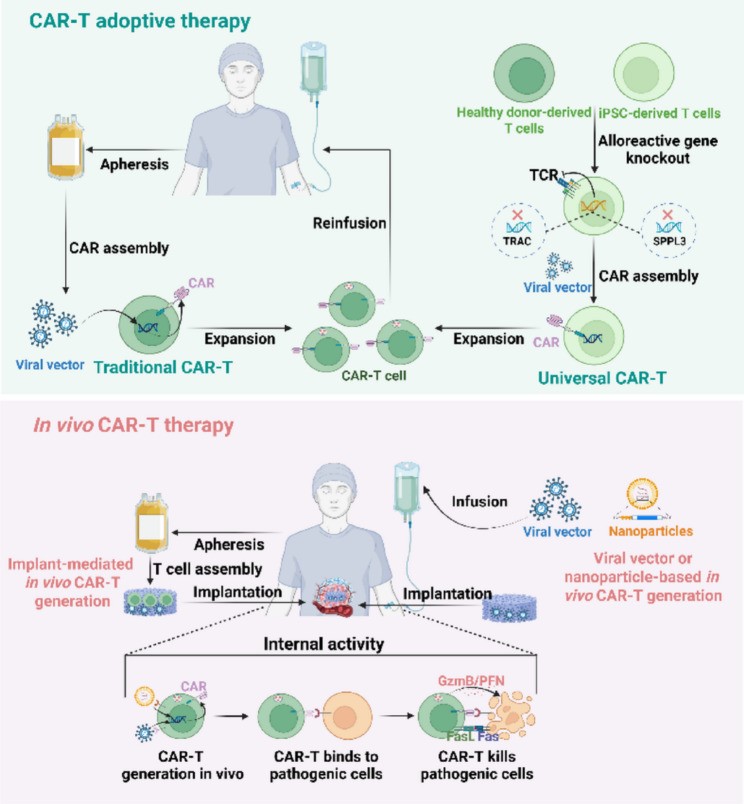 Fig.1 Technical pathways for adoptive and in vivo CAR-T therapy. 1
Why Choose Us
Creative Biolabs stands at the forefront of immuno-oncology by integrating deep biological expertise with high-throughput pharmacological execution. Our unique advantage lies in our proprietary humanized mouse platforms, which enable the modeling of complex human immune interactions that standard murine models fail to capture. Unlike traditional CROs, we specialize in identifying "on-target, off-tumor" toxicities and cytokine release patterns early in the development cycle. Furthermore, we leverage quantitative systems pharmacology (QSP) to transform preclinical data into predictive clinical dose simulations, significantly de-risking the "first-in-human" transition. By choosing Creative Biolabs, you gain access to unrivaled persistence tracking and specialized protocols for next-generation delivery formats like circRNA and cardiolipin-mimetic LNPs.
Eliminate development bottlenecks—Speak with a Specialist and Secure a Customized Quote
FAQs
Can you test CAR-T cells against solid tumors with high fibrosis?
Yes, we specialize in orthotopic and PDX models for solid tumors, including pancreatic and liver cancer, to assess the impact of the extracellular matrix on T-cell infiltration.
How do you monitor for cytokine release syndrome (CRS) risk?
We utilize humanized mouse models and multiplex cytokine assays to detect early human-specific inflammatory markers such as IL-6 and IFN-γ.
Do you support in vivo engineering projects using mRNA or circRNA?
Absolutely. We have specific platforms designed to measure the efficiency and duration of in vivo T-cell programming via LNP delivery without ex vivo culture.
Customer Review
-
Superior TME Insights
Using Creative Biolabs' CAR-T in vivo pharmacology in our research has significantly facilitated our understanding of how our cells navigate the immunosuppressive microenvironment. The PDX models provided a much more realistic challenge than standard cell lines. - Dr. Al*** M -
Accurate Dose Prediction
The integration of QSP modeling with their in vivo data allowed us to refine our starting dose. The persistence data was remarkably clean and helped us argue for a longer dosing interval during our planning phases. - Sarah L***
Related Services
Regulatory T Cell Therapy Development Services
Creative Biolabs develops CAR-Treg therapies via subpopulation profiling, migration assays, and suppression testing. We optimize antigen specificity and functional survival to treat autoimmune disorders and promote immune tolerance.
Learn More →Toxicological Evaluation of Venom Peptides
Creative Biolabs provides venom toxicity testing via MTT/LDH assays, LD50/ED50 studies, and organ-on-a-chip models. We deliver standardized safety assessments and comprehensive reports to accelerate your toxin-based drug development.
Learn More →Contact Us
Creative Biolabs provides the most comprehensive and technologically advanced CAR-T in vivo pharmacology services available today. From complex humanized models to cutting-edge genomic stability monitoring, we ensure your candidate is fully characterized for safety and efficacy.
Partner with experts to maximize your project's clinical potential—Contact Our Team for a Detailed Consultation
Reference
- Chen, Yizhao, et al. "In vivo CAR-T cell engineering: concept, research progress, potential challenges and enhancement strategies." Experimental Hematology & Oncology 14.1 (2025): 133. Distributed under Open Access license CC BY 4.0, without modification. https://doi.org/10.1186/s40164-025-00725-5
 Download our brochure