High Content Analysis (HCA) based Low-Density Lipoprotein (LDL) Uptake Assay Service
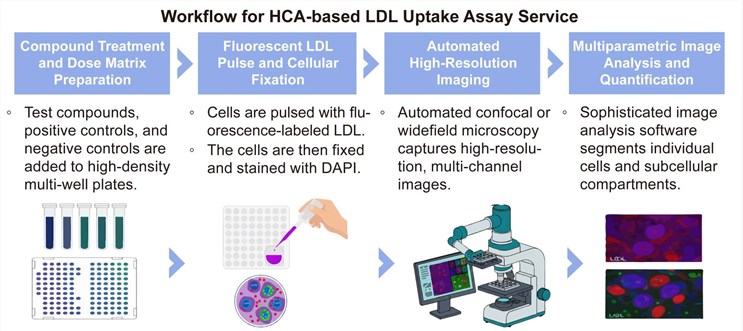
Creative Biolabs' service offers a sophisticated platform for assessing cellular uptake of low-density lipoproteins (LDL), a crucial factor in understanding lipid metabolism and cardiovascular health. Utilizing advanced imaging technologies, this service quantitatively evaluates the internalization of fluorescently labeled LDL particles in various cell types under diverse experimental conditions. The high content analysis (HCA) system provides high-resolution images and automated quantification, enabling customers to analyze multiple parameters such as uptake efficiency, subcellular localization, and cytotoxic effects in a high-throughput manner.
Why Do LDL Uptake
LDL uptake is a crucial physiological process for maintaining cellular function and lipid homeostasis. LDL particles serve as carriers of cholesterol and triglycerides, delivering these essential lipids to cells throughout the body. Cells uptake LDL via specific receptors, primarily the LDL receptor, which facilitates the internalization of LDL particles into the cytoplasm. This process is vital for synthesizing cellular membranes, hormones, and bile acids, all of which rely on cholesterol. Additionally, adequate LDL uptake helps ensure that cells have sufficient energy reserves and structural components. However, excessive LDL uptake and accumulation can lead to pathologies such as atherosclerosis, highlighting the importance of regulatory mechanisms governing LDL metabolism.
Specific Deliverables and Solutions
Mechanistic MoA Elucidation
We provide detailed analysis of LDL particle subcellular localization and trafficking, clarifying compound effects on receptor binding, endocytosis, or lysosomal processing, essential for intellectual property and IND-enabling stages.
Genetic Variant Functional Confirmation
For familial hypercholesterolemia (FH) projects, we deliver definitive functional evidence to classify LDLR gene variants, foundational for precision medicine and patient cohort selection.
Integrated Toxicity Screening
Our platform simultaneously measures multiple cellular health parameters (e.g., nuclear morphology, membrane integrity) alongside efficacy, ensuring early detection of off-target or cytotoxic effects, significantly reducing downstream failure risks.
Discover How We Can Help - Request a Consultation to discuss your specific target and compound series today.
Comprehensive Workflow
Our service follows a clear, structured workflow designed for maximum efficiency and data quality, ideal for visualization as a detailed project flowchart.
Publication
This study establishes an automated high-content imaging platform to profile lipid trafficking in human primary leukocytes. The multiparametric analysis quantifies LDL uptake and introduces a novel "lipid mobilization" score, measuring cellular efficiency in depleting lipid stores. Validated with 65 individuals, the research reveals that impaired lipid mobilization correlates with hypercholesterolemia and age. Crucially, combining these functional cellular readouts with a polygenic risk score significantly improves hypercholesterolemia risk stratification over genetic data alone, providing a powerful approach for personalized cardiovascular risk assessment.
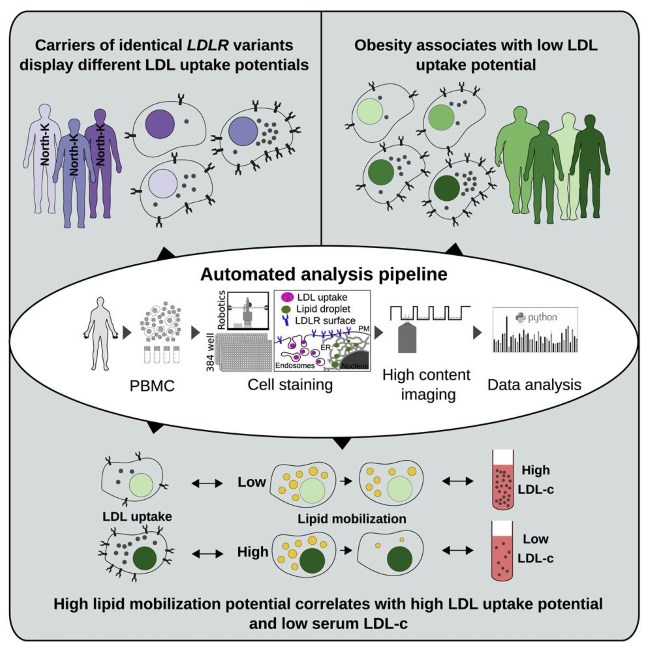 Fig. 1 High-throughput functional assessment of LDL metabolism in PBMC-derived cells. 1
Why Choose Us
Creative Biolabs' HCA-based LDL uptake assay service offers an industry-leading advantage by fusing high-throughput capability with high-content resolution, ensuring fast and actionable biological information. Our superior mechanistic resolution provides spatial localization data, allowing quantification of drug effects on LDL processing within specific organelles, paramount for identifying and validating targets in receptor trafficking. We offer integrated risk reduction through simultaneous efficacy and toxicity readouts, enabling early preclinical risk assessment and deprioritizing flawed leads sooner. Our commitment to quality is guaranteed by rigorous standards, ensuring accurate, reproducible data ready for critical review.
Experience the Creative Biolabs Advantage - Get a Quote Today and secure the high-content data needed for your next milestone.
FAQs
How does HCA compare to standard ELISA or flow cytometry for LDL uptake?
Our HCA assay measures multiparametric data on a per-cell basis, including morphology and subcellular localization, and HCA provides essential mechanistic clarity and enables the detection of off-target effects, information that is simply unavailable through low-content bulk assays.
Can your assay handle complex models, such as patient-derived cells or 3D spheroids?
Yes. Our HCA platform is highly versatile and is specifically optimized for complex, physiologically relevant models, including patient-derived cells and 3D cultures. We customize the imaging and analysis protocols to ensure accurate segmentation and quantification, regardless of cellular complexity.
Is it possible to use the HCA assay to study LDLR degradation or recycling kinetics?
Yes. By precisely controlling pulse and chase times with the fluorescent LDL, we can quantify the rate of LDL internalization and monitor the subsequent trafficking of the LDLR back to the cell surface (recycling) or to the lysosome (degradation).
Customer Review
-
Reduced False Positives
Using Creative Biolabs' service in our research has significantly improved our confidence in our hit list. Their multiparametric toxicity assessment helped us immediately filter out several toxic leads that passed our initial bulk HTS, saving us months of downstream effort. - Dr. L**re Ma*y -
Mechanistic Proof
The ability to get subcellular localization data on the endosomes was the key benefit. This HCA data provided the definitive proof that our compound was indeed enhancing LDLR recycling, not just overall binding. - An*a Jo**es
Related Services
To fully leverage the power of your HCA-based LDL Uptake data, consider integrating these complementary services offered by Creative Biolabs:
Regulatory T Cell Therapy Development Services
Creative Biolabs offers comprehensive Treg therapy development services, including isolation, expansion, subpopulation profiling, genetic modification, and functional assays (Treg suppression, migration, and T-cell transendothelial migration effects).
Learn More →Biologics Testing Services
Creative Biolabs provides comprehensive assays for oncology immunotherapy, covering development, optimization, validation, and performance, adhering to guidelines throughout the drug development cycle.
Learn More →Contact Us
Creative Biolabs offers the definitive, high-resolution solution for validating drug candidates targeting lipid metabolism. Our HCA-based LDL uptake assay service delivers the multi-parametric data and mechanistic clarity required to accelerate your preclinical pipeline and bring confidence to your lead selection.
Contact Our Team for More Information and to Discuss Your Project
Reference
- Pfisterer, S. G., et al. "Multiparametric platform for profiling lipid trafficking in human leukocytes." Cell Rep Methods 2.2 (2022): 100166. Distributed under Open Access license CC BY 4.0, without modification. https://doi.org/10.1016/j.crmeth.2022.100166
 Download our brochure