Ion Channel Panel Screening Service
Understanding Ion Channels
Ion channels are pivotal for the electrical activity of excitable cells and play crucial roles even in non-excitable tissues. These specialized proteins form gateways in cell membranes, regulating the flow of ions such as sodium, potassium, calcium, and chloride, which are vital for various physiological functions. Ion channels are also involved in a multitude of physiological and pathological processes, making them essential targets for treating a broad spectrum of diseases. Due to their roles in cellular function and diseases, ion channels have become hot targets in the development of therapeutic antibodies and proteins. Beyond their direct therapeutic potential, ion channels are crucial biomarkers in drug safety assessments.
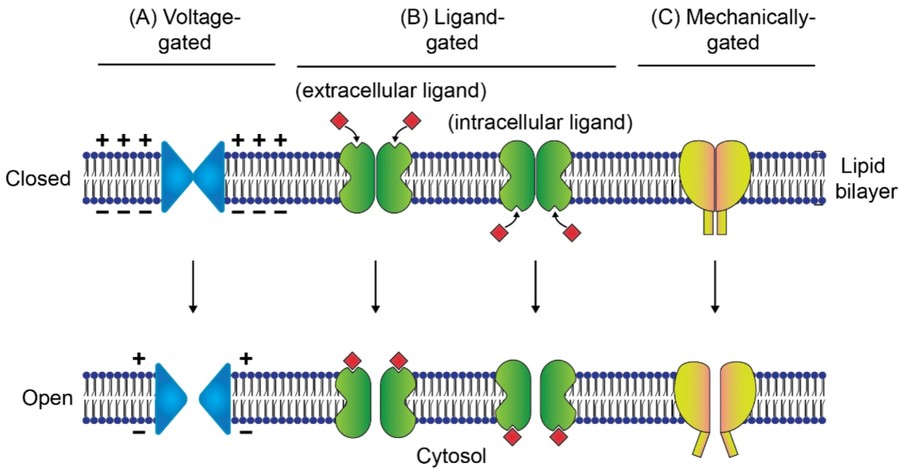 Fig.1 Three types of ion channels.1
At Creative Biolabs, we offer specialized cellular functional selectivity panels tailored for advanced therapeutic antibody and protein development. We are committed to offering ion channel panel screening services to meet the demands of drug discovery and development.
Our Ion Channel Panel Screening Service
Creative Biolabs provides an extensive range of validated assays for meticulous ion channel profiling. Our ion channel assays are supported by over 100 stable cell lines, organized meticulously to incorporate the latest scientific advancements. We offer diverse ion channel screening services, including manual and automated patch clamp techniques, alongside FLIPR assays. These services are designed for an array of therapeutic areas, facilitating detailed risk assessments and mechanistic studies.
Ion Channels & Targets
| Ion Channel | Target | |
|---|---|---|
| Voltage Gated Ion Channels | Sodium channels | NaV1.1, NaV1.2, NaV1.3, NaV1.4, NaV1.5, NaV1.6, NaV1.7, NaV1.8, rNaV1.7, rNav1.8, Late Na |
| Calcium channels | CaV1.2 (L-type), Cav1.3, CaV2.2 (N-type), CaV2.1 (P/Q-type), CaV3.2 (T-type), CRAC (STIM1/Orai) | |
| Voltage-gated potassium channels | KV1.1, KV1.2, KV1.3, KV1.4, KV1.5, KV2.1, KV3.1, KV3.4, KV4.2/chip, KV4.3/chip, KV7.1 (KCNQ1/KCNE), KV7.2, KV7.3, KV7.4, KV7.5, KV7.2/7.3 (KCNQ2/3), KV11.1 (hERG) | |
| Inward-rectifier potassium channels | Kir2.1, Kir4.1, Kir3.1/3.4 (Kach), Kir3.2 (GirK2), Kir6.2/Sur2A, Kir6.2/Sur1 | |
| Calcium-activated potassium channels | BKCa, IKCa, SK1, SK2, SK3 | |
| Two-pore domain potassium channels | TASK-1, TASK-2, TREK-1 | |
| Acid sensitive ion channels | ASIC1a, ASIC1b, ASIC3 | |
| Hyperpolarization-activated cyclic nucleotide-gated ion channel | HCN1, HCN2, HCN4 | |
| Chloride channel | CFTR, ANO-1, ANO-2 | |
| Ligand Gated Ion Channels | GABA | GABAA1-GABAA6 |
| Glutamate | NR1/NR2A, NR1/NR2B, NR1/NR2C, NR1/NR2D, AMPA | |
| Ach | nAChR(α1)2β1ɛ8, nAChRa3β4, nAchRa4β2, nAchRα7/RIC3 | |
| 5-HT | 5-HT3A | |
| Glycine | GlyRa1/β | |
| ATP | P2X1, P2X2, P2X2/3, P2X3, P2X4, P2X5, P2X7 | |
| TRP channels | TRPV1, TRPV3, TRPV4, TRPA1, TRPM4/SUR1, TRPM8, TRPC5, TRPC6, TRPML1, TRPML3, TPC2 |
Comprehensive Ion Channel Panels
Our ion channel panel encompasses a comprehensive suite of offerings targeting various physiological and pathological conditions. Key panels include:
- Cardiac Channel Panel: Focused on heart-related ion channels, crucial for cardio-related therapeutic solutions.
- Cardiovascular Channel Panel: Covering channels significant in vascular health and hypertension.
- Pain-Inflammation Channel Panel: Targeting pathways involved in pain and inflammatory responses.
- Seizure-Convulsion Channel Panel: Essential for understanding epilepsy and related disorders.
- Cancer Channel Panel: Focused on channels implicated in cancer cell proliferation and metastasis.
- Metabolic GI Channel Panel: Targeting ion channels relevant in gastrointestinal and metabolic conditions.
- Neurodegeneration/Stroke Channel Panel: Essential for therapies targeting neurodegenerative diseases and stroke.
- Pulmonary-Respiratory Channel Panel: Covering channels involved in respiratory and pulmonary health.
- Psychiatric Disorder Channel Panel: Targeting mood disorder-related channels.
- Genitourinary Channel Panel: Focusing on channels involved in urinary tract functions.
Applications of Ion Channel Panel Screening Service
Our service is structured to deliver insights into several key aspects, including:
- Selectivity Profiling: Determining the specificity of a compound for its targeted ion channel, crucial for understanding potential off-target effects.
- Safety Assessment: Evaluating the safety profile of compounds to prevent adverse effects, particularly cardiac-related issues linked to ion channels.
- Mechanism of Action (MoA) Research: Delving into how therapeutic antibodies or proteins interact with their target channels to exert their effects.
Contact us today to discover how our services support your drug discovery endeavors.
Reference
- Islam, Md Sirajul, James P. Gaston, and Matthew AB Baker. "Fluorescence Approaches for Characterizing Ion Channels in Synthetic Bilayers." Membranes 11.11 (2021): 857. under Open Access license CC BY 4.0, without modification.
 Download our brochure