Creative Biolabs provides senescence marker profiling, quantifying SA-β-gal activity and p16/p21 expression. We utilize multiplexed protein assays to evaluate senescence-associated secretory phenotype (SASP) and cell cycle arrest for therapeutic validation.
Learn More →Cellular Senescence & SASP driven Tumor Progression Analysis Services
Creative Biolabs provides a comprehensive analytical roadmap to decode how senescent cells influence tumor evolution. We deliver precise quantification of the senescence-associated secretory phenotype (SASP) and its impact on neighboring malignant and immune cells. By defining the "senescence burden" in your models, we enable the validation of senolytics, senomorphics, and combination therapies that prevent tumor recurrence and immune escape. Our approach leverages high-dimensional data to move beyond simple staining, providing a functional understanding of how senescent populations remodel tissue architecture and suppress anti-tumor immunity.
Background Featured Services Workflow Publication Why Choose Us FAQs Customer Review Related Services Contact Us
Comprehensive Insights into SASP and Tumor Evolution
Cellular senescence is a stress-induced state of cell cycle arrest that, while initially tumor-suppressive, paradoxically drives malignant progression through the SASP. Recent research highlights that chronic SASP accumulation creates an immunosuppressive "senescence–plasticity axis" governed by pathways like cGAS-STING and the secretion of pathogenic factors such as SPP1 and ANGPTL4. These bioactive molecules facilitate immune escape, promote angiogenesis, and trigger the reprogramming of cancer cells into stem-like states, fueling therapeutic resistance and metastasis.
Specialized Solutions for Senescence Characterization
To address the multifaceted nature of cellular senescence, Creative Biolabs has developed a series of specialized analytical modules. These solutions are designed to bridge the gap between basic biomarker detection and deep functional characterization of the senescence-associated secretome.
Senescence Marker Profiling
Senescence associated Secretory Phenotype Analysis
Creative Biolabs provides senescence-associated secretory phenotype (SASP) analysis, quantifying pro-inflammatory secretomes. We utilize multiplex cytokine profiling and proteomics to evaluate paracrine signaling and TME remodeling for anti-aging therapeutic validation.
Learn More →Senescent Cell-Immune Interaction Mapping
Creative Biolabs provides senescent cell-immune interaction mapping, quantifying SASP-mediated immune recruitment. We utilize high-plex spatial profiling to evaluate senolytic efficacy and immune clearance dynamics within the complex tumor microenvironment.
Learn More →Senescence induced Tumor-Promoting Inflammation Assessment
Creative Biolabs provides senescence-induced tumor-promoting inflammation assessment, quantifying SASP profiles and TME remodeling. We utilize high-resolution cytokine arrays to evaluate senescence-driven genomic instability and immune evasion for therapeutic optimization.
Learn More →Therapy induced Senescence Evaluation & Stress Response Profiling
Creative Biolabs provides therapy-induced senescence evaluation, quantifying SA-β-gal activity and SASP secretomes. We utilize high-resolution stress response profiling to evaluate mitochondrial DNA leakage and metabolic shifts for therapeutic validation.
Learn More →Is your research hitting a bottleneck in TME characterization? — Request a Strategy Session with Our Oncology Specialists
Workflow
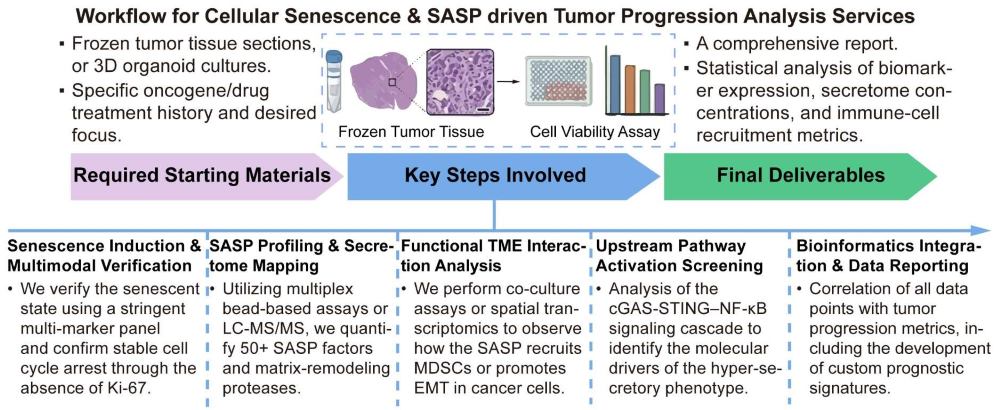
Our standardized yet flexible workflow ensures that every project receives the rigorous oversight necessary for high-stakes drug discovery. By following a structured progression from induction to integrated bioinformatics, we guarantee reproducible and highly granular data.
Publication
This study reveals that a small subset (<7%) of malignant senescent cells promotes glioblastoma (GBM) progression. Partial elimination of p16Ink4a-expressing senescent cells using a p16-3MR transgene or the senolytic drug ABT263 significantly prolongs survival in GBM-bearing mice. Through single‑cell and bulk RNA sequencing, the authors identify NRF2 as a key driver of the senescent phenotype. A senescence gene signature derived from mouse models is conserved in patient GBMs, where higher signature scores correlate with worse survival, suggesting that senolytic therapy may benefit GBM patients.
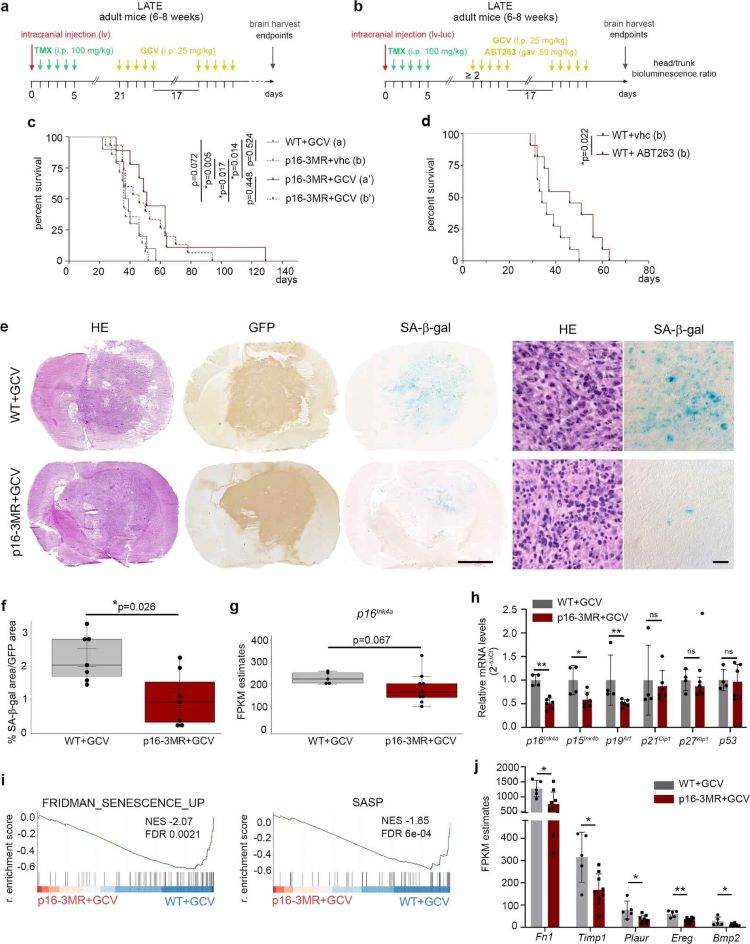 Fig.1 Partial elimination of senescent cells prolongs survival in GBM-bearing mice. 1
Why Choose Us?
Creative Biolabs stands at the global forefront of senescence research, offering a unique blend of mechanistic depth and high-throughput capacity. Our platforms are meticulously optimized to distinguish between transient, tumor-suppressive senescence and persistent, pathogenic populations—a critical distinction for modern precision oncology. We utilize benchmarked data from high-impact research to validate our SASP prognostic signatures, ensuring your findings align with current scientific standards in molecular cancer research. Our commitment to accuracy ensures that therapeutic candidates are tested against biologically relevant models, ranging from 3D patient-derived organoids to complex co-culture systems.
Experience the Creative Biolabs Advantage – Get a Precise Quote for Your Project Today
FAQs
How do you differentiate between senescent cells and quiescent or apoptotic cells?
We use a multi-marker strategy including SA-β-gal activity, SAHF formation, and the absence of Ki-67 incorporation, paired with annexin V staining to rule out apoptosis, ensuring the highest specificity.
Can you analyze the SASP in samples?
Yes. While secretome analysis is most sensitive in fresh samples, we utilize spatial transcriptomics and highly multiplexed IHC to profile SASP gene and protein signatures directly within tissue sections.
Is the cGAS-STING pathway analysis essential for all senescence projects?
While not mandatory, it is highly recommended for projects exploring the innate immune triggers of the SASP or evaluating senomorphic drugs designed to suppress inflammation without clearing cells.
Customer Review
-
High Sensitivity in SASP Detection
Using Creative Biolabs' analysis in our research has significantly facilitated the characterization of low-abundance cytokines in our pancreatic cancer organoids. Their multiplex platform is far superior to standard ELISA for secretome mapping. - Dr. Sarah W -
Innovative Mechanistic Insights
Characterizing the cGAS-STING pathway activation in our senescent fibroblasts gave us the mechanistic proof needed for our research. Creative Biolabs provided a level of detail we couldn't achieve in-house. - Prof. Elena L
Related Services
Fibronectin targeted IFNγ Development Service
Creative Biolabs develops Fn-IFNγ fusion proteins, quantifying fibronectin-targeted localization and IFNγ signaling. We utilize detuned cytokine engineering to evaluate MHC-I upregulation and stromal deactivation for an optimized therapeutic index.
Learn More →IFNα Conditional Activation Engineering Service
Creative Biolabs provides IFNα conditional activation engineering, quantifying protease-sensitive masking and PK optimization. We utilize biased agonism to evaluate TME-specific activation and JAK/STAT signaling, maximizing efficacy while minimizing systemic toxicity.
Learn More →How to Contact Creative Biolabs
Creative Biolabs provides the most comprehensive services in the industry. By combining structural biomarkers, innate immune signaling (cGAS-STING), and prognostic secretome modeling, we empower researchers to overcome the complexities of the tumor microenvironment and accelerate the development of next-generation oncology therapeutics.
Ignite Your Discovery – Partner with Creative Biolabs for Comprehensive Senescence Analysis
Reference
- Salam, Rana, et al. "Cellular senescence in malignant cells promotes tumor progression in mouse and patient Glioblastoma." Nature communications 14.1 (2023): 441. Distributed under Open Access license CC BY 4.0, without modification. https://doi.org/10.1038/s41467-023-36124-9
 Download our brochure
Loading case studies...
Online Inquiry