Telomerase (hTERT) Expression & Activity Assessment Service
Creative Biolabs provides a definitive roadmap for measuring cellular immortality across diverse biological contexts. Whether you are validating a novel oncology therapeutic designed to inhibit telomerase or engineering a stable cell line for long-term production, our deliverables ensure that hTERT activity is accurately quantified and functionally verified. We resolve the "black box" of telomere maintenance by providing clear data on protein stability, mRNA splicing, and enzymatic throughput, allowing you to make data-driven decisions in your development pipeline.
Introduction to Telomerase (hTERT) Dynamics
Telomerase is the essential ribonucleoprotein responsible for maintaining telomere length, a prerequisite for the indefinite proliferation observed in 90% of human cancers. Recent scientific literature emphasizes that hTERT is regulated through a multi-layered hierarchy: from promoter mutations that recruit ETS factors, to post-translational "soft" controls like Akt-mediated phosphorylation and ubiquitination-led degradation. Furthermore, the discovery of telomere-to-promoter crosstalk, where telomere length dictates the sequestration or release of TRF2 to repress hTERT, has redefined our approach to assessing cellular immortality. Understanding these dynamics is critical for the development of targeted oncology therapeutics and the safety of engineered cellular products.
Comprehensive hTERT Assessment Solutions
To support the diverse needs of the global research community, Creative Biolabs offers a multi-layered analytical suite that covers every aspect of the telomerase lifecycle:
Enzymatic Activity Quantification
Utilizing the gold-standard telomeric repeat amplification protocol (TRAP), refined through digital droplet technology (ddTRAP). This allows for absolute quantification and unparalleled sensitivity, detecting activity in rare cell populations where standard fluorescence-based assays fail.
Expression Profiling (mRNA & Protein)
We employ RT-qPCR with isoform-specific primers to distinguish between full-length active hTERT and non-functional splice variants (e.g., alpha and beta variants). Protein levels are assessed via high-affinity western blotting and IHC, validated for nuclear localization.
Regulatory Mechanism Analysis
Beyond simple activity, we investigate the post-translational modifications that control hTERT stability. This includes phosphorylation state analysis (PI3K/Akt/mTOR pathway) and ubiquitination assays to track protein turnover.
Epigenetic & Chromatin Studies
We offer specialized ChIP-seq services to map TRF2 binding and G-quadruplex (G4) formation at the hTERT promoter, providing a holistic view of the "telomere-to-promoter" feedback loop that regulates cellular senescence.
Unlock Insights into Cellular Immortality – Request a Specialist Consultation Today
Workflow
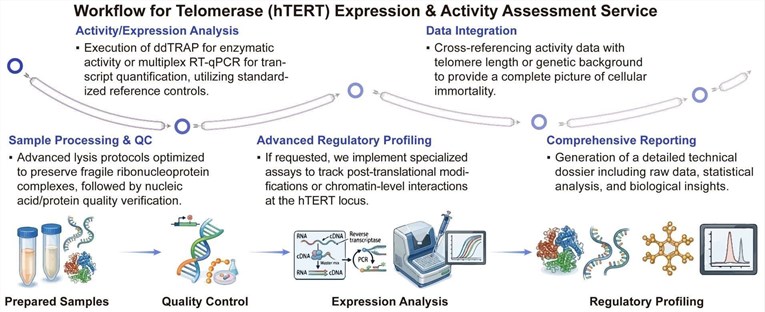
To ensure the highest levels of data reproducibility and scientific rigor, Creative Biolabs utilizes a standardized, phase-gate workflow designed to minimize experimental noise and maximize sensitivity.
Publication
This review comprehensively examines the genetic and epigenetic mechanisms regulating hTERT expression in cancer, including promoter mutations, gene amplification, genomic rearrangements, promoter methylation, and microRNA interactions. The authors highlight the clinical implications of these regulatory alterations, emphasizing their potential as diagnostic and prognostic biomarkers across multiple tumor types. By elucidating how cancer cells achieve telomerase reactivation and limitless self-renewal, this work provides insights crucial for developing targeted telomerase-based therapies.
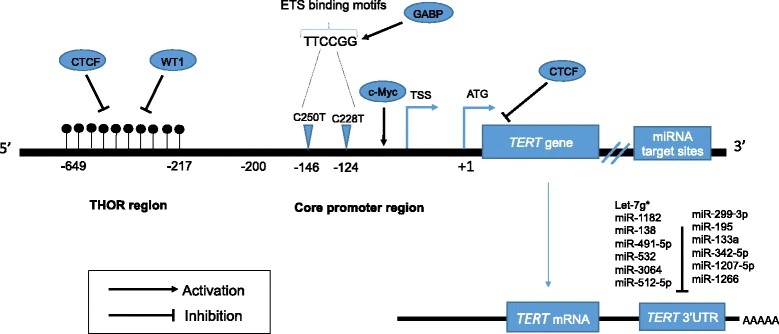 Fig.1 Unraveling the complex regulatory mechanisms of hTERT in cancer. 1
Why Choose Us?
Choosing Creative Biolabs means partnering with a leader in telomere biology. We offer the industry's most sensitive detection limits, capable of identifying activity in as few as 1–10 positive cells. Our unique ability to profile TRF2 and G-quadruplex interactions provides insights that standard assays overlook, ensuring your project accounts for the latest discoveries in feedback regulation. According to published data, our optimized ddTRAP platform offers 10-fold higher precision in liquid biopsy samples compared to conventional methods. Our specialized isogenic background modeling ensures that any observed shifts in hTERT activity are truly reflective of your experimental variables rather than inherent cellular noise.
Empower Your Oncology Pipeline with Expert Insights – Experience the Creative Biolabs Advantage & Get a Quote Today
FAQs
How does ddTRAP compare to the standard gel-based TRAP assay?
ddTRAP provides absolute quantification and significantly higher sensitivity by partitioning the reaction into thousands of droplets, eliminating the variability inherent in semi-quantitative gel analysis.
Can you distinguish between full-length hTERT and non-functional splice variants?
Yes, Creative Biolabs utilizes isoform-specific RT-qPCR primers to accurately quantify active full-length transcripts versus dominant-negative variants.
What is the minimum sample requirement for reliable activity detection?
While we can detect activity in very few cells, we generally recommend 10^5 cells to ensure robust sample processing and multiple technical replicates.
Customer Review
-
Highest Sensitivity
Using Creative Biolabs' ddTRAP in our research has significantly facilitated the detection of telomerase reactivation in rare circulating tumor cells, which was previously impossible with standard kits. - Dr. A***n H -
Reliable Validation
Using Creative Biolabs' hTERT assessment has significantly improved our confidence in our immortalized fibroblast lines; the detailed splice-variant analysis helped us troubleshoot a lack of activity we couldn't explain. - Sarah M***z
Related Services
Cancer Stem Cell Single-Cell RNA-Seq Data Analysis
Creative Biolabs resolves tumor heterogeneity by isolating cancer stem cell signatures and quiescent "persister" cells. We provide high-resolution lineage maps to validate therapeutic targets and overcome chemoresistance.
Learn More →Cell-based Lysosomotropism Assay Service
Creative Biolabs provides high-content analysis (HCA) of lysosomotropic accumulation using H9c2 cells. We quantify lysosomal volume and fluorescence to evaluate drug safety and off-target cardiotoxicity in cancer immunotherapy.
Learn More →How to Contact Creative Biolabs
Creative Biolabs provides a high-precision platform for the quantification and regulatory analysis of hTERT, supporting both oncology drug development and regenerative medicine through expert technical execution.
Partner with Creative Biolabs to leverage our high-end analytical platforms and scientific heritage.
Reference
- Leão, Ricardo, et al. "Mechanisms of human telomerase reverse transcriptase (h TERT) regulation: clinical impacts in cancer." Journal of biomedical science 25.1 (2018): 22. Distributed under Open Access license CC BY 4.0, without modification. https://doi.org/10.1186/s12929-018-0422-8
 Download our brochure