Mouse Lymphoma Cell A20 based Proliferation Assay Service
Unleashing Insights into Lymphoma Treatment with A20 Cell Proliferation Assay
Lymphoma research is a rapidly evolving field, with increasing demand for accurate and reliable assays to evaluate therapeutic candidates. Creative Biolabs introduces the mouse lymphoma cell A20-based proliferation assay, a robust platform designed to assess the effects of therapeutic compounds on lymphoma cell growth. By leveraging A20 mouse lymphoma cells, this assay offers researchers precise insights into drug efficacy and mechanisms of action, facilitating the development of innovative treatments.
Technical Method
The mouse lymphoma cell A20-based proliferation assay is a functional assay that uses A20 mouse lymphoma cells to investigate the antagonistic effects of test compounds. The assay employs luminescence detection to measure cellular proliferation and viability, allowing for accurate quantification of growth inhibition (GI50), total growth inhibition (TGI), and lethal concentration (LC50) values.
| Assay Type | Cell Type | Model | Detection Method | Control Inhibitor |
|---|---|---|---|---|
| Functional | A20 | Antagonist | Luminescence | Staurosporine |
Procedure
- A20 cells are seeded into 96-well plates and incubated overnight at 37°C with 5% CO2 to allow cell attachment.
- Test compounds are introduced, and the cells are incubated for an additional 72 hours.
- After the incubation period, cell viability is assessed using a luminescence-based detection method, which provides quantitative data on cell proliferation.
The assay evaluates three key parameters:
- GI50: The concentration of the test compound required to reduce cell growth by 50% compared to the vehicle control.
- TGI: The minimum concentration of the compound that completely inhibits cell proliferation.
- LC50: The concentration causes a 50% reduction in cell viability relative to the initial cell population.
Service Advantages
The mouse lymphoma cell A20-based proliferation assay offers a highly sensitive and reliable approach for evaluating the efficacy of therapeutic compounds. The luminescence-based detection method ensures high accuracy in measuring cell viability, allowing for a detailed assessment of compound potency. This assay is particularly valuable in preclinical drug screening, helping to identify and advance promising drug candidates.
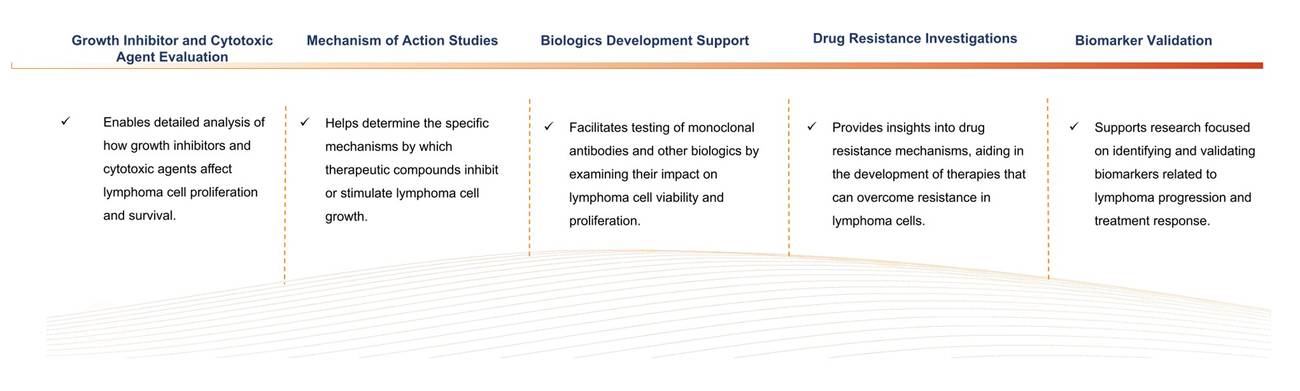
Applications
Frequently Asked Questions
Q1: Can this assay be used for combination drug studies?
A1: Yes, the assay can be used to test combination therapies, allowing researchers to investigate potential synergistic or antagonistic effects between compounds.
Q2: Is this assay suitable for testing biologics, such as antibodies?
A2: Absolutely. The assay can be adapted to assess the effects of biologics, including monoclonal antibodies, on lymphoma cell growth and viability.
Q3: What is the detection method used in this assay?
A3: The assay utilizes a luminescence-based detection method, which measures cell viability and proliferation with high sensitivity and accuracy.
Mouse lymphoma cell A20-based proliferation assay at Creative Biolabs offers a cutting-edge solution for evaluating the effects of novel therapies on lymphoma cells. With high sensitivity, precise measurements, and customizable options, this assay is an essential tool for advancing lymphoma research and drug discovery. Let us help accelerate your development process-contact us today to explore how this assay can support your specific research needs!
 Download our brochure