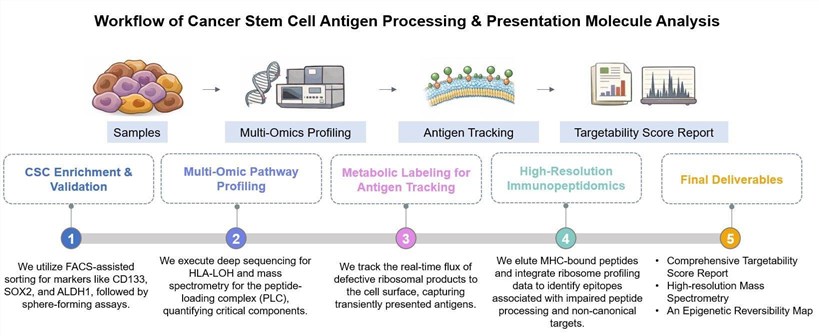
We provide a seamless end-to-end workflow, managing everything from sample dissociation and stem cell enrichment to high-resolution MHC peptide identification within our specialized discovery laboratory.
Cancer Stem Cell Antigen Processing & Presentation Molecule Analysis Service
Creative Biolabs offers a sophisticated, multi-omic exploration of the mechanisms that govern antigen visibility in stem-like tumor populations. We provide high-resolution profiling of the MHC-I/II landscape, quantification of the peptide-loading complex, and real-time tracking of antigen flux. By partnering with us, researchers gain deep mechanistic insights into immune evasion, high-confidence peptide target lists, and validated data to drive the development of next-generation immunotherapy candidates. Our clients gain a decisive advantage in target identification, allowing them to focus their discovery resources on the most stable and immunogenic CSC-specific molecules.
Introduction What We Can Offer How We Can Help Why Choose Us Customer Reviews FAQs Related Services Contact Us
Introduction to CSC Antigen Processing
Cancer Stem Cells (CSCs) utilize a "Double-Lock" evasion strategy, combining structural MHC-I loss with active degradation pathways like ERAD (mediated by SND1) and autophagic sequestration. Research data confirms that CSC models exhibit unique epigenetic silencing of NLRC5 and TAP1/2. Creative Biolabs' platform addresses these specific defects by mapping the immunopeptidome and identifying "invisible" targets like TEIPPs, ensuring that discovery pipelines can bypass traditional resistance mechanisms in research environments.
Request a Consultation →
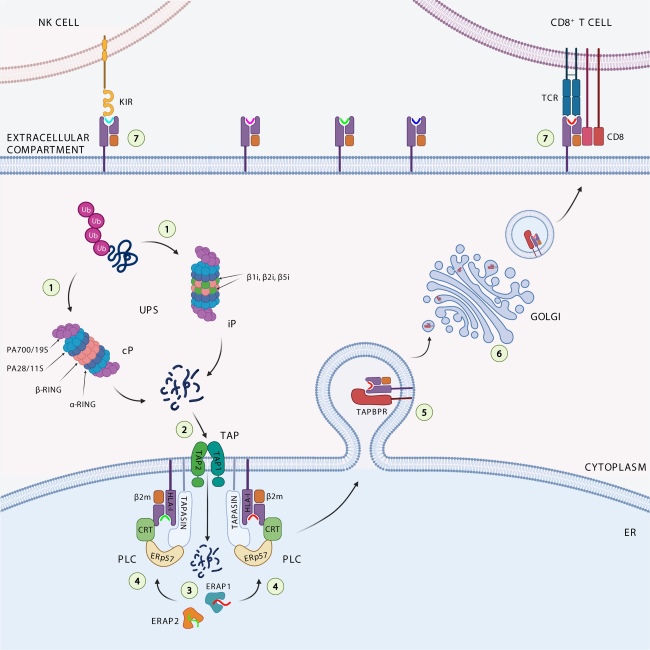 Fig.1 Antigen processing and presentation pathway. 1
What We Can Offer
One-stop CSC Multi-Omics
Specialized TEIPP Discovery Pipeline
We employ exclusive protocols to reveal hidden T-cell epitopes that emerge specifically in models with impaired processing machinery, such as TAP-deficient or MHC-I low CSCs.
High-Precision Quality Control
Our platform integrates Quality-by-Design (QbD) and process analytical techniques (PAT) to ensure the highest fidelity and reproducibility during critical peptide elution and sequencing stages.
Customized Bioinformatics Integration
We develop bespoke computational pipelines that merge Ribo-Seq, transcriptomics, and mass spectrometry data to accurately identify non-canonical, spliced, and out-of-frame tumor antigens.
How Creative Biolabs Can Assist Your Project
Highlights
Interdisciplinary Expertise
Creative Biolabs operates at the vital nexus of stem cell biology and advanced immunology, providing deep biological context that standard profiling services simply cannot match.
Specialized Evasion Analysis
We focus on unique biological pathways that cause immune avoidance, uncovering how specific cellular components trigger the internal breakdown of vital recognition molecules.

Degradation Pathway Insight
Our platform investigates how aggressive tumor cells hide from the immune system by recycling or destroying their own surface markers through internal cellular transport.
Signal Persistence Identification
We identify stable molecular markers that remain present even when complex internal mutations or signaling shifts attempt to suppress the visibility of the cell.
Submit a formal inquiry regarding the development of bespoke Cancer Stem Cell analytical solutions.
Customer Reviews
-
Enhanced Target Visibility
Implementation of the CSC analysis platform has expedited the resolution of non-canonical antigens in lung adenocarcinoma. Crucially, the system differentiates between total protein levels and actual surface presentation—a distinction that proved vital for our discovery efforts. - Dr. A**l J. -
Reliable Degradation Mapping
Utilization of this analytical service has yielded profound insights into the kinetics of MHC-I turnover in vitro. Our investigation revealed that the CSC models were actively sequestering MHC via autophagic pathways. Consequently, this finding allowed for the restoration of immunogenicity through targeted inhibitors. - Prof. M**a. S.
FAQs
Can you work with limited sample volumes?
Our ultra-sensitive enrichment protocols allow for antigen profiling from minimal research specimens; however, we often recommend model expansion to ensure high-confidence results during full immunopeptidome elution.
What makes your TEIPP discovery unique?
Our platform specifically identifies alternative antigens that emerge when traditional peptide processing is inhibited, uncovering high-value targets in tumors previously classified as non-immunogenic or "cold."
Related Services
Strategies for Engineering Cancer Cells
We utilize synthetic biology to implement logic-gated circuits within stem-like cells, effectively programming them to initiate autonomous apoptotic pathways upon specific recognition.
Learn More →Single-Cell RNA-Seq Cancer Stem Cell Subpopulation Analysis Service
Map the open chromatin landscape of CSC subpopulations to identify the master regulatory elements and transcription factor binding sites driving stemness and immune-evasive gene signatures at single-cell resolution.
Learn More →How to Contact Us
Creative Biolabs offers a sophisticated, multi-omic approach to overcoming the primary obstacle in modern oncology research: the immune invisibility of the cancer stem cell. From real-time antigen tracking to the discovery of novel TEIPP targets, we provide the evidence needed to build more durable immunotherapy discovery pipelines.
For detailed project planning and to receive a technical consultation with our immunology team, please contact us.
Reference
- D'Amico, Silvia et al. "Targeting the antigen processing and presentation pathway to overcome resistance to immune checkpoint therapy." Frontiers in immunology vol. 13 948297. 22 Jul. 2022. Distributed under an Open Access license CC BY 4.0, without modification. https://doi.org/10.3389/fimmu.2022.948297
 Download our brochure
Loading case studies...
Online Inquiry