Cancer Stem Cell Immune Evasion Mechanism Prediction Service
Our service is engineered to dismantle the most complex barrier in modern oncology: the intrinsic ability of cancer stem cells (CSCs) to remain invisible to the host immune system. Creative Biolabs provides a comprehensive analytical framework that goes beyond simple marker identification. We deliver actionable insights into how these cells actively remodel their local environment to suppress T-cell infiltration and NK-cell cytotoxicity. By predicting these evasion strategies early in the development cycle, we empower researchers to design therapies that specifically "unmask" the most malignant cells within a tumor, ensuring a more durable therapeutic response.
Introduction to CSC Immune Evasion
The concept of the CSC has shifted from a narrow focus on tumor initiation to a broader understanding of immune evasion as a primary hallmark of stemness. Recent literature established that CSCs are the central architects of an immunosuppressive milieu, utilizing a multifaceted "epigenetic cloak" to survive the rigorous process of immune selection that eliminates their non-stem descendants. Through the active impairment of antigen processing machineries, including the downregulation of TAP1/2 and major histocompatibility complex (MHC-I) molecules, CSCs render themselves virtually invisible to cytotoxic T-cell surveillance. Furthermore, the secretion of specific chemokines and metabolic byproducts, such as lactate, stabilizes this resistant phenotype and recruits secondary suppressive cells to the niche.
Comprehensive Service Modules
Creative Biolabs offers a multi-layered analytical suite designed to decode the specific biological circuits CSCs use to hijack immune surveillance. Our offerings are categorized into specialized modules that can be tailored to the specific infrastructure requirements of your project.
Epigenetic "Cloak" Deciphering
We provide high-resolution mapping of histone modifications (e.g., H3K27me3, H3K4me3) and DNA methylation patterns that lead to the silencing of MHC molecules and tumor-associated antigens (TAAs). This module is essential for identifying targets that can be pharmacologically "uncloaked."
Metabolic Niche Hostility Assessment
Our platform quantifies the metabolic byproduct landscape—specifically, lactate-driven histone lactylation and extracellular acidification. We predict how these metabolic shifts stabilize the CSC phenotype and create a physical and chemical barrier against infiltrating lymphocytes.
Secretome and Chemokine Profiling
Creative Biolabs analyzes the "extrinsic" evasion signals, including the secretion of CCL2, TGF-β, and IL-10. We model how these factors actively recruit myeloid-derived suppressor cells (MDSCs) and tumor-associated macrophages (TAMs) to the CSC niche to form a protective immunosuppressive shield.
Checkpoint Architecture Mapping
Beyond PD-L1, we profile the expression of "don't eat me" signals (e.g., CD47) and non-classical checkpoints (e.g., HLA-G, Galectin-9) specifically within the stem-like subpopulation to identify escape routes utilized during standard therapy.
Antigenic Plasticity Modeling
We utilize single-cell sequencing to predict the "shaving" or loss of antigens during immune selection, helping you develop therapies that target conserved nodes of the CSC hierarchy that are less prone to antigenic drift.
Empower Your Research with Precision Data — Explore Our Modular Evasion Modeling Solutions
Workflow
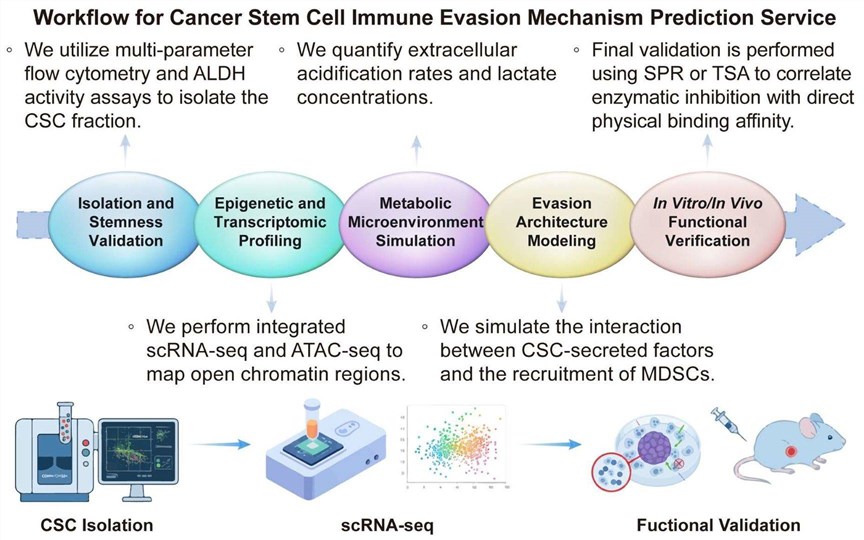
To ensure the highest degree of predictive accuracy, Creative Biolabs utilizes a standardized yet flexible pipeline that transitions from high-resolution cellular isolation to complex bioinformatic modeling.
Publication
This comprehensive review explores the multifaceted mechanisms of immune evasion in cancer, including tumor-induced immunosuppression, checkpoint regulation, and microenvironment modulation. It analyzes key pathways like PD-1/PD-L1 and CTLA-4, alongside genetic and epigenetic influences. The article also highlights cutting-edge therapeutic strategies such as immune checkpoint inhibitors, CAR-T cell therapy, and nanotechnology-driven approaches, offering valuable insights for advancing cancer immunotherapy and improving patient outcomes.
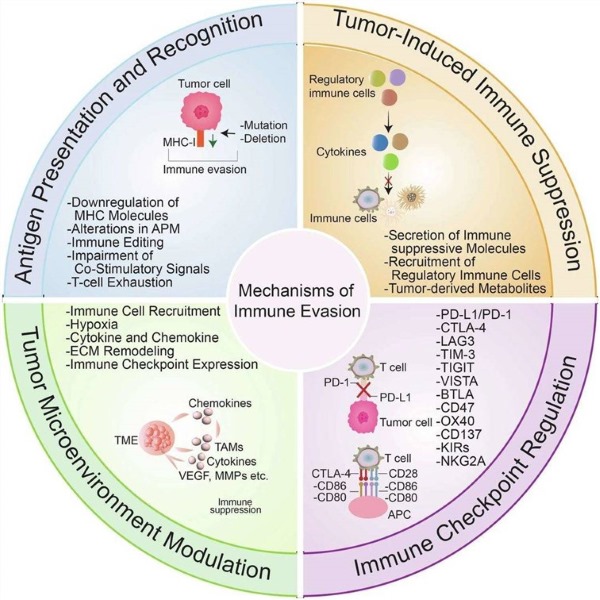 Fig.1 Decoding cancer's immune evasion strategies. 1
Why Choose Us?
Choosing Creative Biolabs means accessing a cutting-edge platform that integrates the latest advancements in "immune selection" and epigenetic plasticity. Our unique advantage lies in a dual-focus methodology: we simultaneously analyze the intrinsic "stealth" genetic programs of the CSC and the extrinsic "fortress" factors of the microenvironmental niche. By leveraging published data on metabolic reprogramming and histone modifications, our predictive models achieve industry-leading accuracy in identifying why specific tumors resist standard immune checkpoint inhibitors. We offer a highly scalable, modular service architecture that adapts to your specific drug pipeline requirements, from initial target discovery to lead optimization.
Experience the Difference of Elite Scientific Support — Request a Precise Quote Tailored to Your Project Scope
FAQs
How does Creative Biolabs ensure the specificity of CSC evasion predictions?
We combine single-cell resolution with functional stemness assays (e.g., sphere-forming efficiency) to ensure that the evasion signatures we identify are unique to the self-renewing population rather than the bulk tumor.
Can your service identify targets for overcoming "cold" tumors?
Yes. Our modeling specifically looks for the "exclusion" mechanisms (like CCL2/CCR2 signaling) that prevent immune cells from entering the CSC niche, offering strategies to turn "cold" tumors "hot."
What role does epigenetic mapping play in your service?
Epigenetic mapping identifies the histone modifications responsible for the reversible silencing of antigens. This is crucial for planning combination therapies that can "uncloak" the tumor.
Customer Review
-
Unprecedented Niche Clarity
Using Creative Biolabs' CSC evasion prediction has significantly improved our ability to map the recruitment of MDSCs. Their spatial transcriptomics data revealed a layer of cytokine signaling we had previously overlooked. - Dr. A***n L -
Metabolic Barrier Analysis
The inclusion of lactate-driven evasion modeling was essential for our project. We finally understood why our CAR-T cells were losing potency in the acidic core of the tumor niche. - Prof. S***a K
Related Services
Function Assays for Immune Checkpoint
Creative Biolabs provides one-stop checkpoint functional assays, including T cell activation, MLR, and cytotoxicity services. We quantify cytokine release and inhibitor efficacy to validate immuno-oncology targets.
Learn More →Monocyte Immunophenotyping Service
Creative Biolabs provides high-dimensional flow cytometry to subtype monocytes and detect activation/checkpoint markers (HLA-DR, PD-L1). We resolve myelid lineage differentiation using t-SNE/UMAP clustering to reveal disease-specific functional states.
Learn More →How to Contact Creative Biolabs
Creative Biolabs provides a high-end, integrated solution for predicting and neutralizing the immune evasion mechanisms of CSCs. Our expertise in multi-omics, niche biology, and metabolic reprogramming ensures that your drug discovery pipeline is equipped to handle the root causes of tumor recurrence.
Partner with Creative Biolabs Today — Inquire Now for a Detailed CSC Strategy Proposal
Reference
- Tufail, Muhammad, Can-Hua Jiang, and Ning Li. "Immune evasion in cancer: mechanisms and cutting-edge therapeutic approaches." Signal transduction and targeted therapy 10.1 (2025): 227. Distributed under Open Access license CC BY 4.0, without modification. https://doi.org/10.1038/s41392-025-02280-1
 Download our brochure