We provide fully customizable service modules tailored to your specific research models, including specialized biomarker panels designed for rare solid tumors and complex hematological malignancies to maximize discovery.
Cancer Stem Cell Immune Infiltration Profiling Service
Creative Biolabs provides researchers with a comprehensive analytical toolkit to dissect the complex interactions within the tumor microenvironment. We provide high-dimensional data that bridges the gap between cell phenotype and spatial function. By partnering with Creative Biolabs, clients can expect to gain a clear understanding of the metabolic and molecular barriers preventing immune cell infiltration in their research models, identify novel targets for combination therapies, and generate robust data for high-impact scientific publications and R&D decision-making.
Introduction What We Can Offer How We Can Help Why Choose Us Customer Reviews FAQs Related Services Contact Us
Introduction to CSC Immune Infiltration Profiling
Cancer Stem Cells (CSCs) represent the roots of malignancy, driving metastasis and recurrence through sophisticated immune evasion. Scientific research confirms that CSCs utilize exosomal signaling, metabolic competition, and epigenetic plasticity to create an immune-privileged niche. Creative Biolabs' service is designed to quantify these interactions, providing the scientific credibility and deep-data insights necessary to overcome resistance in drug discovery and achieve durable research outcomes.
Request a Consultation →
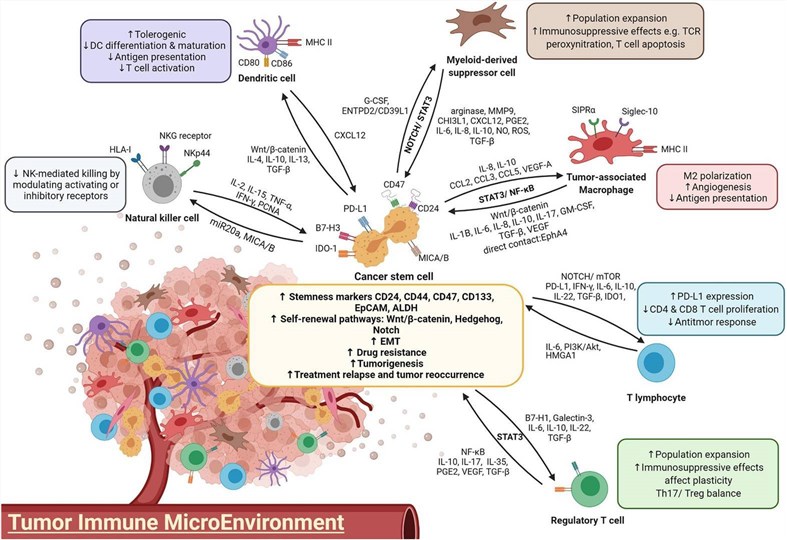 Fig.1 A diagram illustrating the crosstalk between immune cells and CSCs. 1
What We Can Offer
Customized Multi-Omic Profiling
High-Resolution Spatial Mapping
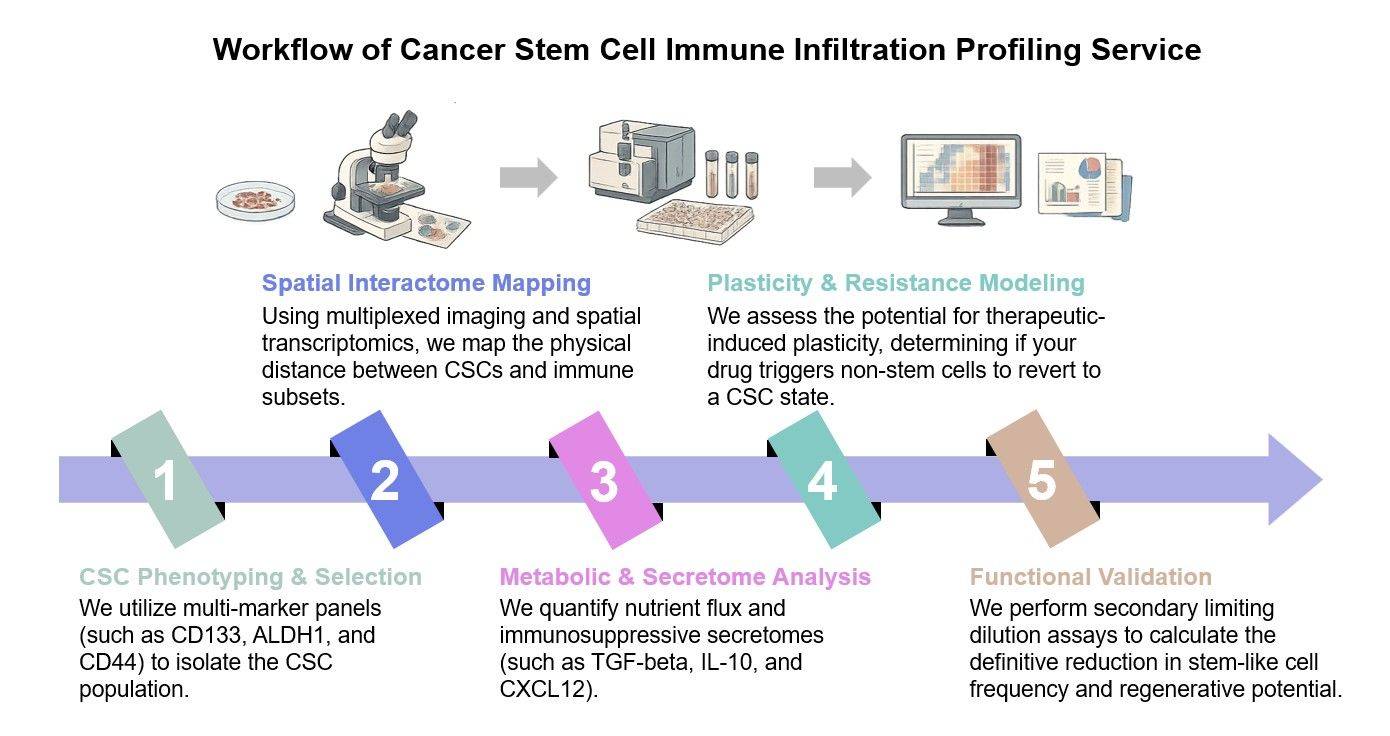
Our team utilizes multiplexed immunofluorescence and spatial transcriptomics to visualize the precise proximity interactome of CSCs and immune effectors, revealing physical barriers to effective cell infiltration.
Deep Metabolic Flux Analysis
We offer quantification of nutrient competition, including glucose, glutamine, and tryptophan, between stem cells and immune cells to identify metabolic checkpoints that paralyze anti-tumor responses.
Standardized Quality Control
Our platform implements Quality-by-Design (QbD) principles and strict SOPs to ensure the absolute reproducibility of single-cell and spatial data across different experimental batches and timelines.
How Creative Biolabs Can Assist Your Project
Highlights
Specialized TME Expertise
Creative Biolabs stands at the forefront of oncology research, offering extensive specialized experience in tumor microenvironment (TME) dynamics to help researchers navigate the complex biological interactions of the niche.
Detecting Cellular Plasticity
Our unique advantage lies in our ability to detect therapeutic-induced plasticity, identifying how specific treatments might inadvertently cause non-stem cells to revert to a resilient stem-like state.

Uncovering Immune Hijacking
We utilize advanced analytical tools to identify interferon hijacking and other evasion mechanisms that are often missed by standard bulk sequencing, providing a clearer view of resistance.
Superior Resolution Technology
Our integrated multi-modal approach provides significantly higher resolution of the CSC niche compared to traditional immunohistochemistry methods, ensuring no critical spatial or functional detail is overlooked in your study.
To obtain a customized project strategy tailored to specific research requirements, we invite you to get a quote today.
Customer Reviews
-
Precision Niche Mapping
Identifying the interferon hijacking mechanism using Creative Biolabs' service in our research has significantly improved our understanding of T-cell exclusion in brain tumor models. The spatial data was far more precise than our internal methods. - Dr. A***n. L. -
Actionable MoA Validation
The metabolic flux analysis provided by Creative Biolabs facilitated our MoA validation for a novel signaling inhibitor. We were able to see exactly how the drug restored immune cell fitness within the CSC niche. – S**h. K.
FAQs
How does this service differ from standard immune cell analysis?
While standard analysis typically counts total immune cells, Creative Biolabs maps the specific spatial and functional relationship between those cells and the CSC niche, revealing the drivers of resistance.
Can you handle rare or small research samples?
Yes, our high-sensitivity single-cell and spatial platforms are optimized for limited laboratory biopsy material and small-scale animal model samples, ensuring robust data even from minimal starting inputs.
Related Services
Naive T-Cell Infiltration Analysis
We offer specialized quantification of unprimed T-cell populations within the tumor microenvironment to evaluate baseline immune readiness and the potential for successful de novo priming.
Learn More →Anti-Cancer Resistance Inhibitor Discovery
We provide comprehensive screening solutions to identify novel small molecules or biologics that specifically target and neutralize the molecular pathways responsible for multi-drug resistance in stem-like cell populations.
Learn More →How to Contact Us
Creative Biolabs offers a robust, multi-dimensional analysis of the tumor microenvironment, specifically targeting the resilient CSC populations that drive research model failure. By decoding the metabolic, spatial, and genetic barriers of the niche, we enable the development of more effective oncological research tools. Please contact us.
Reference
- Lei, Martina Mang Leng, and Terence Kin Wah Lee. "Cancer Stem Cells: Emerging Key Players in Immune Evasion of Cancers." Frontiers in cell and developmental biology vol. 9 692940. 21 Jun. 2021. Distributed under an Open Access license CC BY 4.0, without modification. https://doi.org/10.3389/fcell.2021.692940
 Download our brochure
Loading case studies...
Online Inquiry