NEXT™ CAR-T Engineering Services
Creative Biolabs provides a comprehensive suite of engineering solutions to transform conceptual designs into validated cell products. Our multidisciplinary approach integrates synthetic biology circuits and site-specific genomic modifications to overcome traditional receptor limitations. We offer specialized modules for receptor fine-tuning, metabolic reprogramming, and safety switch integration, ensuring candidates thrive in hostile microenvironments. By building multi-layered logic gates, we enhance sensitivity to antigen-low tumors and protect healthy tissues, providing the precision necessary for durable therapeutic responses.
Introduction to Next CAR-T Engineering
Adoptive cell therapy has revolutionized oncology, yet solid tumors remain resistant due to the immunosuppressive TME and antigen heterogeneity. Traditional CARs often lack the sensitivity required to detect low levels of antigen or the durability to withstand chronic stimulation. Recent research highlights the necessity of "armored" CARs and sensitivity-tuning adaptors, such as MT-SLP-76, to overcome these hurdles. By integrating site-specific gene editing and synthetic biology circuits, next CAR-T engineering shifts the paradigm from simple activation to intelligent, context-aware tumor eradication. These advancements provide the structural blueprint for safer, more potent, and persistent cell therapies that can be adapted for both oncological and non-oncological indications.
Next CAR-T Engineering Platform
To enhance tumor-killing activity
To accelerate your cellular and gene project
To meet your special needs in cellular and gene therapy
To accelerate efficient completion for your research project
To accelerate technology fusion strategies for cancer treatment
To serve for your industry on cellular and gene therapy
To be the leading technology research and development platform
To assist your research in gene therapy
Ready to redefine your therapeutic limits? Request a Technical Consultation with Our Experts
Comprehensive Engineering Workflow and Deliverables
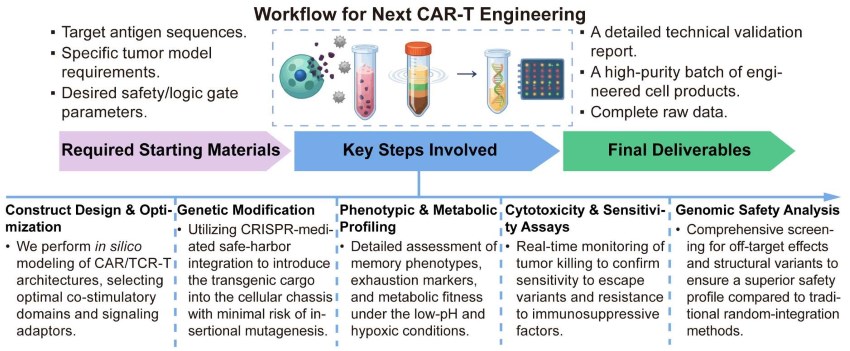
Our systematic approach ensures every modification is validated for both efficacy and genomic safety, providing a clear path to regulatory-ready data. We prioritize architectural planning to ensure that the cellular chassis is optimized for the specific challenges of your target indication.
Publication
This review comprehensively examines next-generation CAR T-cell engineering strategies to overcome solid tumor challenges, including antigen heterogeneity and immunosuppressive microenvironments. It highlights structural innovations in receptor architecture, logic-gated control systems, intrinsic checkpoint modulation, cytokine armoring, and epigenetic reprogramming to enhance persistence and functionality. The development of allogeneic off-the-shelf platforms from iPSCs and NK cells is also discussed, along with key translational bottlenecks and future directions for programmable cellular immunotherapy.
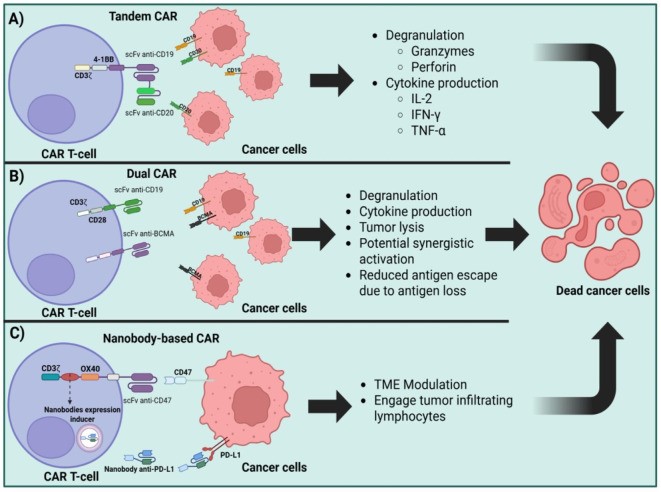 Fig.1 Strategies for multi-target antigen recognition and TME immune modulation in CAR T-cell therapy. 1
Why Choose Us
Creative Biolabs stands at the forefront of cellular engineering, combining two decades of protein expertise with cutting-edge synthetic biology. Our unique platform solves the industry-wide problem of antigen-low resistance by tethering the signaling adaptor to the membrane, effectively mimicking native TCR sensitivity. Furthermore, our modular CAR systems offer unprecedented control over therapeutic activity, allowing for "tunable" responses that can be adjusted based on the patient's specific needs. Beyond sensitivity, we prioritize the metabolic resilience of the cell. By engineering pathways that utilize alternative carbon sources or resist toxic metabolites, we ensure our next CAR-T products maintain activity deep within the fibrotic stroma of solid tumors.
Unlock superior potency for your pipeline - Request a Detailed Service Quote Today
FAQs
How does the MT-SLP-76 platform differ from standard co-stimulatory modifications?
Our platform tethers the cytosolic adaptor SLP-76 directly to the membrane, fixing the "proximal signaling deficit" inherent in many CAR designs and allowing the cell to trigger activation at much lower antigen densities.
Can you perform site-specific integration for multi-gene circuits?
Yes, we utilize high-fidelity CRISPR systems to perform site-specific integration into "safe harbor" loci. This ensures stable expression of complex multi-gene circuits without the risks associated with random viral integration.
Are your services compatible with allogeneic (off-the-shelf) starting materials?
Absolutely. Creative Biolabs offers comprehensive TCR and HLA knockout services to generate allogeneic CAR-T and CAR-NK cells, reducing GvHD risk and enabling scalable, ready-to-use therapeutic solutions.
Customer Review
-
Superior Sensitivity for Antigen-Low Targets
Using Creative Biolabs' CAR-T engineering in our research has significantly facilitated our ability to target B-cell malignancies that previously relapsed due to antigen downregulation. The sensitivity increase was measurable and consistent across multiple donors. - Dr. H***en L -
Robust Safety with CAR-EVs
Utilizing the CAR-derived extracellular vesicles (CAR-EVs) platform from Creative Biolabs has significantly improved our safety profile. We avoided the cytokine release issues seen with whole-cell therapies while maintaining excellent penetration into dense stroma. - Prof. M***ael S
Related Services
NGS based Genome Sequencing Service
Creative Biolabs offers complete genome analysis for cancer research. Our specialists provide precise, high-quality insights from sampling to reporting, enabling individualized treatments and genomic studies.
Learn More →System Immunity Measurement
Creative Biolabs offers comprehensive bioassay and multi-omics services for system immunity measurement in gut microbiota-associated neuro diseases, leveraging the latest understanding of microbiome-immune interactions.
Learn More →Contact Us
Creative Biolabs provides the end-to-end expertise required to build the next generation of immune cell therapies. From enhancing signaling sensitivity to remodeling the tumor stroma, our platforms are designed to ensure your therapy is both potent and safe. We invite you to leverage our deep technical knowledge and innovative engineering modules to accelerate your research toward the next therapeutic milestone.
For detailed technical inquiries or to discuss a custom project plan, please contact our team of scientists.
Reference
- Garcia-Robledo, Juan Esteban, et al. "Engineering the next generation of CAR T-cells: precision modifications, logic gates and universal strategies to overcome exhaustion and tumor resistance." Frontiers in Oncology 15 (2026): 1698442. Distributed under Open Access license CC BY 4.0, without modification. https://doi.org/10.3389/fonc.2025.1698442
 Download our brochure