CD20 Assay Portfolio Service
Equipped with state-of-the-art facilities and experienced immunology experts, Creative Biolabs is dedicated to providing one-stop CD20 assay portfolio services to facilitate your project success.
CD20 as a Tumor Target
As the first specific B-cell marker, CD20 was discovered in 1980 and is a transmembrane phosphoprotein of the membrane-spanning 4-A family, expressed on committed B cells at almost all the development stages. CD20 is thought to work as a calcium channel in the cell membrane and plays an important role in B-cell development and maturation.
Particularly, CD20 is considered as an appealing tumor target owing to several characters as follows.
- It is expressed in most B-cell lymphomas.
- Except for B cells, it is almost not expressed on other cells, thus effectively reducing off-target effects.
- Because CD20 is not expressed in the first stage of B cell development, healthy B cells destroyed by CD20 targeting therapy can be easily replenished.
CD20 Targeted Therapeutics
During the last few decades, various of CD20 targeted therapeutics have been approved for the treatment of B cell lymphomas and B cell-mediated autoimmune diseases, such as CD20 antibodies, anti-CD20 CAR-T therapies.
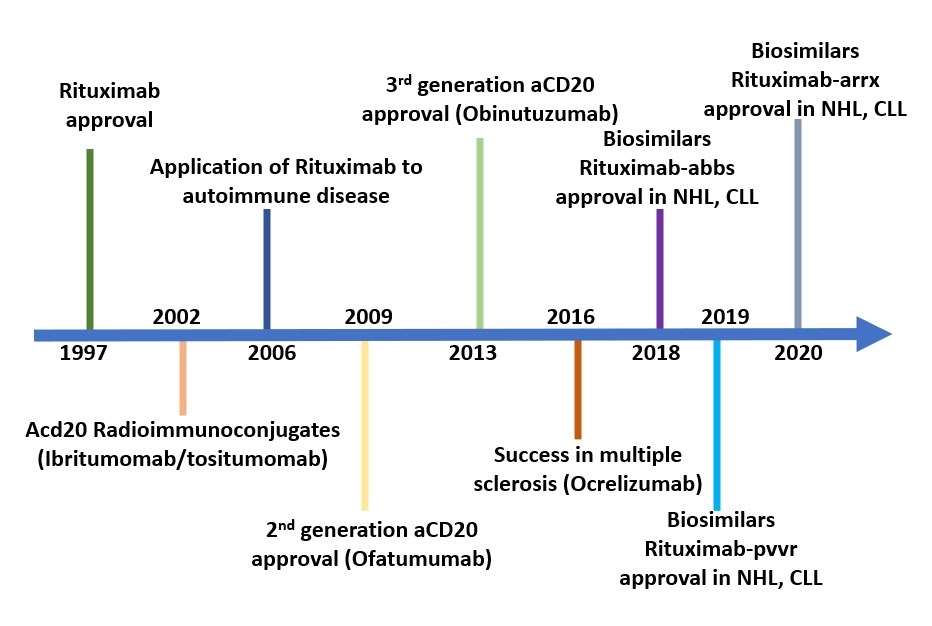 Main approved antibodies and combinations targeting CD20.
Publication
This publication investigates a subpopulation of T cells that express the B-cell marker CD20. These CD20-positive T cells are found in the peripheral blood of healthy individuals and autoimmune and cancer patients. The study highlights that these cells are enriched in the effector memory subset and are primarily cytotoxic CD8 T cells that produce IFN-gamma. The researchers used RNA sequencing to identify the transcriptomic profile of these cells, revealing an altered transmigration and adhesive profile combined with an enhanced activation status. They also ectopically expressed CD20 on healthy T cells to study the functional properties of CD20 expression. The findings suggest a potential role for CD20-positive T cells in both autoimmunity and cancer.
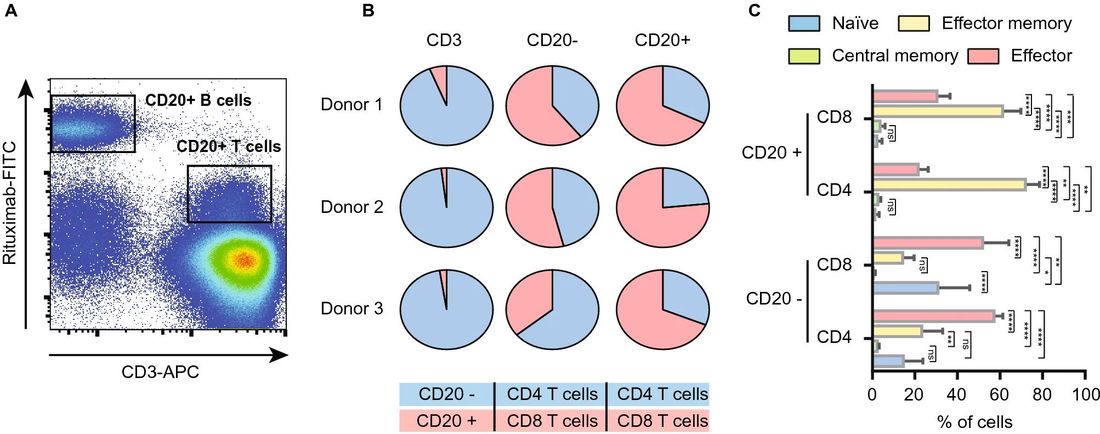 Fig.1 Flow cytometry analysis demonstrates a predominant effector memory phenotype in CD20+ T cells.1
Why Choose Us?
Creative Biolabs stands at the forefront of B-cell therapeutic development. Our key advantages include deep scientific expertise, a highly customizable service model, and access to state-of-the-art technologies that provide unparalleled insights into CD20 biology. We don't just run assays—we partner with you to solve your most complex development challenges.
Highlights:
- Extensive experience: Creative Biolabs has extensive experience in assay development platforms.
- Advanced techniques: They use advanced techniques and offer custom assay services.
- Excellent quality: They are committed to excellent quality.
- Timely feedback: They provide timely feedback to their clients.
If you are interested in our services, please contact us to discuss your project.
Frequently Asked Questions
Q1: Can your assays help me understand the difference between Type I and Type II anti-CD20 antibodies?
A1: Absolutely. Our comprehensive portfolio includes specific assays designed to evaluate the distinct mechanisms of action associated with Type I (strong CDC) and Type II (direct cell death) antibodies. We can provide the critical data you need to characterize and differentiate your therapeutic.
Q2: What if my target B-cell line has very low CD20 expression?
A2: That's a common challenge. We offer specialized services to address low CD20 expression, including assays that evaluate the potential for combination therapies with agents like HDAC inhibitors that can upregulate CD20 levels.
Q3: How do you address potential off-target effects?
A3: Our team is acutely aware of the latest research, including the existence of CD20-positive T cells. We can design specific assays to evaluate the interaction of your therapeutic with this unique cell population, helping you mitigate potential off-target effects and ensure a favorable safety profile.
Customer Review
-
Safety Profile Refinement
The thorough safety profiling provided by Creative Biolabs helped us identify a subtle off-target interaction in our lead candidate. We were able to re-engineer the antibody to eliminate this issue, greatly strengthening its development profile. - H. T. P****
-
Combination Therapy Strategy
The in-depth mechanistic data from Creative Biolabs' assays allowed us to build a strong case for a combination therapy approach. We now have compelling evidence to support our strategy of pairing our novel antibody with a complementary therapeutic agent. - I. V. C****
Related Services
Our CD20 assay portfolio service is often a part of a larger development pipeline. To help you achieve your goals, we also recommend the following complementary services:
DCs-Involved Immuno-Oncology Models for In Vivo Testing
Dendritic cells (DCs) are a core part of the immune system, bridging innate and adaptive immunity. They are crucial for promoting anti-tumor responses by interacting with T cells. Therefore, developing models that co-inoculate DCs, T cells, and cancer cells is significant for drug development in cancer therapy.
Learn More →Tumor Contrast Imaging Solutions
Creative Biolabs has developed a platform for tumor-specific photoacoustic imaging technology, extending the range of existing tumor imaging technologies. Their scientists provide integrated services, from detection assay solutions to big data analytics, to advance your tumor imaging projects.
Learn More →How to Contact Us
At Creative Biolabs, we are committed to being your strategic partner in B-cell therapeutic development. Our CD20 assay portfolio service provides the critical data and expert analysis you need to bring your projects to fruition.
To learn more and get a detailed quote, please reach out to our team today. We are ready to discuss your specific project and demonstrate how our expertise can accelerate your success.
Reference
- Vlaming, Martijn, et al. "CD20 positive CD8 T cells are a unique and transcriptionally-distinct subset of T cells with distinct transmigration properties." Scientific Reports 11.1 (2021): 20499. Distributed under Open Access license CC BY 4.0, without modification. DOI: https://doi.org/10.1038/s41598-021-00007-0
 Download our brochure