We also offer standard HuPBMC reconstituted models and HuPBMC cancer co-inoculated models for general safety and efficacy testing, where DC functional superiority is not the primary endpoint.
Learn More →DC involved Immuno-Oncology Modeling Service for In Vivo Testing
Creative Biolabs provides the necessary high-fidelity system to validate agents that rely on effective dendritic cell activation, including novel vaccines, STING agonists, and ICB combination therapies. We precisely quantify your drug's ability to overcome TME-mediated immunosuppression, a key mechanism of resistance in clinical trials. Creative Biolabs' DCs-Involved immuno-oncology models for in vivo testing help you de-risk your pipeline and obtain predictive efficacy data through our functionally superior DC subsets and advanced humanized models.
Introduction What We Can Offer Workflow Why Creative Biolabs Customer Reviews FAQs Related Services Contact Us
Developing DCs Involved Immuno-Oncology Models is Significant for Cancer Therapy
As a core player in the immune system, dendritic cells (DCs) serve as an essential intermediary across the innate and adaptive immune systems and can be found in virtually every tissue of the body. They can be divided into three main types: conventional DCs (cDCs), plasmacytoid DCs (pDCs), and monocyte-derived DCs (moDCs). Functionally, DCs promote the anti-tumor immune responses by lineaging with T cells. Therefore, developing models co-inoculated with DCs, T cells, and cancer cells is of great significance for drug development in cancer therapy.
Discover how we can help - Request a consultation.
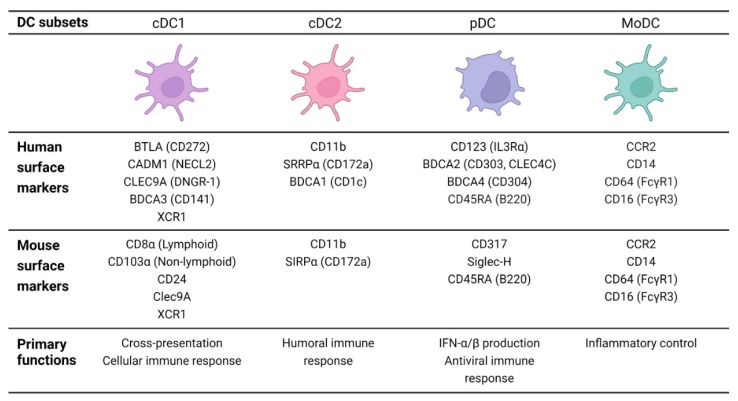 Fig.1 The distinct DC subsets with their respective surface markers and primary functions. 1
What We Can Offer
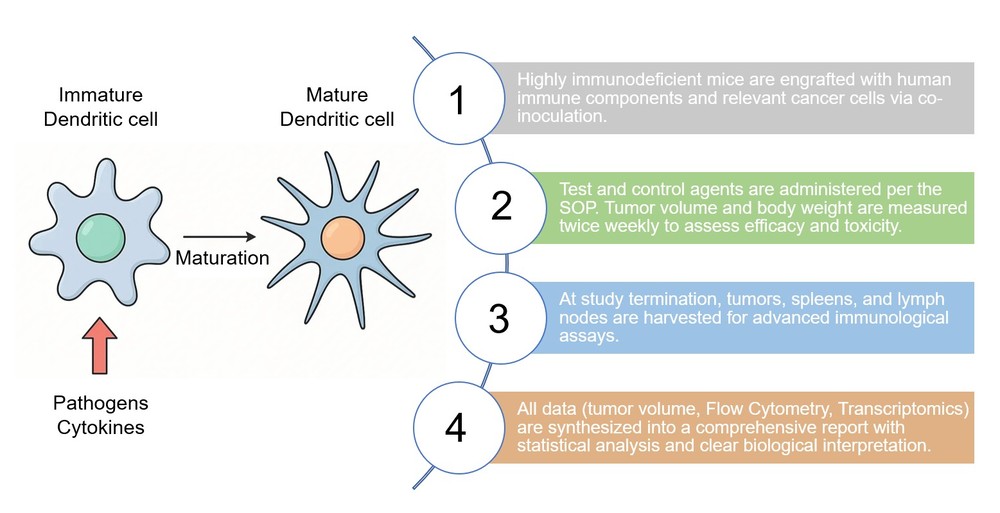
To assess the antitumor efficacy in animal models, Creative Biolabs successfully developed DCs-involved immuno-oncology models for in vivo testing. We take advantage of the co-inoculation technology to develop the DCs-involved immuno-oncology models co-inoculated with CD3+ T cells, induced DCs, and cancer cells. We not only provide ready-to-use DCs-involved immune-oncology models but also deliver solutions to develop the desirable immuno-oncology models for customers to aid in their projects. Furthermore, we also provide several humanized models for in vivo preclinical evaluation of anti-cancer drugs and immunotherapies. At Creative Biolabs, we will try our best to meet every customer's needs and ensure that your project is completed smoothly.
Here, we provide two well-developed DCs-involved immune-oncology models for global customers to design for their projects. In addition, we offer a full range of services to help every customer develop the appropriate DCs-involved immune-oncology models and several humanized mouse models for your convenience.
| DCs-involved Immune-Oncology Models | Humanized Mouse Models | Services |
|---|---|---|
|
|
|
DCs Involved Immuno-Oncology Models at Creative Biolabs
Highlights
Enhanced Predictive Accuracy and Sensitivity
cDC1 subsets are engineered for enhanced predictive accuracy and high sensitivity in drug evaluation. This approach critically assesses a candidate's capacity to induce effective T-cell responses, which is a prerequisite for subsequent developmental success.
Strategic Targeting of Immunotherapy Resistance
The platform rigorously mimics the immunosuppressive TME, enabling precise measurement of efficacy against Tregs and MDSCs. This is essential for identifying agents that reverse ICB resistance and promote an immune-active tumor phenotype.

Prolonged Immunological Response
cDC1s drive robust CD8+ CTL activation, inducing strong immunological memory. This superior mechanism is directly associated with achieving extended duration of effectiveness in preclinical drug testing models.
Comprehensive Service Integration (MoA and ICD)
A one-stop DC-involved model service provides comprehensive MoA and ICD validation. By integrating multi-color flow cytometry and omics analysis, the platform supplies robust data on critical immune pathway engagement.
Discover how a partnership with us can streamline your research - Get a quote today.
Customer Reviews
-
Pinpointed TME Suppression
The granular flow cytometry analysis facilitated by Creative Biolabs' models allowed us to precisely monitor the Treg/MDSCs populations, giving us crucial insight into the mechanism of ICB resistance in our drug-resistant tumor line. - A. Lynch. -
Validated ICD Engagement
Creative Biolabs' specialized syngeneic platform was invaluable for confirming that our novel therapeutic actively promotes immunogenic cell death by monitoring DC activation signals, providing a strong biological rationale for our combination strategy. - J. Hansen.
FAQs
Q: Can your models help assess immunotherapy resistance mechanisms?
A: Absolutely. Our comprehensive phenotyping includes precise tracking of TME immunosuppressive populations like Tregs and MDSCs alongside DC maturation status. By showing how your therapeutic modulates these populations, we can provide direct evidence of your drug's ability to counteract TME-mediated resistance.
Q: What precautions should I take regarding the starting materials provided?
A: While the models are highly flexible, the primary precaution is ensuring the highest purity of any provided antigens or DC pulsing materials. Contamination can impact DC maturation status and skew the T-cell priming response. We highly recommend a pre-study quality control check with our team.
Related Services
Humanized Models
Immuno-oncology Immunophenotyping Service
Detailed multi-color flow cytometry and tissue immunofluorescence imaging for deep analysis of immune cell subsets (including NK, B, and T cells) within the TME.
Learn More →How to Contact Us
Creative Biolabs' DCs-involved immuno-oncology models offer a scientifically validated platform focused on overcoming the biological challenges of TME-mediated immunosuppression and ICB resistance. Partner with Creative Biolabs to effectively mobilize the power of the dendritic cell and transform patient outcomes. Please contact us now.
Reference
- Verheye, Emma et al. "Dendritic Cell-Based Immunotherapy in Multiple Myeloma: Challenges, Opportunities, and Future Directions." International journal of molecular sciences vol. 23,2 904. 14 Jan. 2022. Distributed under an Open Access license CC BY 4.0, without modification. https://doi.org/10.3390/ijms23020904
 Download our brochure
Loading case studies...
Online Inquiry