DNA Damage Response (DDR) Cell Panel Screening Service for Immuno-Oncology Drug Discovery
Our DNA Damage Response (DDR) Cell Panel Screening Service is an innovative offering aimed at facilitating the development of immuno-oncology therapies. The DDR pathway is essential for preserving genomic integrity, and cancer is frequently linked to its malfunction. By incorporating advanced technologies and comprehensive panels, we help accelerate your research in immuno-oncology and contribute to the identification of novel therapeutic strategies.
DNA Damage Response (DDR) Cell: An Important Focus in Immuno-Oncology
The DNA Damage Response (DDR) Cell refers to the intricate network of cellular mechanisms that detect, signal, and repair damage to DNA, ensuring genomic integrity and cellular survival. This response is critical for maintaining homeostasis within the cell and plays a vital role in the body's response to genotoxic stress, such as that induced by radiation or chemotherapeutic agents. When DNA damage occurs, key proteins are activated to halt the cell cycle, allowing time for repair mechanisms to address the damage. If the damage is irreparable, DDR pathways can trigger programmed cell death to prevent the propagation of damaged DNA, thus contributing to cancer prevention. In the context of immuno-oncology, understanding the DDR pathways is essential, as many cancer therapies rely on inducing DNA damage in cancer cells. The interplay between DDR pathways and the immune response can influence treatment efficacy, tumor progression, and the development of resistance to therapies, making DDR an important focus for research and drug development in cancer treatment.
Our Service
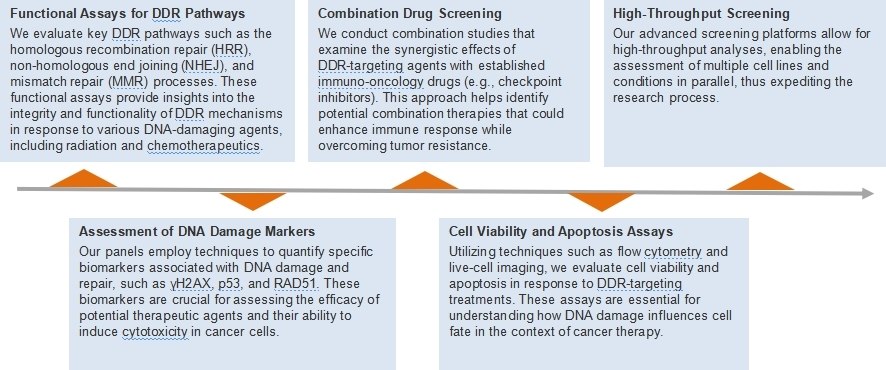
The DDR Cell Panel Screening Service encompasses a wide array of assays designed to assess the cellular responses to DNA damage across different cancer cell lines. This service includes:
Unique Features of Our Services
- Comprehensive Insights: By integrating a variety of functional assays, our service provides a holistic understanding of how DNA damage influences tumor biology and immune interactions.
- Customized Panels: We understand that research projects may require specific cell lines, biomarkers, or conditions. Our services can be tailored to meet your individual project needs, allowing for maximum relevance and applicability.
- Expert Guidance: Our team consists of seasoned researchers with extensive experience in immuno-oncology and DNA damage response, providing expert consultation to help design experiments that align with your objectives.
- Robust Data Quality: We prioritize accuracy and reproducibility in our assays, ensuring that the data you receive can be trusted to inform your research decisions.
Why Choose Us
When it comes to advancing your research in immuno-oncology through our DNA Damage Response (DDR) Cell Panel Screening Service, we are your ideal partner. Our commitment to excellence is reflected in our cutting-edge technologies, customizable solutions, and unparalleled support from a team of experts with extensive experience in the field. We understand the complexities of cancer biology and the critical role that DNA damage response plays in treatment outcomes. By choosing us, you gain access to a comprehensive suite of assays designed to deliver meaningful insights, accelerate your drug discovery process, and ultimately improve patient outcomes. Together, we can explore innovative therapeutic strategies and push the boundaries of cancer treatment, making us the best choice for your research needs.
Contact Us
We are dedicated to supporting your research in immuno-oncology through our specialized DNA Damage Response (DDR) Cell Panel Screening Service. If you have specific questions about our services, require assistance with your experimental design, or want to discuss how our panels can be customized to meet your unique research needs, please reach out to us directly.
We appreciate your interest in our offerings and are eager to collaborate with you to further your research in immuno-oncology. Together, we can make strides toward innovative cancer therapies and improved patient outcomes.
 Download our brochure