Environmental/Exposure induced Inflammatory Response Characterization Service
At Creative Biolabs, we provide a definitive roadmap from environmental inhalation to systemic pathology. Our service identifies the "danger signals" that standard assays miss, such as mitochondrial DNA (mtDNA) leakage or impaired lymphangiogenesis. By characterizing the transition from local lung irritation to chronic metabolic stress, we enable you to determine the exact safety profile and mechanistic action of your candidates. We bridge the gap between environmental toxicology and drug discovery by providing actionable data on how pollutants influence drug metabolism and inflammatory resistance.
The Mechanistic Frontier of Environmentally-Driven Systemic Inflammation
In modern toxicology, the lung is recognized as a complex "bioreactor" that converts inhaled environmental stressors into systemic metabolic stressors. Characterization of this intricate response involves analyzing the synergistic interplay between protease-activated receptors (PARs), mitochondrial damage-associated molecular patterns (DAMPs), and NLRP3 inflammasome activation. Recent research confirms that environmental stressors like urban dust extracts and chemical pollutants do not merely irritate pulmonary tissue but trigger expansive systemic cascades. These cascades, mediated by cell-free mitochondrial DNA (cf-mtDNA) and oxidatively modified proteins, can significantly exacerbate systemic autoimmunity, cardiovascular disease, and neurodegeneration.
Multi-Dimensional Analytical Capabilities for Inflammatory Profiling
Our service portfolio is designed to address the multifaceted nature of environmental immunology, moving beyond simple cytotoxicity to complex molecular interactions.
Advanced Mitochondrial DAMP Profiling
We quantify the release of mtDNA and reactive oxygen species (mtROS). Evidence suggests that environmental stressors trigger mitochondrial membrane potential depolarization, turning mitochondria into internal sources of inflammation that drive systemic disease.
Protease-Activated Receptor (PAR) Analysis
We identify the enzymatic drivers of epithelial disruption. Environmental proteases found in dust and biological extracts cleave host PAR-1 and PAR-2 receptors, acting as an irreversible switch for IL-6 and IL-8 cascades.
Systemic Metabolic Stressor Quantitation
We detect oxidatively modified biomolecules, such as 4-HNE-modified proteins and F2α-isoprostanes. These "metabolic stressors" enter the circulation from the lungs, serving as biomarkers for systemic oxidative stress and providing a link to autoimmunity and neurodegeneration.
Tissue Remodeling and Lymphatic Assessment
We monitor changes in LYVE-1 expression and pro-lymphatic genes. Impaired lymphangiogenesis is a hallmark of chronic exposure, leading to edema and hypoxia that can exacerbate the pathological profile of drug candidates.
Unlock Precise Mechanistic Insights - Request a Detailed Technical Consultation with Our Immunology Team
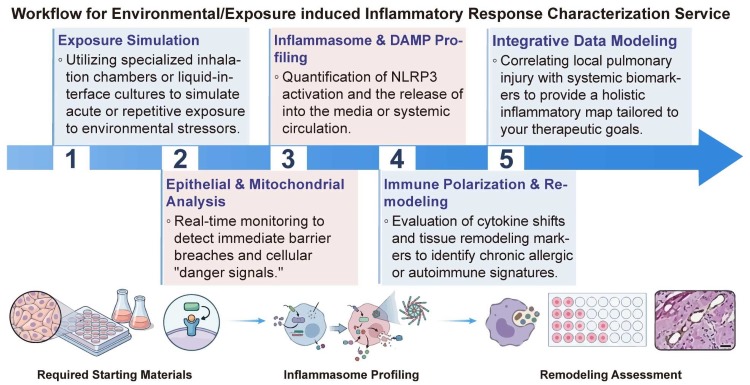
Workflow
Our workflow is meticulously designed to mirror physiological exposure and systemic cascade effects, ensuring the highest level of translational relevance.
Publication
This review examines the adverse health effects of particulate matter, focusing on oxidative stress and inflammation as key mechanisms. Particulate matter components, including metals and polycyclic aromatic hydrocarbons, generate ROS via Fenton reactions, NADPH oxidases, and mitochondrial dysfunction. ROS-driven signaling activates NF-κB and MAPK pathways, promoting inflammatory cytokine release. The article discusses particulate matter-associated respiratory diseases, cardiovascular diseases, skin disorders, and neurodegenerative impairments, highlighting the need for further mechanistic and multi-approach studies.
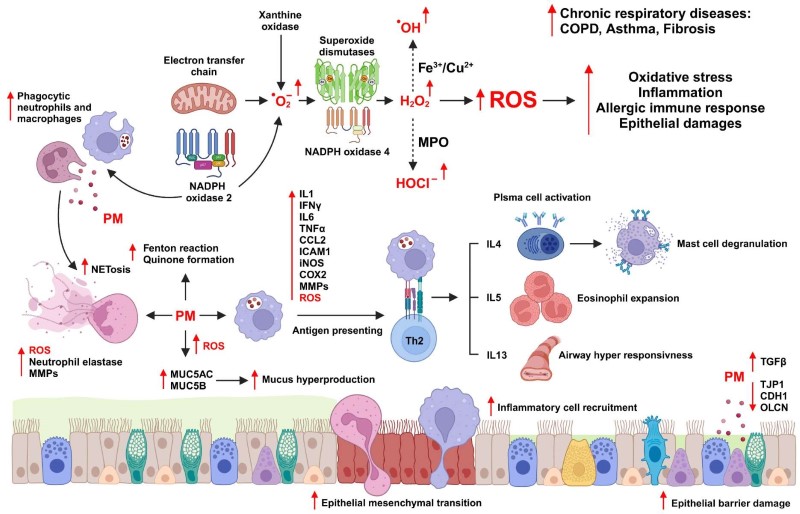 Fig.1 ROS signaling pathways in particulate matter‑induced onset and exacerbation of chronic inflammatory respiratory diseases. 1
Why Choose Us?
Creative Biolabs stands at the forefront of environmental toxicology, bridging the critical gap between environmental health and immunology. Our unique advantage lies in our unparalleled ability to detect "silent" inflammatory mediators, such as circulating mitochondrial DAMPs, that traditional toxicological methods often overlook. We leverage over two decades of sophisticated experience in antibody development and protein engineering to offer a superior, multi-parametric predictive model for human health impacts. By integrating synergistic co-exposures and mitochondrial-driven inflammatory signatures, we ensure your drug development project is supported by the most current and rigorous scientific paradigms.
Experience the Creative Biolabs Advantage - Partner with Us to Elevate Your Toxicology Data
FAQs
Can you distinguish between local irritation and systemic inflammation?
Yes, Creative Biolabs utilizes separate analysis of bronchoalveolar lavage fluid (BALF) for local markers and serum/plasma profiling for systemic "metabolic stressors" to provide a clear distinction for your safety assessments.
How does this service compare to standard inhalation toxicology?
While standard tox looks at survival or gross pathology, we characterize the mechanistic immune polarization and molecular "danger signals" like mtDNA and Clec4e expression to provide a deeper biological context.
Are co-exposure models customizable for specific regional profiles?
Absolutely. Creative Biolabs can design custom "cocktails" of pollutants to match specific regional environmental profiles or urban exposome data relevant to your target market.
Customer Review
-
Precision in Mitochondrial Tracking
Using Creative Biolabs' characterization in our research has facilitated our understanding of how environmental stressors trigger systemic lupus flares via mtDNA release. The specificity of their cf-mtDNA assays is unmatched, providing a level of detail we couldn't achieve in-house. - Dr. Al*** J -
Tissue Remodeling Insights
Focusing on LYVE-1 and lymphangiogenesis helped us explain the persistent edema in our chronic exposure models. Their expertise in PAR-mediated signaling saved us months of troubleshooting and guided our next phase of development. - Dr. Ri*** W
Related Services
Cytokine Immunotherapy Development Services
Creative Biolabs provides cytokine immunotherapy development, quantifying receptor-biased signaling and half-life extension. We utilize advanced engineering and delivery systems to evaluate T-cell persistence and tumor-localized activation for enhanced safety.
Learn More →Therapeutic Cytokine Development Services
Creative Biolabs provides therapeutic cytokine development, quantifying receptor specificity and TME-confinement. We utilize rational protein engineering to evaluate Treg-sparing IL-2 variants and IL-15 fusions for an optimized therapeutic index.
Learn More →How to Contact Creative Biolabs
Creative Biolabs provides the most sophisticated service. By integrating mitochondrial health, protease signaling, and systemic biomarker tracking, we offer a complete diagnostic and predictive package for environmental health and drug safety. Our approach ensures that you are not just seeing the inflammation but understanding the mechanisms that drive it.
Ready to Advance Your Research? Contact Our Scientists Today for an In-Depth Project Proposal
Reference
- Lim, Eun Yeong, and Gun-Dong Kim. "Particulate matter-induced emerging health effects associated with oxidative stress and inflammation." Antioxidants 13.10 (2024): 1256. Distributed under Open Access license CC BY 4.0, without modification. https://doi.org/10.3390/antiox13101256
 Download our brochure