Immune-Inflammatory Crosstalk & Carcinogenesis Assessment Service
Creative Biolabs provides a robust analytical framework to quantify the transition from chronic inflammation to malignant transformation. Our service is designed to identify "cold" tumor niches, predict the risk of inflammation-induced genomic instability, and evaluate the efficacy of immunomodulatory candidates. By mapping the interaction between myeloid-derived suppressor cells (MDSCs), tumor-associated macrophages (TAMs), and epithelial progenitors, we deliver actionable data to refine your therapeutic strategy. We specialize in identifying whether a drug candidate inadvertently triggers "smoldering" inflammatory signals that could promote cellular transformation or if it successfully interrupts the feedback loops that sustain a pro-tumorigenic tumor microenvironment (TME).
Uncovering the Mechanistic Link Between Inflammation and Cancer
Carcinogenesis is no longer viewed as a purely genetic event but as the culmination of persistent immune-inflammatory crosstalk. Chronic inflammation initiates a pro-tumorigenic "extrinsic" pathway where cytokines such as TNF-α and IL-6 induce genomic instability, ROS-mediated DNA damage, and the epigenetic silencing of tumor suppressors like E-cadherin. Conversely, oncogenic mutations trigger an "intrinsic" inflammatory response, hijacking the host's immune system to create a self-sustaining niche. Research underscores that the TME acts as a "metabolic battlefield" where nutrient competition and exosomal signaling drive immune exhaustion and facilitate metastasis.
Comprehensive Assessment Offerings
To provide a 360-degree view of the immune-inflammatory landscape, Creative Biolabs offers an integrated suite of analytical modules:
Epigenetic Landscape Mapping
We analyze how chronic inflammatory signaling induces DNA methyltransferase (DNMT) activity, leading to the hypermethylation of gatekeeper genes like E-cadherin. We also monitor the demethylation of the PD-L1 promoter, a key mechanism of immune evasion driven by NF-κB signaling.
Metabolic Battlefield Profiling
Our platform quantifies nutrient competition within the TME, measuring the accumulation of immunosuppressive metabolites such as lactate and adenosine, which drive T-cell exhaustion.
Exosomal Dialogue Characterization
We isolate and characterize tumor-derived exosomes (TDEs) to evaluate their role in distal immune reprogramming and the systemic spread of pro-tumorigenic signals.
Cytokine & Chemokine Kinetics
Real-time monitoring of the IL-6/STAT3 and IL-1β axes to determine the "inflammatory tone" of the microenvironment and its impact on angiogenesis and metastasis.
Validate Your Therapeutic Mechanism Today – Explore Our Full Range of Assessment Modules
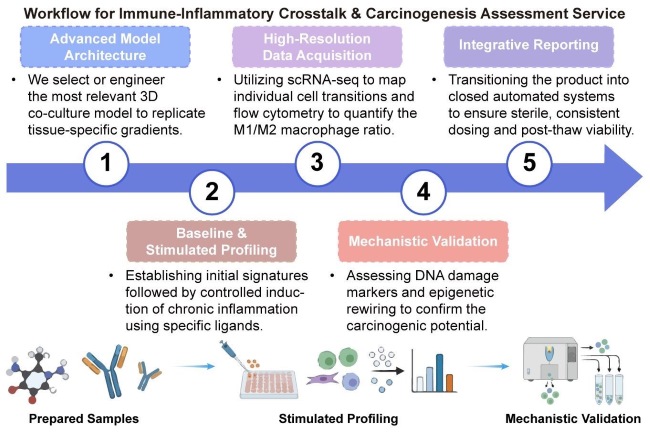
Workflow
To ensure the highest scientific rigor and data integrity, Creative Biolabs employs a streamlined, multi-phase workflow designed to translate complex biological samples into clear, mechanistic insights.
Publication
This review highlights the pivotal role of TAMs in linking inflammation, immunity, and cancer progression. It discusses how TAMs promote tumor development through coordinated mechanisms: stimulating angiogenesis via VEGF and MMPs, sustaining chronic inflammation via IL-1, IL-6, and TNF-α, and suppressing antitumor immunity via IL-10, TGF-β, and PD-L1. The article also summarizes key signaling pathways (NF-κB, STAT3, chemokine-receptor, TGF-β) involved in these processes, emphasizing the complex crosstalk between TAMs and other immune cells within the tumor microenvironment.
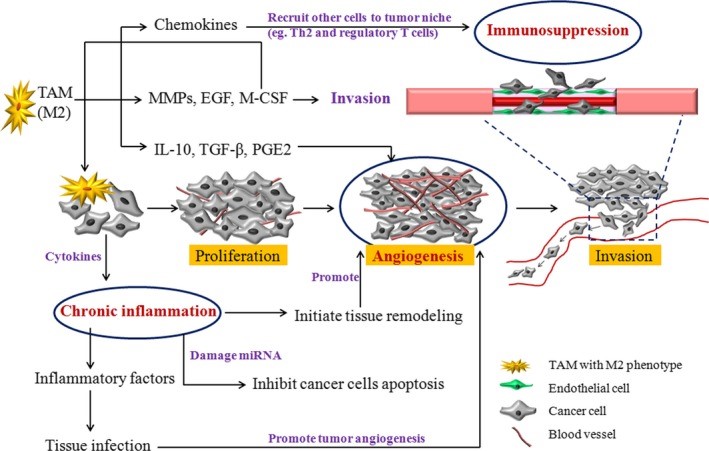 Fig.1 TAMs drive tumor development through angiogenesis, chronic inflammation, and immune suppression. 1
Why Choose Us?
Choosing Creative Biolabs means partnering with a leader in TME complexity. We offer an unparalleled interdisciplinary approach that simultaneously assesses immunology, epigenetics, and metabolism within a single and cohesive study. Our proprietary "TME-on-a-Chip" and 3D organoid platforms move beyond the limitations of traditional 2D cultures to accurately capture the spatial gradients of oxygen and nutrients that dictate immune cell behavior. We leverage two decades of specialized expertise to ensure that our in vitro inflammatory signatures reflect complex tumor-infiltrating patterns. By providing high-resolution single-cell "omics" and advanced exosomal profiling, we ensure that every pro-tumorigenic signal is identified, characterized, and quantified to safeguard your oncology pipeline from unexpected developmental failures.
Don't Leave Your Preclinical Success to Chance – Experience the Creative Biolabs Advantage and Get a Quote Today
FAQs
How does your service differentiate between acute and chronic inflammatory responses?
Acute responses are transient, while chronic "pro-tumorigenic" inflammation is marked by sustained STAT3 phosphorylation and cumulative DNA methylation changes, which we monitor over extended culture periods.
Can you perform assessments on specific tissue types, such as gastrointestinal or hepatic models?
Yes. Creative Biolabs has specialized protocols for "hotspots" of inflammation-driven cancer, including IBD-related colorectal cancer and NASH-related hepatocellular carcinoma.
What is the advantage of using your 3D organoid-immune co-culture over traditional 2D models?
2D models lack the spatial architecture and oxygen gradients that regulate immune cell behavior. Our 3D models provide a much higher predictive value for how a drug will perform in the complex environment of a human tumor.
Customer Review
-
Precise Epigenetic Insights
Using Creative Biolabs' assessment in our research has significantly improved our understanding of how IL-1β drives E-cadherin silencing. The methylation data were exceptionally clean and helped us validate our DNMT inhibitor strategy. - Dr. A***n L -
Exosomal Communication Mapping
The ability to track exosomal PD-L1 transfer between tumor and immune cells using their platform facilitated our latest study on immune evasion. It provided a level of detail we couldn't achieve in-house. - Prof. M***e S
Related Services
Immunophenotyping based Nanomedicine Services
Creative Biolabs provides immunophenotyping-based nanomedicine services, quantifying biocompatibility and EV cargo. We utilize high-resolution flow cytometry to evaluate nanomaterial immunogenicity and targeted delivery mechanisms for optimized therapeutic precision.
Learn More →Quantitative Microbiome Profiling
Creative Biolabs provides quantitative microbiome profiling (QMP), quantifying absolute microbial loads via flow cytometry or qPCR. We utilize PMA pre-treatment to evaluate intact cell composition, bypassing NGS compositional bias.
Learn More →How to Contact Creative Biolabs
Creative Biolabs provides the industry's most comprehensive assessment of the immune-inflammatory nexus, enabling researchers to navigate the complexities of carcinogenesis with precision. From molecular signaling to epigenetic rewiring, we provide the data you need to ensure your oncology pipeline is both robust and innovative.
Our Experts are Standing By – Contact Us Now to Discuss Your Project Goals and Secure a Customized Proposal
Reference
- Wang, Jing, et al. "Crosstalk between cancer and immune cells: Role of tumor‐associated macrophages in the tumor microenvironment." Cancer medicine 8.10 (2019): 4709-4721. Distributed under Open Access license CC BY 4.0, without modification. https://doi.org/10.1002/cam4.2327
 Download our brochure