Immunotoxicology Service
To help you efficiently navigate the complicated biological landscape of the immune system caused by cancer immunotherapy, Creative Biolabs offers immunotoxicological studies to facilitate your preclinical testing and move your program efficiently forward to IND approval and further market approval. Accurate analysis of the immunotoxicological study results is critical to describe the therapeutic or adverse effects on the immune system.
The Role of the Immunotoxicology Service
Cancer immunotherapies are designed to modulate the immune system to treat cancer, improving our own natural ability to fight cancer. For unexpected consequences, we work closely with our clients with our expertise in immunotoxicology and immunology to isolate the adverse effects and push the program along the continuum. In Creative Biolabs, you can find a wide breadth of assays in immunotoxicology and immunology as biomarkers to monitor the potential safety risks and pharmaceutical efficacy via defining immune endpoints and changes in cell function.
To facilitate a technical evaluation of your specific project requirements, please consider initiating a formal consultation.
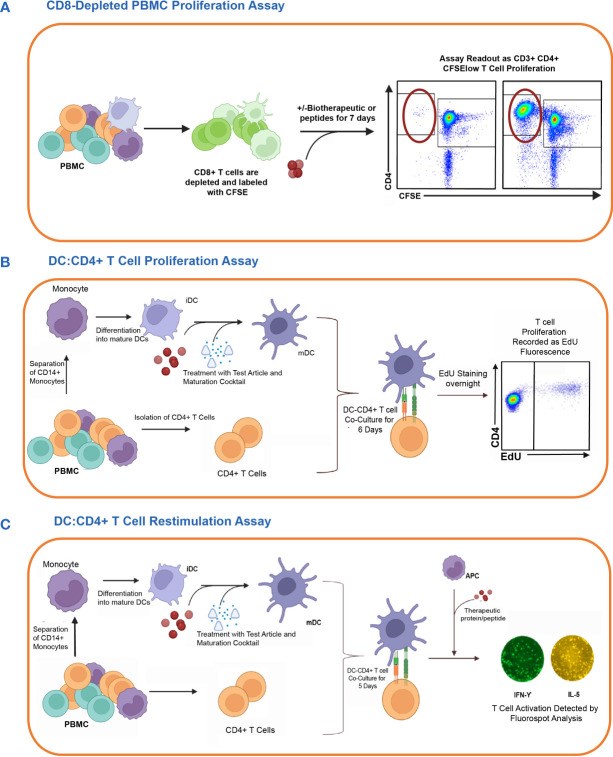 Fig.1 Flowchart of experimental design for immunogenicity of biotherapeutics using CD4 T cell assays. 1
What We Can Offer
Cell-based Assays
Creative Biolabs provides an end-to-end immunotoxicology platform focused on the mechanistic evaluation of immune-mediated risks. We provide immunophenotyping assays in blood or tissues, functional assays using primary cells from multiple species, functional assays using established cell lines, and immune response analysis.
| • T cell-dependent antibody response | • Complement response | • Proliferation | • Natural killer (NK) cell activity |
| • T cell cytotoxicity | • ADCC/CDC | • Basophil | • Delayed-type hypersensitivity |
|
Cytokine/Chemokine
|
Neutrophil/Macrophage
|
Immuno-biomarker analysis
Receptor occupancy and candidate molecule binding |
|
Whole Animal Studies
| • Immunophenotyping assays (blood, tissues) | • Immunoassays (including T-dependent antibody responses) |
Hypersensitivity Responses
| • Complement response | • Murine local lymph node assay | • Guinea pig maximization test and Buehler test |
| • Histamine release assay | • IgE titration | • Antidrug antibody (ADA) assays |
| • Host resistance models | • Studies supporting vaccine and biologic development | |
Platform-based Approaches
| • Flow cytometry | • ELISA, ELISpot, and FluoroSpot | • Immunoassay | |
| • Immunochemistry | • Immunohistochemistry | ||
How Creative Biolabs' service Can Assist Your Projects
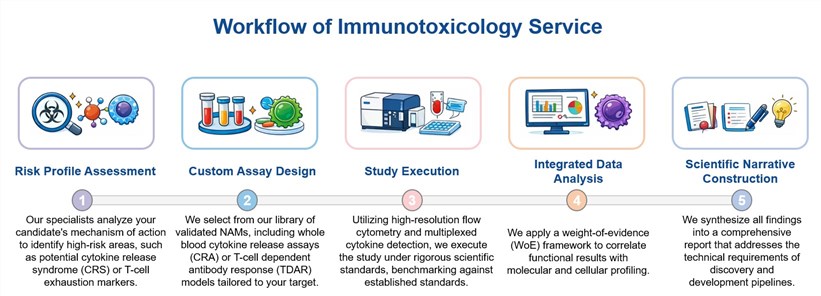
Highlights
Holistic Immunological Support
We provide expert support for diverse cancer therapies, including small and large molecules, cell therapies, and vaccines. This oversight is vital as novel candidates often trigger complex immune interactions.
Methodological Convergence
We prioritize shifting from descriptive observations to mechanistic, human-centric data. By synthesizing advanced assessment frameworks, we ensure safety conclusions are grounded in rigorous logic to bridge the current translational gap.

Technological Sophistication
Our architecture leverages high-resolution cellular analysis alongside integrated data streams. This allows investigators to clarify cryptic interactions, perhaps significantly mitigating unforeseen risks with precision during the advanced research phases.
Empirical Reliability
Backed by two decades of success, we deliver robust data packages aligned with scientific expectations. We emphasize balancing high-fidelity results with efficient delivery to keep projects within budgetary constraints.
To leverage the strategic advantages provided by the Creative Biolabs platform, please request a formal quotation for your project.
Customer Reviews
-
Translational Optimization
Implementing the immunotoxicology platform from Creative Biolabs has significantly enhanced our capacity to anticipate human-specific cytokine liberation. Their utilization of purified cell populations offers scientific resolution far exceeding that of conventional whole-blood methodologies. - Dr. Al***n S. -
Analytical Precision
The integration of Creative Biolabs' safety services markedly facilitated our data synthesis. We found the weight-of-evidence framework to be exceptionally robust; furthermore, the granular detail provided in the functional antibody response analysis was indispensable for our candidate profiling. – S**h M.
FAQs
In what specific ways do your methodologies improve upon traditional animal models?
Our platform utilizes human-relevant methodologies that prioritize primary human cells. These systems often detect hypersensitivity or cytokine-related risks that remain occult in standard rodent models. This discrepancy perhaps arises from species-specific variations in receptor binding and signaling cascades.
Is it possible to investigate anomalous responses observed during preliminary studies?
Indeed. We provide specialized ex vivo support utilizing donor cohorts to elucidate the molecular mechanisms driving atypical research observations. Such investigations may perhaps assist in the refinement of molecular architecture or the selection of superior lead candidates.
Related Services
Genetic Toxicology
We provide comprehensive screenings to identify potential genomic instabilities and mutagenicity induced by novel candidates, ensuring that your therapeutic platform maintains rigorous safety and molecular integrity throughout research.
Learn More →Infusion Toxicology Service
We offer specialized in vitro models to predict unintended systemic reactions during administration, elucidating mechanisms such as complement activation or direct cellular triggers to optimize candidate safety profiles.
Learn More →How to Contact Us
In Creative Biolabs, we assist our clients in realizing immunotherapy efficiency with our wide range of assays in preclinical studies to move your candidate drug or therapy along the continuum. Please contact us for more detailed information.
Reference
- Walsh, Robin E et al. "Preclinical immunogenicity risk assessment of biotherapeutics using CD4 T cell assays." Frontiers in immunology vol. 15 1406040. 28 May. 2024. Distributed under Open Access license CC BY 4.0, without modification. https://doi.org/10.3389/fimmu.2024.1406040
 Download our brochure