Inflammation driven Tumor Microenvironment Remodeling Analysis Service
Our specialized analysis service acts as a critical bridge between basic inflammatory research and successful drug application. Creative Biolabs provides deep-dive insights into the mechanisms by which the tumor "soil" is modified to exclude immune cells, allowing your team to design therapies that can effectively "normalize" the tumor microenvironment (TME). Whether you are developing small molecule inhibitors for matrix metalloproteinases (MMPs) or engineering complex CAR-T therapies for solid tumors, our data provide the mechanistic proof-of-concept and high-resolution characterization required for robust drug candidate validation.
Introduction to Inflammation-Driven TME Remodeling
The development and progression of tumors are intrinsically linked to the surrounding inflammatory milieu. Chronic inflammation induces a comprehensive and destructive "remodeling" of the extracellular matrix (ECM) and the local metabolic landscape. Key events include the accumulation of low-molecular-weight hyaluronan that triggers receptor-mediated stemness and the stabilization of metabolic regulators like HIF-1α under hypoxic stress. These alterations create a self-sustaining, immunosuppressive cycle that excludes effector cells and promotes drug resistance. Understanding this complex architectural shift is essential for developing next-generation immunotherapies designed to penetrate the desmoplastic barrier and reactivate the host immune system.
Strategic Analytical Capabilities
To fully decode the inflammatory remodeling of the TME, Creative Biolabs offers a multi-dimensional analytical toolkit that goes beyond standard cellular profiling. We specialize in identifying the subtle biochemical and mechanical shifts that define a pro-tumorigenic environment.
Spatial Multi-Omics & Neighborhood Mapping
We utilize industry-leading spatial transcriptomics to visualize the co-localization of inflammatory markers and immune cells. This allows us to define "hot" and "cold" regions with single-cell resolution, mapping the exact boundaries where inflammation-induced fibrosis excludes T-cell infiltration.
Extracellular Matrix (ECM) & Hyaluronan Profiling
We provide specialized analysis of the "glycocalyx" and matrix stiffness. This includes quantifying low-molecular-weight hyaluronan fragments, known drivers of receptor-mediated stemness, and assessing collagen cross-linking density via second harmonic generation (SHG) imaging.
Metabolic Immunosuppression Analysis
Our mass spectrometry platforms quantify the "metabolic exhaust" of the inflammatory TME. We track the levels of adenosine, kynurenine, and lactate, helping you understand how nutrient competition and acidity drive immune cell exhaustion in your specific research models.
Exosomal & Secretome Characterization
We analyze tumor-derived extracellular vesicles (EVs) that carry inflammatory microRNAs and proteins. This service helps identify how local inflammation prepares pre-metastatic niches in distal organs, providing a holistic view of systemic disease progression.
Stimuli-Responsive Interaction Testing
For clients developing "smart" drug delivery systems, we offer specialized assays to validate pH-triggered charge reversal or enzyme-responsive drug release within accurately modeled inflammatory matrices.
Explore Our Full Technical Suite — Inquire Now to Customize Your Project Roadmap
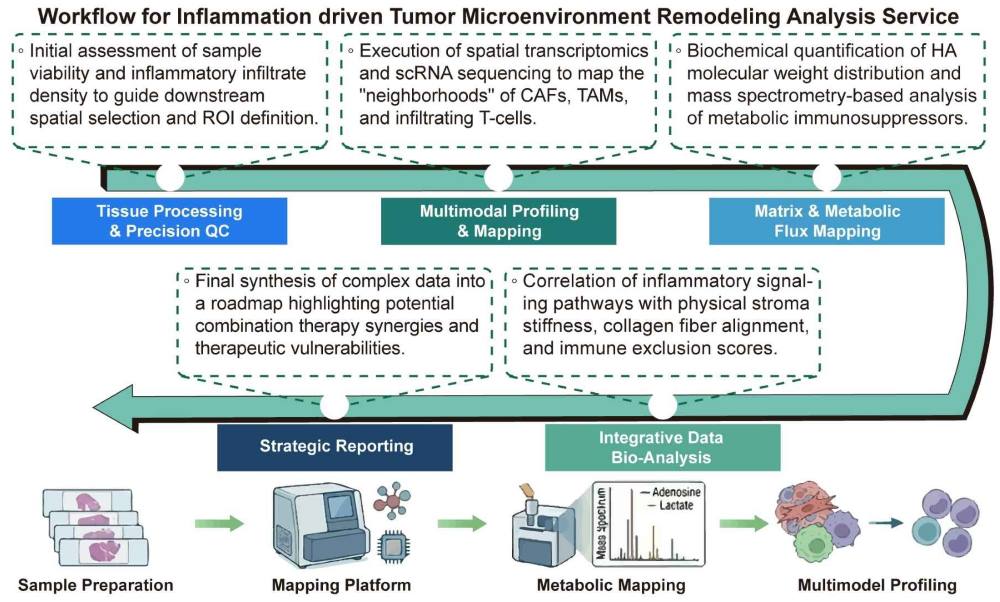
Workflow
To ensure the highest data integrity and translational relevance, our workflow is meticulously designed to be comprehensive, transparent, and reproducible.
Publication
This review explores how the inflammatory microenvironment (IME) drives endometrial cancer (EC) progression and immune evasion. Key components include M2-polarized tumor-associated macrophages, regulatory T cells, and cytokines like IL-10 and TGF-β that suppress antitumor immunity. Inflammatory signaling pathways (NF-κB, IL-6/JAK/STAT3) upregulate immune checkpoints such as PD-L1, while metabolic shifts and ECM remodeling further impair cytotoxic T-cell infiltration. The authors discuss therapeutic strategies targeting IME components, immune checkpoints, and metabolic pathways, highlighting clinical trials combining pembrolizumab with lenvatinib.
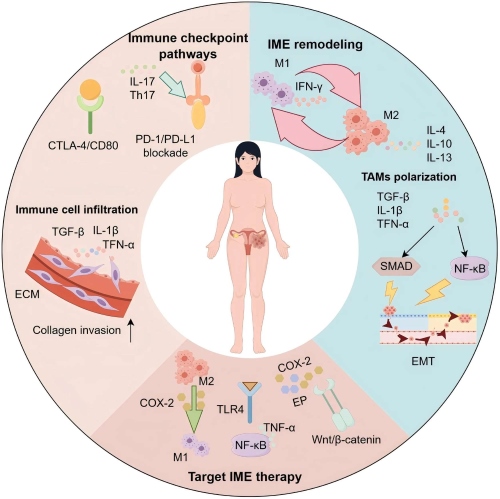 Fig.1 The inflammatory tumor microenvironment in endometrial cancer: mechanisms and therapeutic opportunities. 1
Why Choose Us?
Creative Biolabs stands at the global forefront of TME research by providing high-precision analytical solutions that standard CROs simply cannot match. While others offer generic cellular assays, we specialize in the "smart" interaction analysis of the inflammatory matrix. Our platform excels in testing how stimuli-responsive nanoplatforms, enzyme-triggered self-assembling fibers, or charge-reversal delivery systems react within a remodeled environment. By integrating extracellular proteostasis and hyaluronan metabolism profiling, we offer a multi-layered depth of data that uncovers hidden therapeutic vulnerabilities. Our commitment to accuracy and innovation ensures your project is backed by the most advanced scientific insights, significantly reducing lead optimization timelines and increasing the success rate of your drug development programs.
Experience the Creative Biolabs Advantage — Request a Detailed Quote and Project Feasibility Assessment
FAQs
Can your service handle very small research samples?
Yes, Creative Biolabs utilizes highly sensitive spatial profiling technologies designed specifically for limited samples, ensuring high-quality data even from archival tissue or small animal biopsies.
How do you differentiate between macrophage phenotypes in your analysis?
We employ a combination of single-cell transcriptomics and multiplex immunofluorescence markers to provide a precise polarization ratio and spatial distribution map.
Do you offer specific assays for desmoplasia and collagen fiber stiffness?
Absolutely. We employ advanced imaging to visualize collagen alignment and can integrate mechanical data to correlate stroma stiffness with your drug's penetration profile.
Customer Review
-
Enhanced Spatial Clarity
Using Creative Biolabs' TME analysis in our research has significantly improved our ability to distinguish between immune-excluded and immune-desert niches. The spatial transcriptomics data were essential for our latest project. - Dr. Elena V***as -
Unmatched Technical Support
We were concerned about the complexity of nanoparticle testing in an acidic environment, but Creative Biolabs provided a tailored matrix model that perfectly validated our delivery system's efficacy. - Sarah K***er
Related Services
Tumor Cell Ferroptosis Services
Creative Biolabs provides tumor ferroptosis analysis using metabolomics and pathway profiling (GPX4/DHODH). We evaluate TME crosstalk and evasion mechanisms to identify therapeutic targets and validate drug-induced metabolic stability and interactions.
Learn More →Identifiy and Characterization of Venom Peptides
Creative Biolabs isolates and characterizes disulfide-rich venom peptides targeting ion channels. Utilizing chromatography and quantitative mass spectrometry, we deliver high-resolution sequence identification and target validation for therapeutic development.
Learn More →How to Contact Creative Biolabs
Creative Biolabs provides a comprehensive analytical gateway into the inflammation-driven TME. By combining spatial insights with high-resolution biochemical and metabolic mapping, we empower researchers to overcome the mechanical and immunological barriers of the tumor stroma. Our data-driven approach ensures that your development program is supported by the most advanced scientific insights available today.
Contact Our Specialist Team for More Information and to Kickstart Your Project Today.
Reference
- Tan, Z., et al. "Inflammation-driven mechanisms in endometrial cancer: pathways from inflammatory microenvironment remodeling to immune escape." Front Immunol 16 (2025): 1689114. Distributed under Open Access license CC BY 4.0, without modification. https://doi.org/10.3389/fimmu.2025.1689114
 Download our brochure