Insulin Release Assay Service
Creative Biolabs delivers specific, actionable functional data essential for advancing compounds targeting glucose homeostasis. We move beyond simple concentration measurements to provide deep pharmacological characterization of your drug candidates, ensuring every lead is rigorously vetted for in vivo potential. Our comprehensive services include glucose-induced insulin release assays, glucose uptake assays, and receptor binding and activation studies. These capabilities provide a holistic understanding of your compound's mechanism of action, potency, and selectivity, enabling informed decision-making and accelerating your drug development pipeline.
Introduction: Addressing the Global Metabolic Crisis
Dysregulation of glucose homeostasis, primarily due to compromised insulin function, is a major global health challenge, with type 2 diabetes mellitus (T2DM) reaching epidemic proportions. The accurate, sensitive, and reliable quantification of insulin release in vitro is an absolute scientific imperative for drug developers targeting pancreatic β-cells. The Insulin Release Assay is the gold standard functional assay for quantifying β-cell secretory capacity, vital for developing new drugs against T2DM, where insufficient glucose-stimulated insulin secretion (GSIS) is the core pathology.
A Robust and Standardized Protocol for Efficacy Screening
The reliability of any functional assay is dictated by its model system and rigorous protocol. Our cell-based insulin release assay is meticulously standardized to provide biologically relevant and consistent data.
| Assay Parameter | Specification | Purpose |
|---|---|---|
| Cell Model | HIT-T15 β-cells (Hamster pancreas) | Well-characterized, insulin-secreting line ensuring physiological relevance. |
| Detection Method | Time-resolved fluorescence resonance energy transfer (TR-FRET) | High sensitivity and low background interference. |
| Functional Mode | Agonist/Antagonist screening | Comprehensive evaluation of compound activity. |
| Control Activator | D-Glucose (10 mM or 100 mM) | Positive control for physiological insulin release stimulation. |
| Control Inhibitor | Somatostatin-14 | Negative control for demonstrating assay inhibition. |
Contact Creative Biolabs today to discuss how our service can accelerate your metabolic disease research and transform your lead compounds into viable therapeutic candidates.
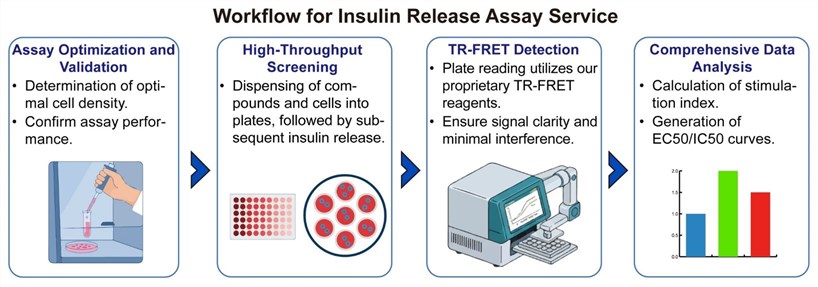
Detailed Workflow for Functional Lead Optimization
This comprehensive workflow is designed for transparency and is suitable for visualization as a flowchart, making it very clear to potential clients what is involved and what high-quality outputs to expect at each stage.
Publication
This study introduces a rapid, homogenous time-resolved fluorescence assay for insulin detection. Designed to overcome the cost and throughput limitations of ELISAs and RIAs, this homogenous, mix-and-read method is significantly faster and cheaper. The assay was effectively validated by measuring GSIS in INS-1E cells and mouse pancreatic islets. Its utility was further demonstrated by confirming dopamine and the anti-diabetic drug bromocriptine as potent inhibitors of GSIS, establishing it as a robust tool for diabetes research and drug screening.
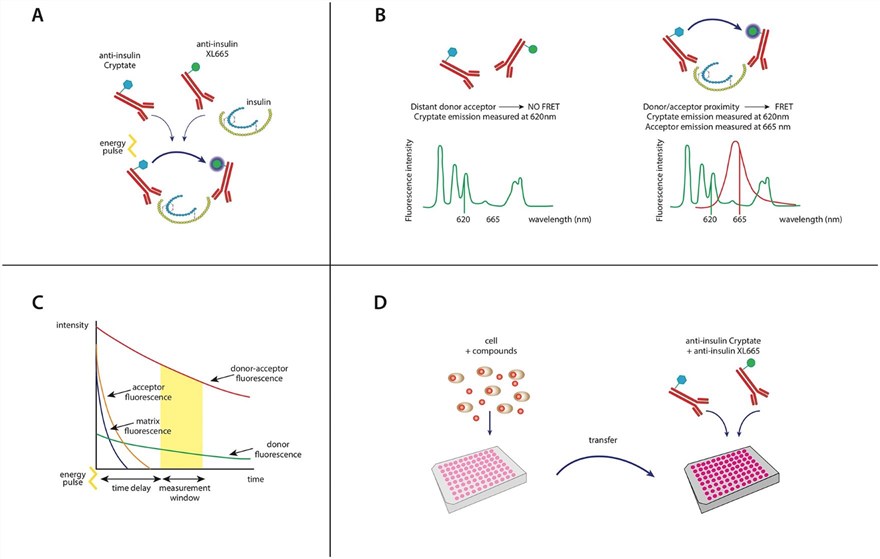 Fig.1 A fluorescence-based insulin assay. 1
Why Choose Us?
Creative Biolabs sets the industry standard for insulin functional assays, minimizing variability and maximizing confidence in lead compounds. Our TR-FRET platform offers superior high-throughput capabilities with an exceptional signal-to-noise ratio, outperforming traditional ELISA methods. We ensure validated quality and reliability, consistently achieving Z'-factor scores up to 0.89, significantly surpassing the industry standard for robust high-throughput screening. Additionally, we utilize specialized β-cell pathophysiology models, including ER stress and genetic defects, to test compounds against specific disease mechanisms, ensuring early clinical relevance.
Inspired by these successes? Experience the Creative Biolabs Advantage - Get a Quote Today to begin your optimized screening campaign.
FAQs
Why should I choose the TR-FRET assay over a conventional ELISA for my high-throughput screen?
Our TR-FRET assay is fundamentally designed for optimal high-throughput and reliability. This dramatically minimizes background noise from biological matrices or compounds, delivering a superior Z'-factor and ensuring that your drug discovery is based on the most robust, cleanest data possible.
Can your assay service handle my unique, patient-derived β-cell model?
Absolutely. Creative Biolabs routinely adapts its protocol for various cell models, including human induced pluripotent stem cell (hPSC)-derived β-cells and genetically modified lines that express specific transcriptional defects.
We are looking to screen an antagonist. What precautions are necessary for this type of compound in your assay?
A key precaution we manage is cytotoxicity; we run parallel β-cell viability assays to ensure any observed reduction in insulin secretion is due to specific antagonism, not general cellular toxicity. We welcome your antagonist libraries and are ready to design a targeted screen.
Customer Reviews
-
High Sensitivity and Confidence
The TR-FRET platform's ability to minimize background noise finally allowed us to confidently distinguish true hits from false positives, something we struggled with using standard ELISA kits. – Dr. Clk P***er -
Clinical Relevance and Resource Efficiency
By focusing on the absolute delta, we filtered out several initial lead compounds that showed high fold-change but had insufficient absolute insulin output, saving us significant resources in downstream animal studies. – Dr. Fse R***do
Related Services
Creative Biolabs offers a suite of complementary services designed to provide an end-to-end solution for your metabolic drug development pipeline.
NGS based Genome Sequencing Service
Creative Biolabs offers complete genome analysis for cancer research. Our specialists provide precise, high-quality insights from sampling to reporting, enabling individualized treatments and genomic studies.
Learn More →System Immunity Measurement
Creative Biolabs offers comprehensive bioassay and multi-omics services for system immunity measurement in gut microbiota-associated neuro diseases, leveraging the latest understanding of microbiome-immune interactions.
Learn More →How to Contact Creative Biolabs
The Creative Biolabs' service provides the precision, scale, and functional depth necessary for modern metabolic drug discovery. Utilizing advanced TR-FRET technology, we deliver high-quality Z'-factor data and clinically powerful analysis. Partner with us to ensure your lead optimization is based on the most accurate and predictive functional data available.
Reference
- Farino, Z. J., et al. "Development of a Rapid Insulin Assay by Homogenous Time-Resolved Fluorescence." PLoS One 11.2 (2016): e0148684. Distributed under Open Access license CC BY 4.0, without modification. https://doi.org/10.1371/journal.pone.0148684
 Download our brochure