Directly demonstrate the biological activity of the drug, often by quantifying downstream functional effects, such as the secretion of inflammatory mediators or the release of cytotoxic molecules.
Release Assay Services
At Creative Biolabs, we specialize in innovative and precise biochemical assays that are cornerstone tools for understanding therapeutic mechanisms of action. Our commitment to scientific excellence is reflected in our cutting-edge laboratory techniques and expertise. We offer highly specialized release assays, including glucose-induced insulin release and TNF-α-induced PGE2 release, meticulously designed to assess agonist and antagonist activity. These assays are crucial for advancing biomedical research, facilitating drug development, and enabling precise therapeutic interventions.
Background Featured Services What We Can Offer Publication Why Choose Us FAQs Customer Review Related Services Contact Us
The Scientific Core: Understanding Release Assays
A release assay is a highly sensitive functional bioassay that measures the cellular output—typically the release of a specific biomarker, signaling molecule, or cytokine—following treatment with a therapeutic candidate. These assays are essential because they:
Confirm Mechanism of Action (MoA)
Determine Potency
Provide a critical measure of drug strength, which is vital for quality control (QC), regulatory submissions (e.g., lot release testing), and establishing comparability between batches.
Assess Safety (Off-Target Effects)
Act as high-sensitivity indicators for unwanted activation or inhibition of cellular pathways, providing an early warning system for potential toxicity risks.
Find All Our Release Assay Services
Insulin Release Assay
|
Mediator Release Assay
|
Our Comprehensive Arsenal of Assessment Technologies
Regulatory Potency Determination (Lot Release)
We develop and validate fully functional bioassays that quantitatively reflect your drug's primary MoA, providing the critical IC50 or EC50 metrics essential for late-stage lot release and stability testing as mandated by regulatory bodies.
Predictive Safety Screening
Our immunological assays (e.g., cytokine release syndrome potential and inflammatory mediator assays) act as a high-sensitivity early warning system, predicting unwanted cellular activation or off-target pro-inflammatory risk of novel biologics well before in vivo studies.
Mechanistic Validation in Complex Pathways
We move beyond reporter genes, employing highly relevant primary or engineered cell lines to confirm compound efficacy within complex signaling cascades. For instance, we provide definitive data on the ability of novel anti-inflammatory drugs to interrupt the TNF-α-COX-2-PGE2 axis.
Discover How Creative Biolabs Can Help You Achieve Regulatory Confidence – Request a consultation to discuss your strategy.
Publication
This study introduces a computational model of glucose-stimulated insulin secretion (GSIS) in the pancreatic β-cell. Developed using a systematic workflow, it integrates data from 39 studies. The model couple's glycolysis with insulin secretion, dynamically linked to the cellular ATP/ADP ratio. It successfully predicts biphasic insulin release and metabolic changes, identifying the ATP/ADP increase as the key trigger. This work provides a reproducible, data-driven resource for understanding β-cell function, offering a foundational tool for diabetes research and a blueprint for building future kinetic models of cell metabolism.
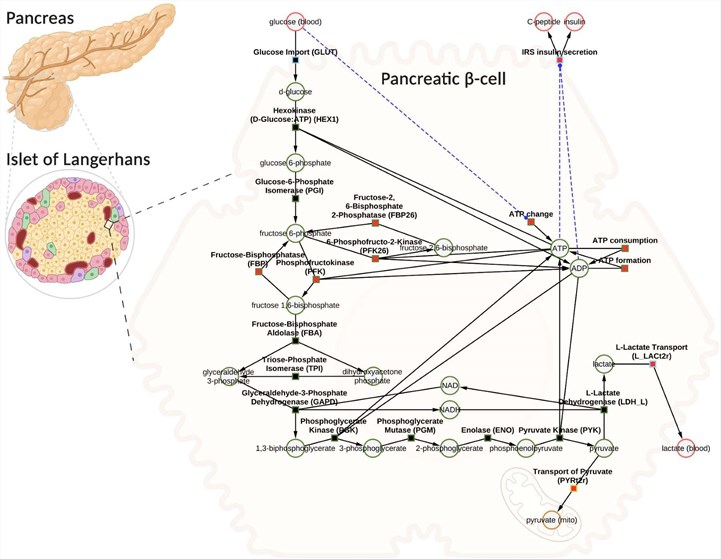 Fig.1 Computational modeling of glucose-stimulated insulin secretion in β-cells. 1
Why Choose Creative Biolabs for Functional Release Assays?
Our advantage stems from combining advanced analytical technology with deep scientific domain expertise, ensuring the data we deliver is not only accurate but also biologically meaningful and strategically valuable for regulatory submissions.
Key Advantages Defining the Creative Biolabs Difference:
Scientifically-Grounded Biological Relevance
Our assays mimic complex disease pathology, focusing on mechanisms like the COX-2-PGE2 axis in inflammation, to provide highly predictive IC50 values.
Proven Mechanistic Insight in Critical Disease Areas
We target biologically sound pathways, such as the TNF-α-COX-2 pathway in neuroinflammation, to demonstrate direct drug interruption of relevant damaging cascades.

Complex Modality Assay Matrices for Biologics
We develop comprehensive, orthogonal functional assays for next-generation therapeutics to prove simultaneous engagement of all functional domains and ensure lot-release consistency.
Rigorous Regulatory Compliance
All assay development and validation adhere to strict protocols and guidelines, providing robust, auditable data packages for accelerated submission.
Experience the Creative Biolabs advantage – Get a quote today to secure your program's functional data with precision and certainty.
FAQs
How do you ensure the biological relevance of the cell model, especially given the variability of primary cells?
We prioritize optimizing every aspect of the culture and stimulation protocol. Our approach ensures we maintain biological relevance (e.g., functional receptor expression) while delivering the low variability and high reproducibility essential for QC and regulatory assays.
Is the release assay platform flexible enough to test multiple therapeutic modalities?
Absolutely. Our platform is designed for versatility. For small molecules, we focus on dose-dependent inhibition or agonism within signaling pathways. For antibodies, we assess target neutralization or activation. For cell therapies, the assay measures the final biological output.
How does Creative Biolabs handle the necessary regulatory documentation for these assays?
We provide comprehensive documentation, full validation reports, and raw data summaries, all developed under our strict QMS. Our team designs the assay package to be phase-appropriate. This proactive approach minimizes delays during regulatory filing.
Customer Review
-
Superior Functional Data
Using Creative Biolabs' services in our research has significantly improved the robustness of our potency data for biosimilar comparison. The low variability and phase-appropriate validation provided definitive proof of lot comparability. - P. Eey* -
Risk Mitigation in Preclinical Safety
The release assay services in our research have facilitated the high-throughput safety screening of multiple immuno-oncology candidates. We quickly identified two high-risk molecules that induced unwanted inflammatory mediator release. - D. Kg**
Related Services
Achieving comprehensive characterization often requires an orthogonal approach. Consider complementing your current release assay focus with the following specialized services:
Macrophage Immunophenotyping Service
Creative Biolabs offers precise macrophage immunophenotyping, leveraging two decades of experience and state-of-the-art technology. We provide deep insights into macrophage populations and functional capabilities for preclinical research and therapeutic development.
Learn More →System Immunity Measurement
Creative Biolabs offers comprehensive bioassay and multi-omics services for system immunity measurement in gut microbiota-associated neuro diseases, leveraging the latest understanding of microbiome-immune interactions.
Learn More →Contact Us
Creative Biolabs' release assay services deliver precision, biological relevance, and regulatory compliance across the most critical functional tests for your therapeutic candidates. We translate complex scientific principles into auditable, high-confidence data packages, providing the necessary scientific proof for potency, consistency, and safety.
Reach out to our development team today to discuss how our mechanism-based functional assays can accelerate your submission timeline.
Reference
- Deepa Maheshvare, M., et al. "A pathway model of glucose-stimulated insulin secretion in the pancreatic β-cell." Frontiers in Endocrinology 14 (2023). Distributed under Open Access license CC BY 4.0, without modification. https://doi.org/10.3389/fendo.2023.1185656
 Download our brochure
Loading case studies...
Online Inquiry