Mouse Lung Cell LL/2 based Proliferation Assay Service
Accelerating Lung Cancer Research: Precision with Mouse Lung Cell LL/2 Proliferation Assay
Lung cancer remains a challenging area of research, requiring advanced tools to evaluate the efficacy of potential treatments. At Creative Biolabs, we provide cutting-edge cell-based assays to support drug discovery and development. Among our offerings, the mouse lung cell LL/2-based proliferation assay is specifically designed to assess the effects of therapeutic compounds on lung carcinoma cell growth. This assay helps researchers gain valuable insights into compound performance, making it an essential tool in preclinical testing.
Technical Method
The mouse lung cell LL/2-based proliferation assay is a functional assay that uses LL/2 mouse lung carcinoma cells to study the antagonistic effects of test compounds. By utilizing luminescence as the detection method, the assay provides high-sensitivity measurements of cell proliferation and viability, allowing for the quantification of growth inhibition (GI50), total growth inhibition (TGI), and lethal concentration (LC50) values.
| Assay Type | Cell Type | Model | Detection Method | Control Inhibitor |
|---|---|---|---|---|
| Functional | LL/2 | Antagonist | Luminescence | Staurosporine |
Procedure
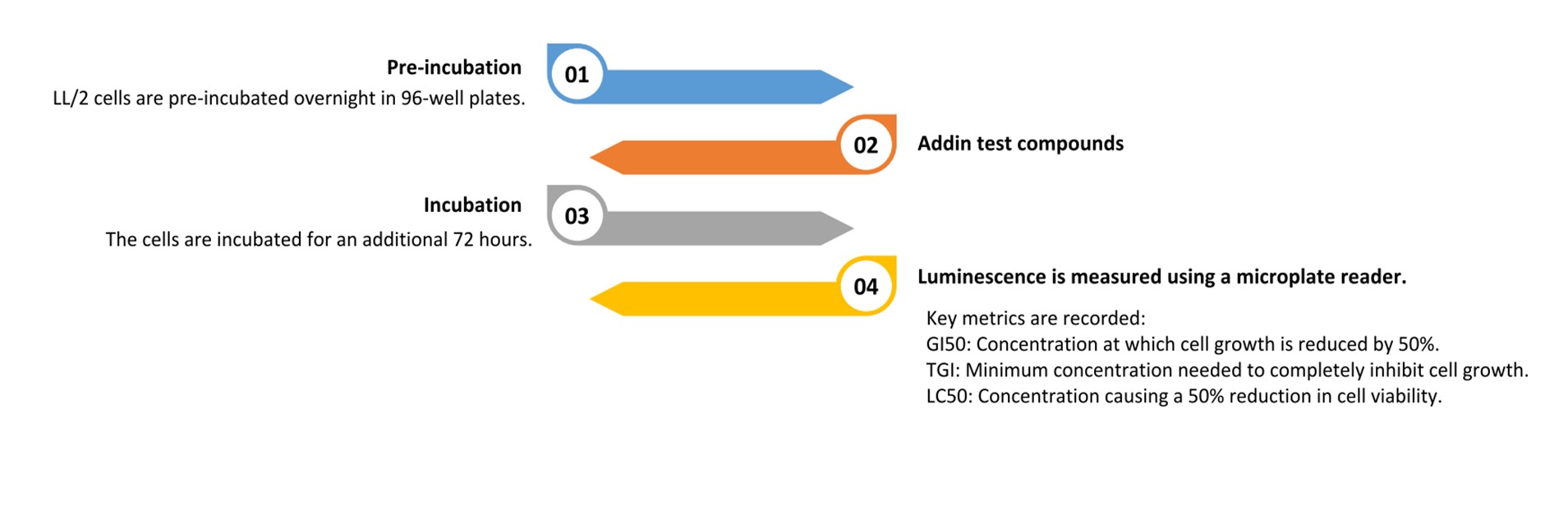
Advantages
This assay offers a reliable and precise method to evaluate the antagonistic effects of therapeutic compounds on lung carcinoma cells. The use of luminescence provides high sensitivity and reproducibility in detecting cell viability and proliferation. The Mouse Lung Cell LL/2-based Proliferation Assay enables researchers to accurately determine critical metrics like GI50, TGI, and LC50, providing essential data for preclinical drug screening and helping to identify the most promising compounds for further development.
Applications
- Screening for potential lung cancer therapies
- Studying the impact of growth inhibitors on lung carcinoma cells
- Assessing compound cytotoxicity and therapeutic efficacy
- Preclinical evaluation of antagonist mechanisms targeting lung cancer
Frequently Asked Questions
Q1: What types of compounds can be tested using this assay?
A1: A wide range of compounds, including small molecules, biologics, and antibodies, can be tested using this assay to evaluate their effects on lung carcinoma cell proliferation.
Q2: How are the results of this assay measured?
A2: The results are measured using luminescence, which detects cell viability and proliferation.
Q3: How is the data from the assay typically analyzed?
A3: The data is analyzed by calculating key metrics such as GI50, TGI, and LC50, which provide insights into the concentration-dependent effects of test compounds on cell proliferation and viability. Standard curve fitting and statistical analysis are used to ensure accurate and reliable results.
Q4: Can the assay be customized for specific compounds?
A4: Yes, the assay can be adapted to test specific compounds or experimental conditions based on your research needs.
The mouse lung cell LL/2-based proliferation assay is a critical tool for assessing the inhibitory effects of compounds on lung carcinoma cells. Its high sensitivity, precise measurements, and ability to generate valuable data on GI50, TGI, and LC50 make it ideal for preclinical drug screening and lead optimization. Whether you're testing potential cancer treatments or studying the biological pathways involved in tumor growth, this assay provides the accuracy and depth of information required for impactful research outcomes. Get in touch with Creative Biolabs today to see how this assay can accelerate your lung cancer drug development process and enhance your research objectives.
 Download our brochure