Mouse Renal Cell based Proliferation Assay Service
Precision Proliferation Assays with Renca Cells
Creative Biolabs has a proven track record in designing and executing tumor cell proliferation assays that provide critical insights for oncology research and therapeutic development. Our highly specialized assays cover a broad spectrum of tumor models, enabling researchers to uncover key data on cell growth, inhibition, and cytotoxicity. We are proud to introduce the mouse renal cell-based proliferation assay using the well-characterized Renca cell line. This assay is a powerful tool for evaluating potential anti-cancer agents targeting renal cell carcinoma, offering precise growth inhibition data to drive drug development forward.
Technical Method
| Assay Type | Cell Type | Model | Detection Method | Control Inhibitor |
|---|---|---|---|---|
| Functional | Renal cell | Antagonist | Luminescence | Staurosporine |
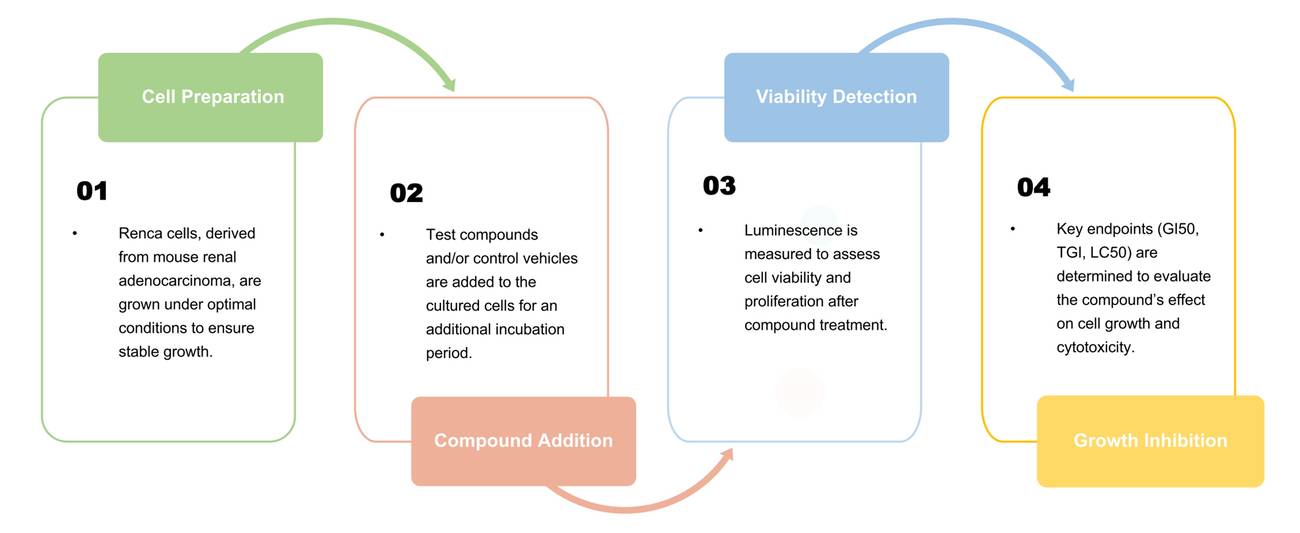
The mouse renal cell-based proliferation assay is a functional assay that focuses on the proliferation of Renca cells, a mouse renal adenocarcinoma cell line. Utilizing an antagonist mode, the assay measures the effects of test compounds on cell growth and viability using luminescence as a highly sensitive detection method. This approach provides valuable data on growth inhibition (GI50), total growth inhibition (TGI), and cytotoxicity (LC50), making it ideal for preclinical drug screening.
Procedure
Service Advantages
- The assay utilizes the Renca cell line, a highly relevant and established model for renal cell carcinoma, ensuring that the results closely reflect in vivo conditions.
- Provides multiple key indicators, including GI50, TGI, and LC50, which allow for a thorough understanding of the compound's anti-proliferative effects.
- Luminescence-based detection offers high sensitivity, ensuring accurate and reproducible results across multiple experiments.
Applications
- Preclinical drug screening: Ideal for testing potential therapeutics that target renal cell carcinoma and understanding their effect on tumor cell proliferation.
- Mechanistic studies: Provides insight into the mechanisms by which compounds induce growth inhibition or cell death in renal cancer cells.
- Therapeutic candidate evaluation: Assists in the prioritization of drug candidates by providing critical data on growth inhibition and cytotoxicity in a renal cancer context.
Frequently Asked Questions
Q1: What types of compounds can be evaluated in the mouse renal cell-based proliferation assay?
A1: This assay is designed to evaluate a broad range of compounds, including small molecules, biologics, antibodies, and novel therapeutics targeting renal cancer cells.
Q2: How does the Renca cell line contribute to understanding renal cancer?
A2: The Renca cell line is a well-established mouse renal adenocarcinoma model, offering a relevant system for studying renal cell carcinoma progression and response to therapies.
Q3: Can the assay be adapted for other cancer research purposes?
A3: Yes, this assay can be customized to meet specific research objectives, including varying the test compound concentrations, and treatment durations, or combining it with other readouts.
Q4: How does the luminescence detection method enhance the accuracy of the assay?
A4: Luminescence-based detection is highly sensitive and provides quantitative, reproducible measurements of cell viability, allowing for precise evaluation of compound effects on cell growth.
The mouse renal cell-based proliferation assay from Creative Biolabs offers a vital tool for advancing renal cancer research by providing detailed insights into compound efficacy and cytotoxicity. With our deep expertise in tumor cell assays and a commitment to delivering high-quality results, we are well-positioned to support your research goals. If you are interested in learning more about this service or discussing how we can tailor it to your needs, please contact us - we're here to collaborate on your breakthrough discoveries.
 Download our brochure