Phosphodiesterase (PDE) Panel Screening Service
Background Service Highlights FAQs Contact Us
The Critical Role of Phosphodiesterase (PDE) Panel Screening
As a biological specialist with over two decades of experience in the industry, I have witnessed firsthand the transformative impact of targeted enzyme modulation in pharmaceutical development. At Creative Biolabs, we recognize that Phosphodiesterases (PDEs) represent a superfamily of enzymes that are profoundly significant in regulating cellular signaling pathways. These enzymes orchestrate the precise hydrolysis of cyclic nucleotides, primarily cyclic adenosine monophosphate (cAMP) and cyclic guanosine monophosphate (cGMP), thereby controlling myriad physiological processes. Dysregulation of PDE activity is implicated in a vast array of pathologies, positioning PDEs as highly attractive and validated drug targets across diverse therapeutic areas.
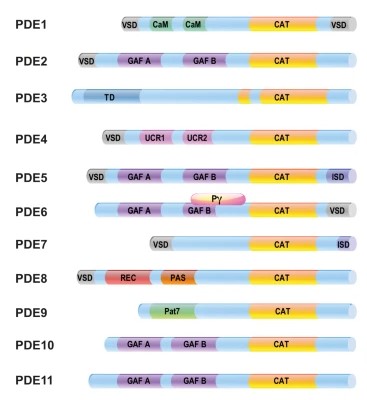 Fig.1 Structure of PDE subfamily. 1
Our Phosphodiesterase (PDE) Panel Screening Service
Creative Biolabs' Phosphodiesterase (PDE) Panel Screening Service offers a sophisticated and comprehensive approach to identify and meticulously characterize inhibitors for various PDE enzyme isoforms. This service is not merely a screening tool; it is a strategic asset for drug discovery programs, particularly those focused on critical therapeutic areas such as cardiovascular diseases (e.g., hypertension, coronary artery disease, pulmonary hypertension, heart failure), erectile dysfunction, respiratory conditions (e.g., asthma, COPD), neurological disorders (e.g., CNS disorders, depression), oncology, and even infectious diseases like malaria.
Our service is meticulously designed to provide unparalleled insights into the potency and selectivity of potential drug candidates. By rigorously profiling compounds against a broad panel of PDEs, Creative Biolabs empowers researchers to pinpoint the most promising compounds for further development, significantly mitigating risks and accelerating the progression of novel therapeutics from discovery to clinic. The emphasis on selectivity is paramount, as it ensures that drug candidates exert their desired therapeutic effects with minimal off-target interactions, thereby enhancing safety and efficacy profiles.
Service Content and Flowchart
Creative Biolabs' PDE Panel Screening Service is designed for efficiency, precision, and comprehensive analysis, guiding your compounds through a systematic evaluation.
Advanced Assay Technologies for Unrivaled Accuracy
Our assays are built upon highly sensitive and reliable platforms, ensuring the highest quality of enzymatic data:
-
Fluorescence Polarization: This widely utilized biochemical assay format is employed across a broad spectrum of PDE targets. Fluorescence Polarization assays detect changes in the polarization of fluorescent light upon molecular binding, offering a sensitive and high-throughput readout for enzyme activity and inhibition.
-
Time-Resolved Fluorescence Resonance Energy Transfer: For specific, demanding screening applications, we leverage TR- Time-Resolved Fluorescence Resonance Energy Transfer technology. This advanced format provides superior signal-to-noise ratios and enhanced robustness, making it ideal for detecting subtle inhibitory effects with high precision.
-
Radiolabel Assays: For projects requiring the utmost sensitivity and direct measurement of product formation, Creative Biolabs also employs radiolabel assays. These assays are renowned for their high quality and provide unambiguous data on enzymatic hydrolysis.
Comprehensive Coverage for Targeted Discovery
Our commitment to comprehensive profiling is reflected in our extensive panel of over 20 PDE targets, encompassing all 11 PDE families (PDE1 to PDE11). This includes:
-
Full-length human isoforms: Essential for ensuring the direct translatability of findings to human physiology.
-
Catalytic domains: Providing insights into the direct enzymatic inhibition without the influence of regulatory domains.
-
Species variants: Including mouse, rat, and dog PDEs, crucial for preclinical studies and understanding species-specific drug responses.
-
Specific examples from our panel include, but are not limited to: PDE1A, PDE1B, PDE1C, PDE2A, PDE3A, PDE3B, PDE4A, PDE4B, PDE4C, PDE4D, PDE5A, PDE6C, PDE7A, PDE7B, PDE8A, PDE9A, PDE10A, and PDE11A. This broad coverage allows for a thorough assessment of inhibitor selectivity across the entire PDE landscape.
Flexible Screening Formats and Comprehensive Data Reporting
Creative Biolabs offers flexible screening formats tailored to your project's needs:
-
Single-Dose Screening: Compounds can be screened in duplicates at a single concentration to rapidly identify initial hits.
-
IC50 Value Determination: For more detailed characterization, we perform IC50 (half maximal inhibitory concentration) determinations using 5 or 10 concentrations, allowing for precise quantification of compound potency.
Every assay includes robust controls, such as a no-inhibitor (DMSO vehicle) control and a target-specific control compound tested in a 10-dose IC50 format. This ensures the reliability and comparability of your data.
Our data analysis and reporting are thorough and transparent. For single-dose assays, you receive raw data, percentage enzyme activity, and control compound IC50 values. For IC50 orders, comprehensive raw data, calculated IC50 values, and curve fitting are delivered in an easily accessible Excel format. Assay conditions, target, and substrate information are also provided upon request.
Why Choose Creative Biolabs for PDE Panel Screening?
With over 20 years of dedicated experience in biological research and drug discovery, Creative Biolabs stands as a leader in PDE panel screening services. Our distinct advantages are rooted in our expertise, technology, and unwavering commitment to client success:
-
Unparalleled Expertise and Experience
-
Most Comprehensive PDE Panel
-
Cutting-Edge Assay Technologies
-
Tailored Solutions and Flexibility:
FAQs
Q1: What is an IC50 value, and why is it important in PDE screening?
A1: In PDE screening, IC50 quantifies the potency of a compound in inhibiting a specific PDE enzyme's activity.
Q2: Why is PDE selectivity crucial for drug development?
A2: PDE enzymes are categorized into 11 families, each with multiple isozymes, often with distinct physiological roles. Selectivity refers to an inhibitor's ability to preferentially target one PDE isoform over others. High selectivity is crucial to minimize off-target effects, reduce potential side effects, and enhance the therapeutic specificity of a drug, thereby improving its safety and efficacy profile.
Q3: What types of compounds can be screened using Creative Biolabs' services?
A3: We can screen a wide range of compounds, including small molecules, natural products, and other chemical entities.
Q4: Can Creative Biolabs develop custom PDE assays or panels for specific research needs?
A4: Absolutely. Creative Biolabs specializes in custom-tailored PDE assay development and the customization of PDE panels. Our team of experts works closely with clients to design and implement assays that precisely align with their unique research objectives and target specific PDE isoforms not covered in standard panels.
Contact Us
To learn more about how Creative Biolabs' Phosphodiesterase (PDE) Panel Screening Service can accelerate your drug discovery program, or to discuss your specific research needs, please do not hesitate to contact our expert team. We are dedicated to providing the highest quality services and scientific support to advance your therapeutic innovations.
Reference
-
Delhaye, Sébastien, and Barbara Bardoni. "Role of phosphodiesterases in the pathophysiology of neurodevelopmental disorders." Molecular psychiatry vol. 26,9 (2021): 4570-4582. doi:10.1038/s41380-020-00997-9. Distributed under Open Access License CC BY 4.0, without modification.
 Download our brochure